
Best House, Worst Street: What SanDisk Can and Can’t Be in NAND
Deep dive, July 22, 2026. Market structure, business, and valuation, we do not handicap price paths.
The one-line thesis: SanDisk is the cleanest, highest-torque way to own NAND, and NAND is the worst-positioned corner of the memory complex. The stock is earning at a violent cyclical peak the market is capitalizing as if it were durable. Own it for the torque, with an exit; don’t own it the way you’d own Micron. SNDK is not Micron.
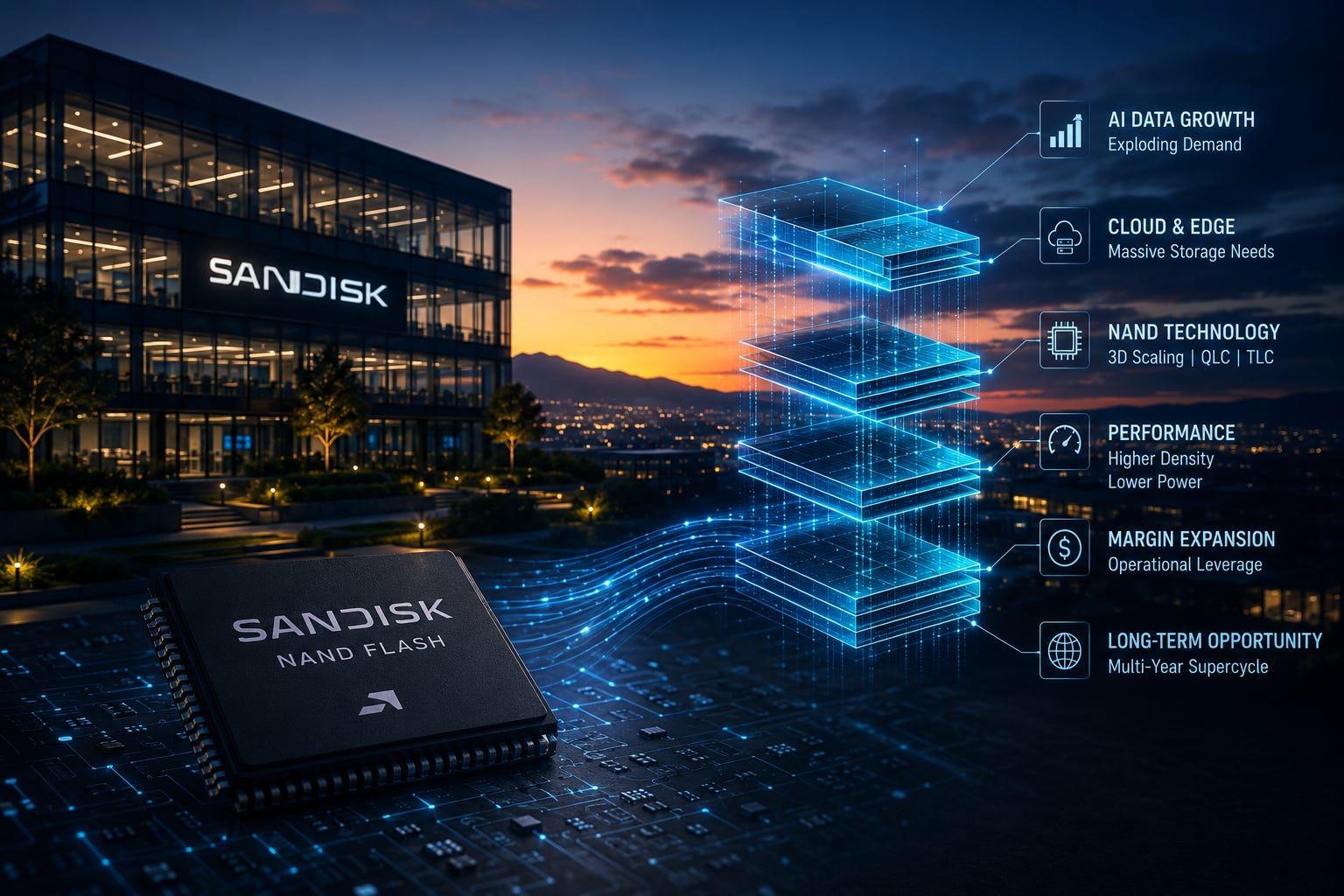
Live Snapshot
Price: $1,599
Market cap: ~$237B (148M shares)
52-week range: $40 to $2,354
YTD return: +573%
Trailing P/E: ~54; forward ~24x FY26 / ~7.5x FY27 (consensus)
P/B: ~17
Balance sheet: zero debt, ~$3.7B cash
The number is real, not a data error, confirmed across four live sources. A NAND-only pure-play is valued at roughly a fifth of Micron, which also owns DRAM and HBM. That anomaly is the entire story of this piece.
1. The NAND Market in One Screen
Genuine AI-driven shortage, ~4-5% undersupplied in 2026 (TrendForce). The engine is the datacenter: servers are now over 40% of NAND bit demand, server shipments +17% YoY.
Consumer is weak, AI absorbs it. Smartphone production down 15-20% YoY, notebooks down ~10%, but datacenter demand more than fills the gap.
The violent price action is at the low-density end: SLC contract prices +120-170% in 2H26 (endurance niche, no supplier adding capacity). Enterprise and eSSD broadly short and rising.
NAND is the follower, not the leader. DRAM ran hotter (contract prices up to +95% in Q1’26). NAND’s up-cycle is real but derivative of the same AI capex wave.
The base case is a 2027 rollover, not a multi-year supercycle. TrendForce sees supply outpacing demand and the balance turning in 2H27. Relief arrives sooner for NAND than DRAM, precisely because the structure is weaker.
2. Why NAND Is the Weakest Leg of Memory
It never consolidated. DRAM is a 3-player oligopoly; HBM is tighter still (SK Hynix ~57%, real pricing power). NAND has six credible players (Samsung, SK Group/Solidigm, Kioxia, Micron, SanDisk, and rising YMTC), so it behaves like a commodity: bit-cost competition, price wars in the downcycle, thinner and more volatile margins.
China is the swing factor. YMTC sits at ~13% share, up from 8% a year ago; Chinese suppliers reach ~19% of global NAND bit output in 2026. They’re adding bits into the one memory segment with no pricing discipline, the primary risk to whether 2027 tips into glut. Note: YMTC has been on the US Entity List (presumption of denial) since December 2022 and still nearly doubled its share, export controls have slowed it, not stopped it.
Tech is not the weakness, structure is. SanDisk/Kioxia’s BiCS10 at 332 layers is sampling, on par with SK Hynix (321, ramping to 375 by end-2026) and Samsung’s line. The layer race is competitive; the market structure is not fixable.
3. SanDisk Is a Textbook Cyclical Blow-Off
Gross margin went 29.8% to 50.9% to 78.4% across the three quarters of FY26 (Oct’25, Jan’26, Apr’26). Diluted EPS: $0.75 to $5.15 to $23.03. Incremental margins near 100%, the signature of a NAND ASP up-cycle.
The growth is almost pure price. Q3 FY26 revenue was +251% YoY, driven by +248% average selling price, price, not volume, is doing nearly all the work. That’s the tell in a commodity: what price gives, price takes away.
One year ago it lost money. FY25 (ended Jun’25): revenue $7.36B, operating margin -18.7%, EPS -$11.32. FY24 was also a loss (-$4.63). This is the cyclicality in two lines.
78% gross margin on a commodity is a peak, not a baseline. It mean-reverts hard. Any valuation that annualizes the current quarter is annualizing the top of the cycle.
The balance sheet is pristine, and it’s real: SanDisk repaid its entire ~$2B spin-related term loan on March 4, 2026, and now carries zero debt against ~$3.7B cash. Any thesis leaning on a spin-debt overhang is stale.
4. The Structure: JV Scale, Consumer Tilt
Flash Ventures (JV with Kioxia): SanDisk holds 49.9% of each of three JV entities with Kioxia and is entitled to ~50% of wafer output from seven Japanese fabs (six Yokkaichi, one Kitakami, an eighth ramping). The JV is unconsolidated (equity method), so most fab capex sits off SanDisk’s balance sheet, surfacing instead as ~$4.5B of funding commitments (~$3B maximum loss exposure). The double edge: lower capital intensity than solo fab owners (Micron, Samsung), but no unilateral capacity control and a cost curve chained to the JV. The single most important structural fact separating it from the integrated players.
On tech it’s at the frontier: BiCS10 at 332 layers (Kioxia’s, 1.5x the prior gen) built on the CBA (CMOS-directly-Bonded-to-Array) architecture, with BiCS8 (~218L) the current volume node. The layer race is not where SanDisk is disadvantaged.
It’s client/consumer-heavy, so it’s less AI-direct than the multiple implies. On the normalized FY25 base: Client/PC-OEM SSD 56%, Consumer 31%, Datacenter just 13%. Datacenter is the fastest-growing leg (+645% YoY last quarter, up to ~25% of revenue), but that share is ASP-inflated by the price spike, on a bit/exabyte basis it’s still smaller. SanDisk rides the AI wave mainly through ASPs lifting all NAND pricing, not through a dominant datacenter-SSD franchise.
5. The Valuation Trap
The cheap-looking forward multiple takes the bull case as its input. Consensus is ~24x FY26 and ~7.5x FY27, but FY27 revenue consensus (~$50B) is 2.5x FY26 and assumes the supercycle ramps straight through the exact window TrendForce calls for a rollover. You are paying a cheap multiple on an earnings number that is itself the optimistic assumption.
The quality-of-earnings mismatch is the core risk. A ~10%-quality-of-earnings business (commodity, six players, China rising) is priced at a peak-cycle $237B cap that rivals Micron’s. The re-rating risk on a NAND price rollover is severe and asymmetric.
Analysts are euphoric, which is itself a caution flag: consensus Buy, average price target ~$2,197 (+37%), high $3,250. Wells Fargo is the lone cautious Hold at $1,620.
Bull Case vs Bear Case
Bull: - Cleanest US-listed NAND pure-play, maximum torque to the up-cycle (78% GM, ~100% incremental margins). - Forward multiple not stretched if the cycle holds (~7.5x FY27). - Flash Ventures JV lowers capex intensity; zero-debt, $3.7B-cash balance sheet. - BiCS10/332-layer tech at the frontier. - Undersupply through 2026 into 1H27.
Bear: - 100% NAND-cycle exposure, no DRAM/HBM to smooth earnings; lost money as recently as FY25. - 78% GM is a peak, not a baseline; the forward number is the bull assumption, not a floor. - JV caps unilateral capacity; client/consumer-heavy mix (datacenter only ~13% normalized) = less AI-direct than the price implies. - $237B cap rivals Micron despite being NAND-only, the plausibility red flag. - China/YMTC (~19% of bits) could pull the glut forward; long-term supply contracts turn into a liability if prices fall.
Bottom Line
SanDisk is the best house on the worst street. Real torque, real tech, clean balance sheet, but it’s the highest-beta way to own the lowest-quality memory segment.
This is a trade, not a hold. The structural quality that lets you own Micron or SK Hynix through a cycle (DRAM/HBM oligopoly, pricing power) is exactly what SanDisk lacks. It’s a NAND-only, consumer-tilted pure-play at a peak-cycle valuation.
The forward multiple is a trap if you don’t respect the cycle. “Cheap on 7.5x FY27” requires NAND staying tight through FY27, which the industry’s own forecaster does not model. Cheap on the bull case; expensive on normalized earnings.
Watch the rate of change, not the level. The turn signal is NAND contract prices decelerating (before they fall), Chinese/YMTC supply adds and any SK Group capex acceleration, and whether SanDisk’s own long-term contracts flip from asset to liability into 2027.
Educational deep dive, not financial advice. For informational purposes only. Do your own research.


