
Compounding a small account by 50% in 2 months
How I grew a small account: $30K to $45K in two months
A real ruleset, real numbers, real losses included. For anyone trying to grow a starter account without blowing it up.
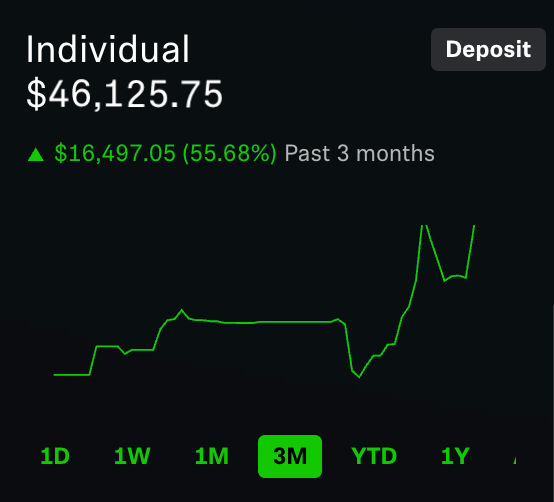
Two months ago I started a small account with $30,000. Today it’s $45,000+. That’s roughly a 50 percent return in 60 trading days. I want to share exactly how — because most of what I read about small-account trading is either survivorship bias or someone selling a course, and the actual math is simpler than people think and harder than people are willing to follow.
The single most important rule
Max risk per trade equals 5 percent of total account cash value.
At $45K, that’s $2,250. Period. That’s the maximum dollar amount I’m allowed to lose on any single position before I close it.
This is the rule everything else serves. It’s the rule I learned the hardest way possible — by losing $8,735 on a single APLD trade and $3,118 on CRCL round-tripping. Both of those losses were 4-5 times the maximum I should have allowed. They violated the only rule that actually matters in a small account: never let one trade hurt enough to threaten the account.
Why 5 percent and not 2 percent or 10 percent? At 2 percent ($900 max loss), positions become so small that even good trades barely move the needle. At 10 percent, three back-to-back wrong calls take you down 30 percent — recoverable but ugly. At 5 percent, I get position size meaningful enough to compound, with enough buffer that a string of wrong calls is a setback, not a portfolio-ender.
The math: $2,250 max loss × stop distance determines my position size, not the other way around.
On a stock at $30 with a 10-percent stop ($3 per share), max position is $2,250 ÷ $3 = 750 shares = $22,500 position.
On a stock at $12 with a 10-percent stop ($1.20 per share), max position is 1,875 shares = $22,500 position.
The position size is whatever the risk math says it is. Not what my conviction says it is.
The other rule that protects you
I hold ONLY two stocks at a time. Not a basket. Not a sector. Two. High conviction.
Why two and not five? Because in a small account, “diversification” is just spreading attention so thin that none of your wins matter. If you’re up 30 percent on a 5-percent position, you made 1.5 percent. The math doesn’t compound unless individual positions are MEANINGFUL.
Why not one? Because one stock means one bad print blows up the whole account. Two gives margin of safety without diluting conviction.
Combined with the 5-percent risk rule, two positions of roughly $22-23K each = total deployment around $45K. With my 1x-equity margin allowance ($45K equity → up to $45K margin → $90K deployment cap), I have room to run two full positions while staying within risk limits.
The price ceiling
Price per share less than account value divided by 1000. With a $45K account, that means $45 max share price.
This isn’t arbitrary. It’s about share count and exit granularity. With $45 max share price and a $22K position, I’m holding 500-1,800 shares depending on the name. That gives me the ability to trim partial positions surgically — 200 shares here, 500 there. With a $200 stock at the same dollar size, I’d have 110 shares total, and any sell becomes a chunky decision.
Granular exit control is half of the strategy. You can’t trail a runner on a 10SMA if you can only sell in giant blocks.
The setup I take
I only buy stocks above their 5-day, 10-day, AND 21-day moving averages. All three. No “it’ll bounce off the 50.”
Trending hard on the month — month performance plus-15 percent or better.
Pulling back to MA support, NOT extended. RSI under 65 at entry. If RSI is 70-plus and the week is up double-digits, I’m late and I know it.
In a hot industry — semis, biotech, energy infrastructure, rare earths. Sector matters because rising tides lift the stocks I’m holding even when my entry timing is off by a day or two.
That filter typically returns 5 to 15 names from the entire market on any given day. From those, I pick two.
The exit ruleset
Sell half on day plus 2 from entry, into any positive close.
Hold the rest as long as it stays above the 10SMA on a closing basis.
The day it closes below the 10SMA, gone at the next open. No “I’ll give it a day.” No averaging down. Trend is broken, position is closed.
Hard stop below the 21SMA OR negative-10 percent from entry, whichever hits first. AND I’m out long before that hard stop if the dollar loss approaches my $2,250 ceiling — that’s the real circuit-breaker.
That’s the whole edge.
My biggest lesson
APLD negative $8,735. The worst trade of the cycle, and the trade that birthed the 5-percent rule. The lesson: I was riding a thematic AI-data-center story and broke every rule I had. Bought when extended. Averaged down when it broke its 21SMA. Held past my negative-10-percent stop hoping for a reversal. The loss was 4 times what should have been my maximum allowed. There was no rule that said “stop here.” Now there is.
So how is the account up?
Because the unrealized gains on positions held — the runners — plus open positions cover the realized loss column and then some. The system works because runners get held and losers get cut. When I follow the rules, the asymmetry is my friend. When I don’t, APLD happens.
The pattern is obvious in retrospect. My winners came from the system. My losers came from overriding it. And the biggest loser came from violating the one rule that exists to prevent any single trade from mattering this much.
What I do not do
I don’t trade through earnings. If a stock is reporting in the next 5 days, it’s a binary event, not a trend trade. I queue it for AFTER the print and re-evaluate. This week I had a perfect technical setup on HIMX — semis, top RS, clean pullback, fits every filter — and I’m not buying it because it reports tomorrow. I’ll wait for the post-print Day-4 absorption window if it gaps higher. If it gaps lower, it’s off the list. The discipline cost me an entry but probably saved me a loss.
I don’t average down. Ever. If my thesis is wrong, the position is wrong. Adding to a wrong position is just being wronger with more money. APLD taught me this on a five-figure tuition bill.
I don’t trade daily. Some days I do nothing. Some weeks I do nothing. The system says “wait for the setup” and that’s what wait means. Most retail accounts get destroyed not by bad trades but by too many trades.
On margin
I use margin, capped at 1x my equity. Equity around $45K = up to $45K of margin = $90K total deployment. That funds two positions of roughly $22-23K each at the 5-percent risk constraint.
This is the leverage that actually compounds. A 10-percent move in a stock = 20-percent in account equity. A bad day cuts both ways — but with religious stops AND the dollar-loss ceiling, the downside is bounded and the upside isn’t.
What you should NOT do is trade margin without stops. That’s how small accounts become smaller accounts. The 5-percent rule is what keeps margin from killing you.
The realistic expectation
50 percent in 2 months is the high end of what discipline plus a friendly tape can produce. The market gave me semis rotation, rare earths rotation, and AI-infrastructure rotation in the same window. Three concurrent themes. That’s not normal. Most months will be 5-15 percent if I execute well. Some will be flat. Some will be down.
The point isn’t matching this run. The point is that a system with rules you actually follow gives you compound returns. A system without rules — or worse, with rules you override when conviction feels right — gives you variance, and variance in a small account looks like a slow bleed to zero.
The read for this week
Holding NASA, the Tema Space Innovators ETF, just opened today. Plus my APLD runner from the winning trim. Watching BEAM (gene-editing biotech, clean fundamentals, one-week pre-earnings setup before May 12) and HIMX (post-earnings if it confirms after the May 7 print) for the next entry. Two events, two filters, one trade decision per day.
The whole strategy fits in one page. Following it is the hard part.
Not financial advice. This is independent market analysis and personal account commentary, not a recommendation to buy or sell anything. Markets are volatile, individual securities can lose 100 percent of their value, and past performance does not predict future results. Do your own due diligence, size positions you can afford to lose, and consult a licensed financial advisor before making investment decisions. Your money, your risk, your call.


