

CrowdStrike is showing current product-specific AI security monetization. Okta paired a stronger core quarter with an agent-identity option that is still priced as an uplift to human users.
CrowdStrike and Okta reported earnings on the same evening, and both stocks ripped higher. By late morning on August 27, CrowdStrike shares were up about 18 percent and Okta shares were up about 22 percent.
Both rallies are happening now. The evidence underneath them is different.
CrowdStrike delivered current operating proof. Revenue grew 26 percent, net new annual recurring revenue grew 51 percent and annual recurring revenue from Falcon Flex accounts grew 101 percent. Its AI Detection and Response product is sold as a separate module, uses token-based pricing and nearly tripled its ending annual recurring revenue from the previous quarter, although the company did not disclose the absolute dollar amount.
Okta also delivered a stronger quarter. Contracted subscription revenue expected over the next 12 months accelerated, large-customer activity improved and profitability remained strong. Its agent-identity products have dozens of customers and several million-dollar-plus deals, but management said the business is still too small to show up in the numbers and will not be material during fiscal 2027.
The pricing details show where Okta is in that transition. Okta for AI Agents is currently sold as an uplift to the per-user charge because most agents still work on behalf of a developer, support representative, accountant or another human user. Management said customers prefer the predictability of that model today. Okta is building the framework for eventual consumption pricing as agents proliferate, but it is not enforcing that model yet.
The investment frame is therefore not CrowdStrike now and Okta later. Investors are rewarding both stocks now. CrowdStrike is being rewarded for current platform and AI security economics. Okta is being rewarded for a stronger core business plus the option value of becoming the identity control plane for a much larger autonomous-agent economy.
Two rallies, two kinds of evidence
Endpoint security watches what happens on laptops, servers, cloud workloads and other systems. It detects suspicious behavior, blocks attacks and helps security teams investigate what occurred.
Identity security decides who or what may act. In an agentic environment, that includes people, software services and artificial-intelligence agents. The identity layer must determine which systems an agent may reach, what data it may use and when its access should be revoked.
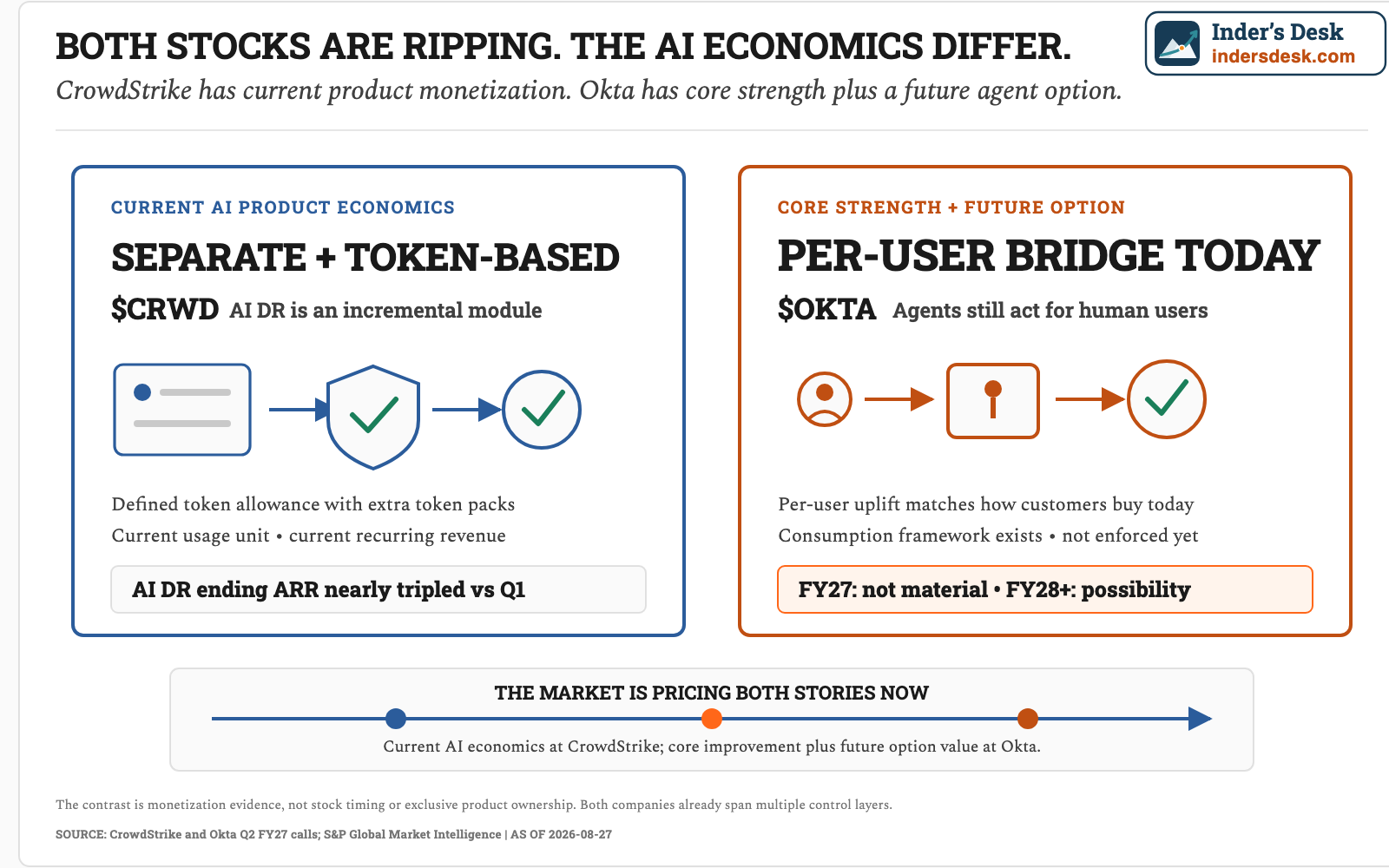
The visual compares the evidence behind the two rallies, not their stock timing or exclusive product ownership. CrowdStrike already sells identity products, and Okta is expanding into runtime enforcement. The important difference is how each company is monetizing the AI opportunity today.
CrowdStrike has current product-specific monetization
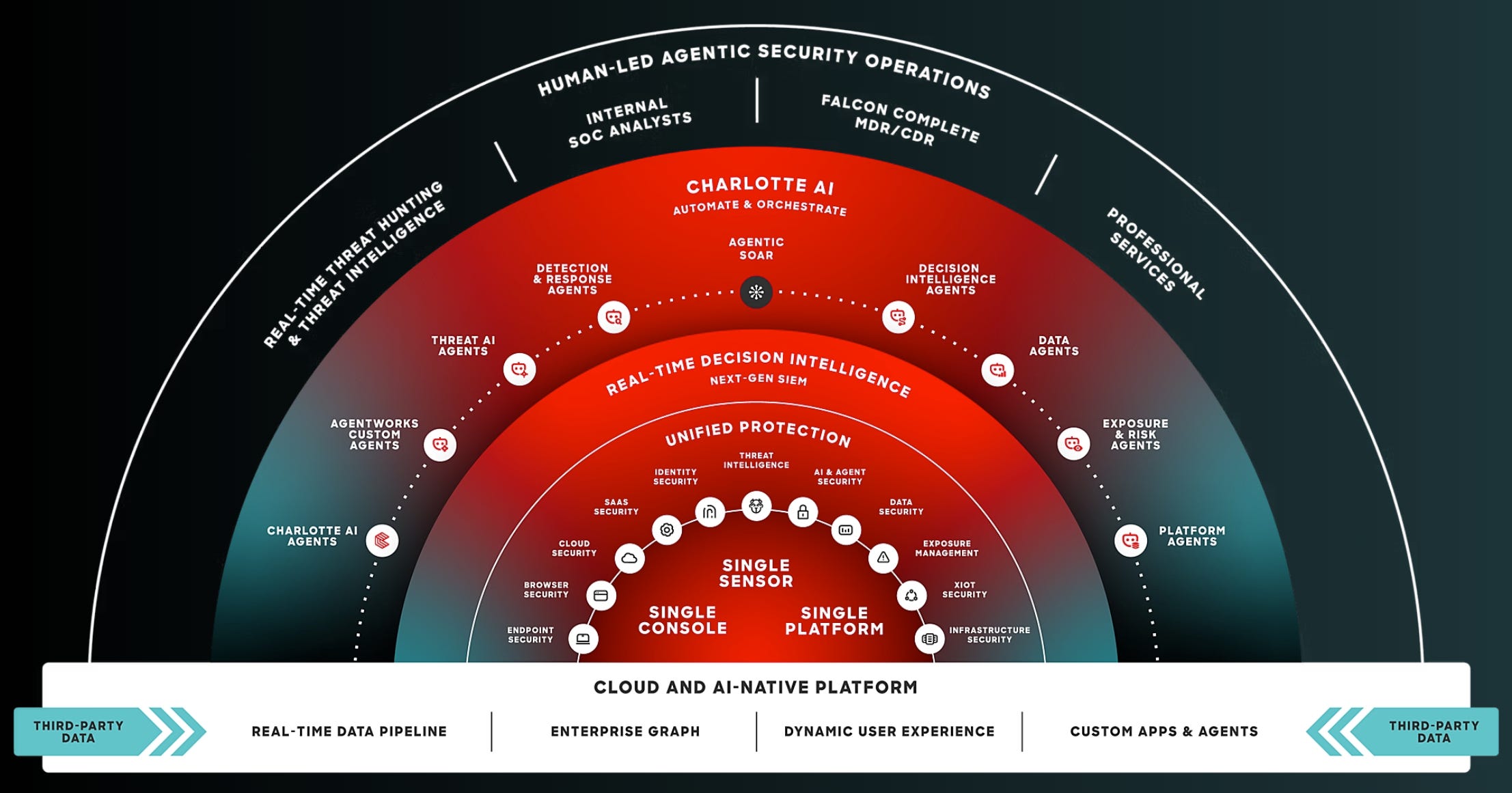
CrowdStrike reported second-quarter revenue of $1.47 billion, up 26 percent from a year ago. Subscription revenue rose 27 percent to $1.40 billion.
Annual recurring revenue reached $5.84 billion, up 25 percent. CrowdStrike added $332.8 million of net new annual recurring revenue during the quarter, an increase of 51 percent from a year ago.
Those numbers are strong. The more revealing number is Falcon Flex.
Flex is not a separate security product. It is a purchasing model that lets customers commit to the Falcon platform and activate products as their needs change. That lowers the friction involved in adding cloud security, identity protection, next-generation security information and event management, and other Falcon modules.
Ending annual recurring revenue from customers that adopted Flex exceeded $2.29 billion, up 101 percent from a year ago. CrowdStrike also reported that 51 percent of subscription customers used at least six modules, 35 percent used at least seven and 26 percent used at least eight.
The investment signal is platform consolidation. Customers are not merely buying another endpoint tool. They are committing a larger share of the security budget to one operating platform.
The earnings call also supplied more direct evidence that CrowdStrike is monetizing AI security as a product. Management said AI Detection and Response is a separate, incremental module rather than a substitute for endpoint detection and response. Ending annual recurring revenue from the product nearly tripled from the previous quarter.
CrowdStrike already uses token-based pricing for AI Detection and Response. Customers receive a defined token allowance and can buy additional token packs if usage exceeds that level. Falcon Flex gives customers budget visibility while making it easier to expand consumption.
The company still does not disclose the absolute annual recurring revenue of AI Detection and Response. Nearly tripling a small base can sound more impressive than the dollars warrant. The disclosure is nevertheless stronger than a product announcement because it identifies a separately priced module, an active usage unit and sequential recurring-revenue growth.
Management raised its full-year net-new annual recurring revenue growth outlook to approximately 34 percent at the midpoint. That was the second increase this year. Full-year revenue is now expected to approach $6.0 billion.
Cash generation supports the operating story. CrowdStrike produced $530.3 million of operating cash flow and $377.4 million of free cash flow during the quarter.
The accounting gap remains important. CrowdStrike reported a generally accepted accounting principles operating loss of $33.2 million while reporting $371.6 million of non-GAAP operating income. The company is producing substantial cash, but investors should not treat the adjusted margin as identical to economic profit. Stock-based compensation and other excluded expenses remain material.
The main conclusion is still favorable: CrowdStrike has a demonstrated mechanism for turning platform breadth into larger contracts today.
Okta’s improvement is also real, but it comes from the core
Okta reported second-quarter revenue of $805 million, up 11 percent. Subscription revenue grew 12 percent to $793 million.
The more useful leading indicator was current remaining performance obligation. This represents contracted subscription revenue Okta expects to recognize over the next 12 months. It reached $2.585 billion and grew 14 percent from a year ago, up from 12 percent growth in the previous quarter.
That two-point acceleration matters because Okta had spent several years slowing down. One quarter does not establish a durable reacceleration, but it provides better evidence than an earnings-per-share beat alone.
Profitability also held. Generally accepted accounting principles operating income reached $107 million, or 13 percent of revenue, compared with 6 percent a year ago. Non-GAAP operating margin remained at 28 percent. Free cash flow was $227 million, also 28 percent of revenue.
Okta raised its fiscal 2027 revenue outlook to between $3.216 billion and $3.226 billion, representing growth of 10 to 11 percent. It expects free cash flow of $910 million to $930 million, or a margin between 28 and 29 percent.
The current business is therefore not waiting for artificial-intelligence agents to arrive. Workforce identity, customer identity and identity governance are paying the bills today.
Okta’s agent option is real, but the pricing bridge is still human

Okta’s longer-term claim is that every artificial-intelligence agent will need an identity, an owner and a set of permissions.
The product architecture is no longer just a presentation. Agent SSO brings agent connections into Okta’s existing single-sign-on system. Agent Gateway applies identity and policy controls when agents such as Claude Code, Cursor, GitHub Copilot and Salesforce Agentforce call enterprise tools. Okta for AI Agents adds discovery, ownership and lifecycle governance.
The Anthropic partnership shows how this could work. An administrator can authorize a connector for an organization, scope access through Okta groups and roles, and revoke that access when a user or agent is deactivated. Instead of allowing every employee or agent to manage permanent credentials, the identity provider becomes the policy checkpoint.
That is strategically important. It is not yet financially material.
On the earnings call, management said agent-related revenue would not be material during fiscal 2027. Fiscal 2028 and beyond could become meaningful if adoption continues, but that was presented as a possibility, not a forecast.
The same call explained how customers are buying the product today. Okta for AI Agents is priced as an uplift to the per-user charge. That matches the current use case because most agents act on behalf of identifiable employees, and customers prefer a predictable extension of the pricing model they already understand.
Okta expects that model to evolve as agents become more autonomous. Agent SSO already includes the framework for a future consumption limit because agents are likely to log in far more often than people. Management said the cap is not being enforced yet. The eventual bridge could be per-agent, per-transaction or consumption-based pricing, but the market has not settled on the durable unit.
This is the central distinction between the two stocks. CrowdStrike can point to a separately priced AI security module with current recurring-revenue growth. Okta can point to real products, customers and larger-than-average deal sizes, but the agent business remains financially immaterial and is still packaged around human users.
The categories are already colliding
The difference in current monetization is not a permanent map of who owns which market.
CrowdStrike is already moving from endpoint telemetry into identity authorization. Its Continuous Identity for AI Agents evaluates every agent action using the identity of the owner, the caller and real-time device risk. Falcon AI Detection and Response inspects prompts and intent, then can trigger access revocation when the risk changes.
Okta is moving in the opposite direction. Agent Gateway applies policy during runtime, not only at login. Okta’s product materials also describe an integration with CrowdStrike Falcon AI Detection and Response that can surface local agents installed on employee endpoints, the systems they connect to and the identity associated with each agent.
That integration is the most important clue in the joint thesis.
Endpoint telemetry can show that an agent or device has become risky. Identity policy can decide whether that agent should retain access. The value increases when those signals flow between the two layers.
The likely winner may not be one company replacing the other. It may be a smaller number of platforms controlling different parts of the same agent-security workflow.
What investors should watch
For CrowdStrike, the next test is whether Flex continues producing large new contracts and repeated expansions, and whether AI Detection and Response becomes material enough for absolute annual recurring revenue disclosure. Flex annual recurring revenue can grow quickly because it measures all annual recurring revenue from accounts that adopted the purchasing model, not revenue from a single product. Investors should track net new annual recurring revenue, module adoption, AI Detection and Response growth and the rate at which customers renew or expand their Flex commitments.
For Okta, the next test is whether agent identity moves from product adoption to measurable economics. The useful indicators will be named customer deployments, agent-related contract value, whether the per-user uplift evolves into enforceable consumption pricing and whether management begins including the category in guidance.
There is also a pricing risk. If artificial-intelligence agents eventually reduce the number of paid human seats, Okta must ensure that agent identities, connections and actions create enough new revenue to offset any pressure on seat-based pricing. The current per-user uplift reduces buying friction, but it does not yet prove that Okta can capture the full economics of autonomous agents.
For both companies, competition is expanding. Microsoft, Palo Alto Networks, Zscaler, CyberArk and a growing set of artificial-intelligence security startups are pursuing pieces of the same control plane. Open standards can expand the market, but they can also make it easier for customers to connect competing products.
The counter-case
CrowdStrike’s strongest current evidence still does not prove how much its newest artificial-intelligence products contribute to total growth. AI Detection and Response is separately priced and its annual recurring revenue nearly tripled sequentially, but CrowdStrike does not disclose the absolute dollar amount. Falcon Flex annual recurring revenue also measures all recurring revenue from accounts using the purchasing model, not revenue from one product.
Okta has the opposite problem. The architecture is credible, the partnerships are relevant and the products are shipping, but management has already told investors not to expect material agent revenue this year.
Both companies also want to own more of the stack. That creates opportunity and execution risk. Moving from a strong core product into adjacent control layers can increase contract size, but it also increases product complexity and competitive overlap.
The bullish interpretation is that artificial-intelligence agents expand the attack surface so quickly that endpoint, identity and runtime security all grow together.
The bearish interpretation is that every major security vendor tells the same agent story before customers establish which controls they will actually pay for.
The current numbers support a middle position. CrowdStrike has clearer current evidence that AI security is becoming a separately monetized product. Okta has a credible agent-identity platform and early commercial wins, but investors are capitalizing a future pricing model before the revenue is material.
Bottom Line
Both stocks are being repriced now. By late morning on August 27, CrowdStrike was up about 18 percent and Okta was up about 22 percent.
CrowdStrike’s current earnings evidence is stronger. Revenue grew 26 percent, net new annual recurring revenue grew 51 percent and annual recurring revenue from Falcon Flex accounts grew 101 percent.
CrowdStrike also has product-specific AI monetization. AI Detection and Response is a separately priced module, uses token-based pricing and nearly tripled its ending annual recurring revenue from the previous quarter, although the absolute dollar amount was not disclosed.
Okta’s core business improved. Current remaining performance obligation growth accelerated to 14 percent, profitability remained strong and management raised its full-year outlook.
Okta’s agent-identity thesis is strategically credible but financially early. The product is currently sold as a per-user uplift because most agents work on behalf of humans, while future consumption pricing remains under development.
CrowdStrike and Okta are complementary more often than they are direct substitutes. Endpoint risk signals and identity policy increasingly need to operate together.
The investment framework is current AI security economics at CrowdStrike versus core improvement plus future agent-economy option value at Okta. The categories are already converging, so investors should watch the evidence rather than the labels.
If this kind of evidence-first technology research is useful, subscribe to Inder’s Desk. If you already subscribe, sharing this article with one investor who follows cybersecurity is the most helpful way to support the work.
Primary sources: CrowdStrike’s second-quarter fiscal 2027 results, CrowdStrike’s earnings webcast, Okta’s second-quarter fiscal 2027 results, Okta’s earnings webcast, CrowdStrike’s Continuous Identity announcement and Okta’s Anthropic authorization partnership.
Disclaimer:
This article is for informational and educational purposes only and does not constitute financial, investment, tax, or legal advice. Any opinions, scenarios, price targets, or market observations reflect my personal views and may change without notice. Investing and trading involve substantial risk, including the possible loss of principal. You are solely responsible for your own investment decisions, position sizing, risk management, and trades. Conduct your own research and consult a qualified professional where appropriate.