
DigitalOcean’s AI Pivot Is Accelerating. Can the Economics Keep Up?
$DOCN: revenue growth accelerated to 29%, RPO is up 12x year-over-year to $894M, and the company posted a record $93M of incremental ARR.
What the company does and how it makes money
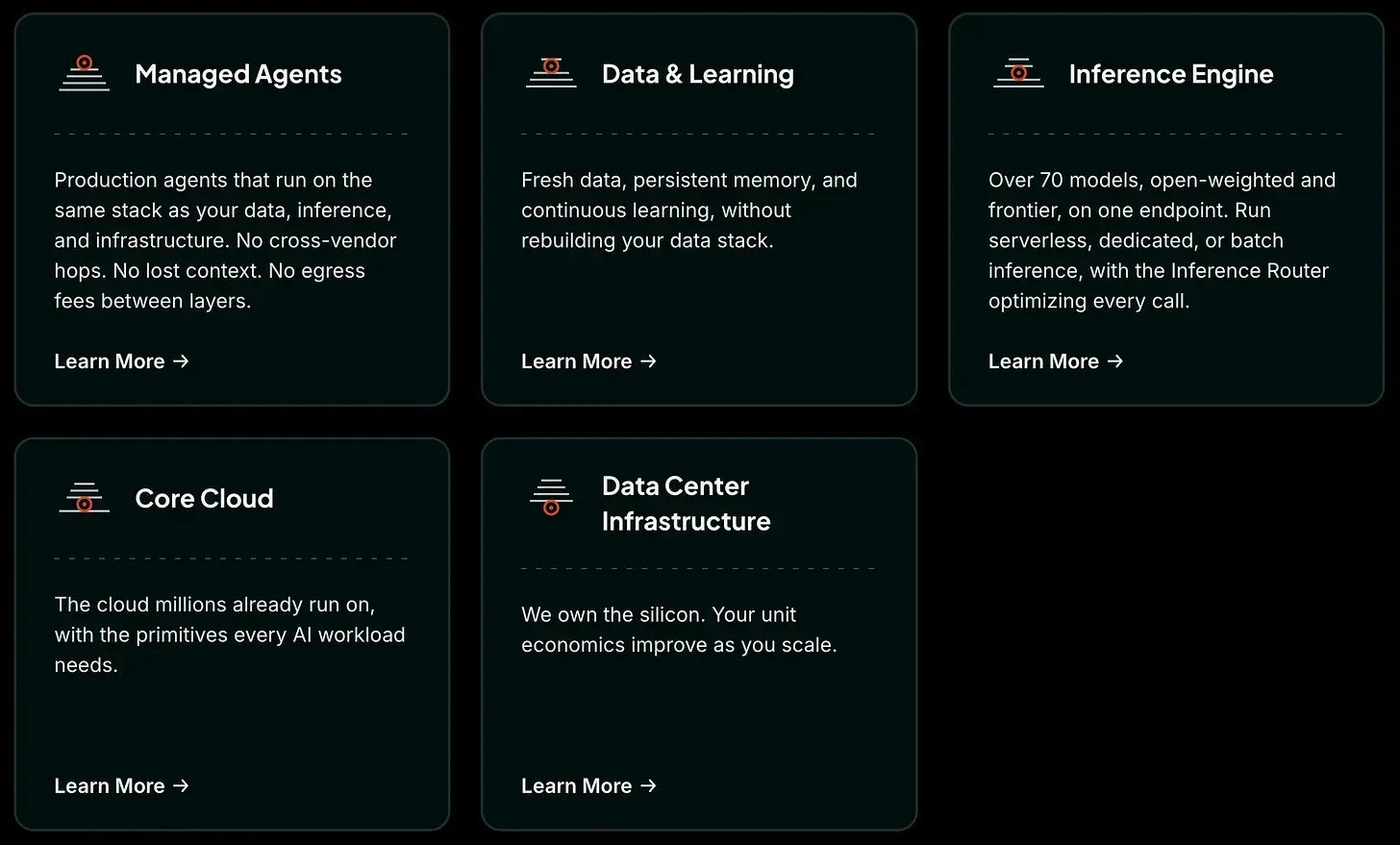
Source: digitalocean.com/products.
DigitalOcean DOCN 0.00%↑ is trying to provide everything needed to build and run an AI application:
It’s own GPUs and data centers, traditional cloud infrastructure and access to more than 70 AI models through one connection.
Tools that give models access to private company data and managed AI agents.
Because the entire stack operates within DigitalOcean customers can avoid some data-transfer fees.
The economic bet is that owning the hardware will improve margins if demand keeps the GPUs busy.
The risk is that DigitalOcean must spend the money before that demand and revenue arrive.
In production at named customers (company case studies): Character.ai serves 1B+ queries a day on its AMD Instinct GPUs; Workato runs 1T+ automation tasks on the Inference Engine, citing 67% lower cost.
No segment P&L is disclosed; ARR cohorts and an AI split stand in: AI Customer ARR $234M (+212% YoY), 20.8% of $1,125M total ARR (+29% YoY). 85% of AI ARR is from Inference Services and Core Cloud, not bare-metal rental (CEO); Inference grew roughly 800% YoY off a small base.
Large customers drive the mix: $1M+ ARR customers +214% YoY (23% of revenue); $500K+ 26% (+160%); $100K+ 35% (+98%). The top 25 are only 20% of ARR, so not concentrated, at least for now.
The business
Q2 revenue $281M, +29% YoY, accelerating from Q1’s +22% and beating expectations. Q3 guided to $304-307M (+32-34%); full-year raised to $1.17-1.18B (roughly 30.5% growth) with a stated Q4 exit rate of “35% or more.”
Adjusted profitability looks strong: 40% adjusted EBITDA margin ($114M, +27% YoY), 24% adjusted operating margin, and $63M of first-half adjusted free cash flow, in line with the 11-13% full-year guide.
GAAP tells a different story: operating income $29M (-18% YoY), net income $35M (-4% YoY), and first-half operating cash flow of $157M essentially flat (+0.2% YoY) against 25%+ revenue growth.
June 30 balance sheet: $767M cash against $921M total debt plus $578M of finance lease obligations. In July DigitalOcean equitized $472M of its 0% 2030 convertible notes with minimal cash and dilution; pro forma net leverage 0.7x.
The bull case
RPO (remaining performance obligations) of $894M, up 12x YoY, with $366M recognizable within 12 months, above the company’s own pre-announced “>$800M.”
A record $93M of incremental ARR (+191% YoY), the most in company history. Management said new data-center capacity contributed “very little” to it, pointing to demand against existing capacity.
The story itself is a market force: DOCN trades, in part, as a smaller, more direct claim on the AI-infrastructure buildout than a hyperscaler, without a neocloud’s commodity-rental shape. The gap is one customers can name: in a company-published testimonial, an AI-startup founder picked DigitalOcean because hyperscalers “don’t have any GPUs left” and cheap data centers have “fragile reliability,” while it offered “availability but also reliability at scale.” Naming it is not endorsing it: story-driven demand moves stocks independent of fundamentals, and it cuts both ways.
The bear case
GAAP operating income fell 18% and net income fell 4% while first-half operating cash flow stayed flat, even as revenue grew 25%+. Every profitability number celebrated on the call was adjusted. Neither management nor a single analyst addressed the GAAP decline. A working hypothesis, unconfirmed: the back-half-loaded buildout ($94M of first-half capex) is driving depreciation ahead of revenue.
The capacity build carries costs now, revenue later: the majority of the 155MW comes online by end of 2027, and the CFO suggested it is late in the year for new commitments to move 2027 much.
GPU unit economics are a black box: asked directly about AMD-vs-NVIDIA economics, the SVP of AI declined, a real non-answer on a material gross-margin driver.
No valuation read available. After a roughly +164% YTD run into the print (vs. Fastly +126%, Cloudflare +43%, Akamai +35%), the evidence speaks to growth quality, not to whether it is cheap or expensive.
What settles it
The Q3 2026 report: revenue vs. the $304-307M guide. At or above supports the acceleration story; a miss weakens the 35%+ exit-rate path.
A GAAP explanation. If buildout depreciation is the driver, disclosure should say so or the gap should narrow as capacity revenue lands; silence plus a widening gap weakens the adjusted-margin narrative.
Formal 2027 guidance, whenever it is issued. A number at or above 50% supports the reiterated framing; anything below weakens it.
Data and market conditions as of August 4, 2026. Historical snapshot, not auto-updated.
Disclaimer: This article is for informational and educational purposes only and does not constitute financial, investment, tax, or legal advice. Any opinions, scenarios, price targets, or market observations reflect my personal views and may change without notice. Investing and trading involve substantial risk, including the possible loss of principal. You are solely responsible for your own investment decisions, position sizing, risk management, and trades. Conduct your own research and consult a qualified professional where appropriate.


