

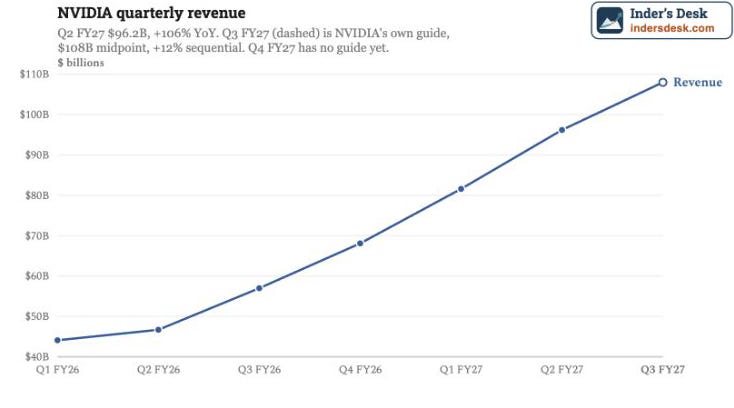
NVIDIA reported $96.2 billion of revenue for the second quarter of fiscal 2027, up 106 percent from a year ago. Non-GAAP earnings per share reached $2.22, up 120 percent.
Those are extraordinary numbers. They are also not the most important part of the report.
The real payload was forward-looking. NVIDIA mapped its gross-margin path through the end of this fiscal year, gave a margin range for fiscal 2028 and, for the first time, offered a full-year-ahead revenue outlook. Management expects revenue to grow approximately 70 percent in fiscal 2028 and says supply, not demand, is the constraint.
For investors, the next year is no longer an open-ended story about artificial-intelligence demand. NVIDIA has volunteered a number against which every quarter can now be measured.
The quarter itself
Revenue accelerated for a fourth consecutive quarter. The company reported $96.2 billion, up 18 percent sequentially and 106 percent year over year. NVIDIA guided third-quarter revenue to a midpoint of $108 billion, another 12 percent sequential increase.
GAAP earnings per share rose only 3 percent sequentially, but that comparison is distorted by gains on NVIDIA’s equity investments. Those gains contributed about 52 cents per share in the first quarter and 24 cents in the second quarter. Non-GAAP earnings, which exclude those investment gains but now include stock-based compensation, rose 19 percent sequentially.
NVIDIA also disclosed a new revenue split. Data Center produced $89.0 billion, or more than 92 percent of company revenue. Edge Computing added $7.2 billion.
Inside Data Center, the company separated hyperscale customers from what it calls AI Clouds, Industrial and Enterprise. That second group includes neoclouds, sovereign customers, startups and traditional enterprises. It generated approximately $40 billion and grew 138 percent year over year. It is now approaching half of the Data Center business.
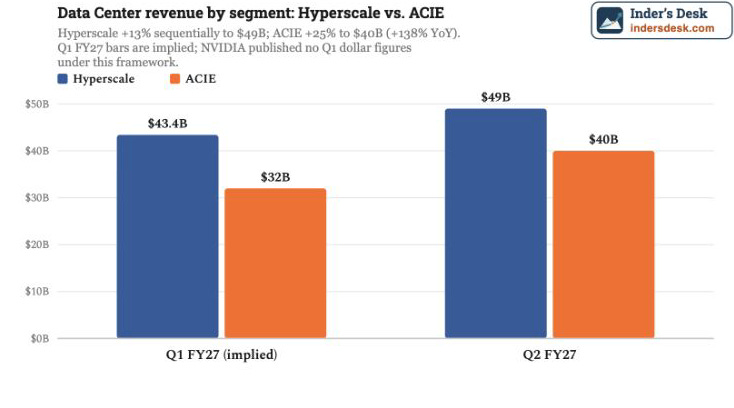
The customer base is broadening beyond a handful of large cloud companies. That is a genuine positive. It also introduces a different kind of customer, one that may require more financing and balance-sheet support.
The yellow flag: cash conversion
Revenue is growing faster than NVIDIA is collecting it.
Accounts receivable consumed $22.3 billion of cash during the quarter. Management said days sales outstanding rose to 60 because of extended payment terms for large customers. Free cash flow fell 56 percent sequentially to $21.3 billion even as GAAP net income increased 2 percent to $59.7 billion.
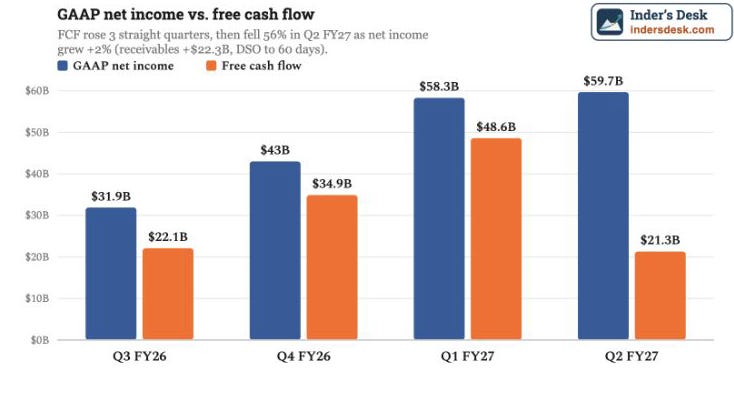
One quarter does not establish a deterioration in earnings quality. It does establish a metric worth watching. If receivables keep growing faster than revenue, NVIDIA’s income statement and cash generation will continue to diverge.
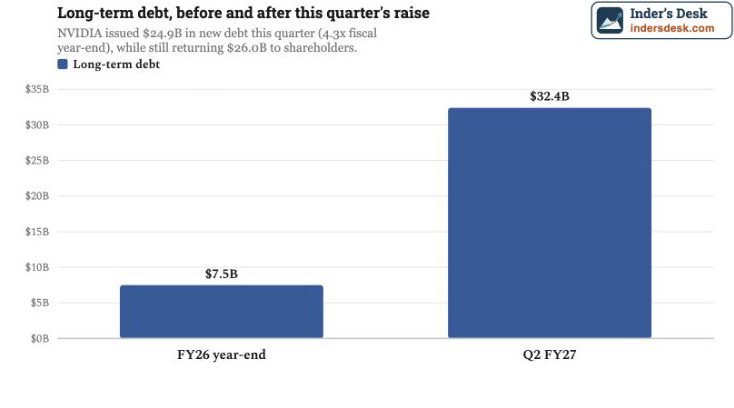
NVIDIA also issued $24.9 billion of new debt during the quarter, lifting long-term debt from $7.5 billion at fiscal year-end to $32.4 billion. It simultaneously returned about $26.0 billion to shareholders through repurchases and dividends. The filing does not connect those flows, so it would be wrong to say NVIDIA borrowed specifically to buy back stock. It is still a meaningful change in the balance-sheet pattern.
The two forward disclosures that matter
The margin reset
Gross margin was 75.0 percent this quarter. NVIDIA guided to 74.0 percent for the third quarter and management expects a trough between 71 and 72 percent in the fourth quarter. It then expects margins to recover to between 72 and 73 percent in fiscal 2028.
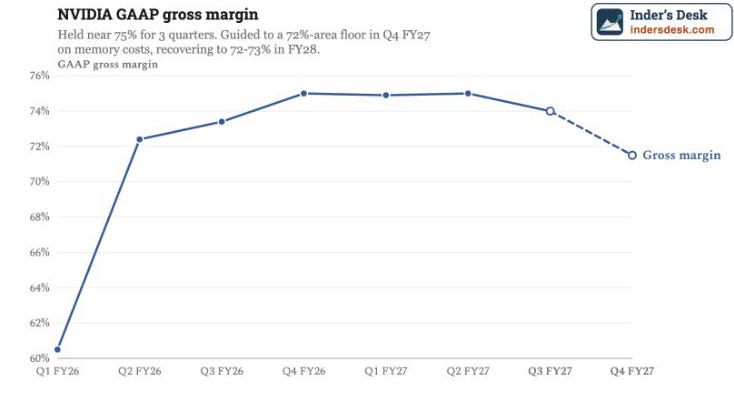
The pressure comes from memory costs. Chief Financial Officer Colette Kress said memory price increases have exceeded the company’s prior expectations and are heading higher into next year. Management expects NVIDIA’s own price increases to begin helping in the first quarter of fiscal 2028.
The margin recovery is therefore a management forecast, not a settled fact. The first fiscal 2028 report will show whether those price increases held.
The 70 percent guide
Kress said NVIDIA expects revenue to grow approximately 70 percent in fiscal 2028 and described that forecast as supply constrained. Jensen Huang added that demand is running above that level, but supply is what the company can confidently deliver.
Nearer term, NVIDIA expects $108 billion of third-quarter revenue. The forecast assumes no Data Center compute revenue from China. H-twenty shipments represented less than 1 percent of Data Center revenue this quarter and carry lower margins, so a resumption would not be costless upside.
The investment implication is simple: supply execution replaces demand as the primary variable. Investors now need to track the Vera Rubin ramp, memory availability and whether NVIDIA can deliver the capacity embedded in its 70 percent outlook.
Who benefits
NVIDIA remains the most direct beneficiary. Vera Rubin shipments began in August, and management expects the platform to contribute about 20 percent of third-quarter Data Center revenue. NVIDIA says each platform generation captures more of the data-center buildout dollar.
Memory suppliers gain pricing power. NVIDIA did not name vendors on the call, but the margin pressure in this report is revenue for somebody else. Higher memory costs are a headwind for NVIDIA and a signal of tight supply upstream.
Amazon Web Services gained a named deployment. Amazon and NVIDIA announced plans for two million additional NVIDIA graphics processors across 2027 and 2028, along with Vera central processors and deeper integration of NVIDIA software into Amazon’s artificial-intelligence stack.
Neoclouds and the wider enterprise ecosystem are becoming material customers. CoreWeave and Nebius are named Vera Rubin partners. Management expects neoclouds to exit the year near eight gigawatts of installed capacity, up from approximately three gigawatts at the end of 2025.
The counter-case
The bear case became more specific in this report.
Financing support is becoming part of the demand engine. NVIDIA says it has invested nearly $50 billion in frontier artificial-intelligence laboratories. It has also announced partnerships with Apollo, BlackRock, Blackstone, Brookfield, Goldman Sachs and KKR intended to mobilize more than $500 billion of third-party capital. Those financing platforms remain subject to final agreements.
Management also discussed an Ohio campus expected to support 4.25 gigawatts for OpenAI and credit enhancement for nearly two gigawatts for an unnamed laboratory. Kress expects balance-sheet-supported demand to represent roughly one-quarter of the business next year.
Huang directly addressed the criticism that these relationships look circular. His answer was that the capital providers are independent, the projects have multiple users and NVIDIA’s risk is limited. The mechanism and management’s rebuttal are both on the record. Investors should monitor the credit exposure rather than dismissing either side.
Cash conversion is lagging reported earnings. Free cash flow fell sharply as receivables expanded, while NVIDIA raised debt and maintained shareholder returns.
GAAP earnings now carry investment-book noise. NVIDIA’s growing equity portfolio can move reported earnings materially in either direction.
The margin recovery depends on price increases. NVIDIA must pass higher memory costs through to customers, including laboratories that are also developing custom silicon.
The 70 percent guide creates a new risk surface. If memory supply tightens further or Vera Rubin slips, NVIDIA could miss a target that it volunteered a year in advance.
Bottom Line
The quarter was exceptional, but the most important disclosure was NVIDIA’s first full-year-ahead outlook: approximately 70 percent revenue growth in fiscal 2028.
Management expects gross margin to bottom between 71 and 72 percent in the fourth quarter before recovering. The recovery depends partly on NVIDIA’s price increases holding.
Growth is broadening beyond hyperscalers. AI Clouds, Industrial and Enterprise is approaching half of Data Center revenue and grew 138 percent year over year.
The bear case now has measurable indicators: free cash flow, receivables, days sales outstanding, financing exposure and long-term debt.
The next checkpoints are Vera Rubin’s expected 20 percent share of third-quarter Data Center revenue, the fourth-quarter margin trough and whether cash conversion improves.
Primary sources: NVIDIA’s second-quarter fiscal 2027 results, the official earnings webcast and NVIDIA’s compute-financing announcement.
Disclaimer:
This article is for informational and educational purposes only and does not constitute financial, investment, tax, or legal advice. Any opinions, scenarios, price targets, or market observations reflect my personal views and may change without notice. Investing and trading involve substantial risk, including the possible loss of principal. You are solely responsible for your own investment decisions, position sizing, risk management, and trades. Conduct your own research and consult a qualified professional where appropriate.