
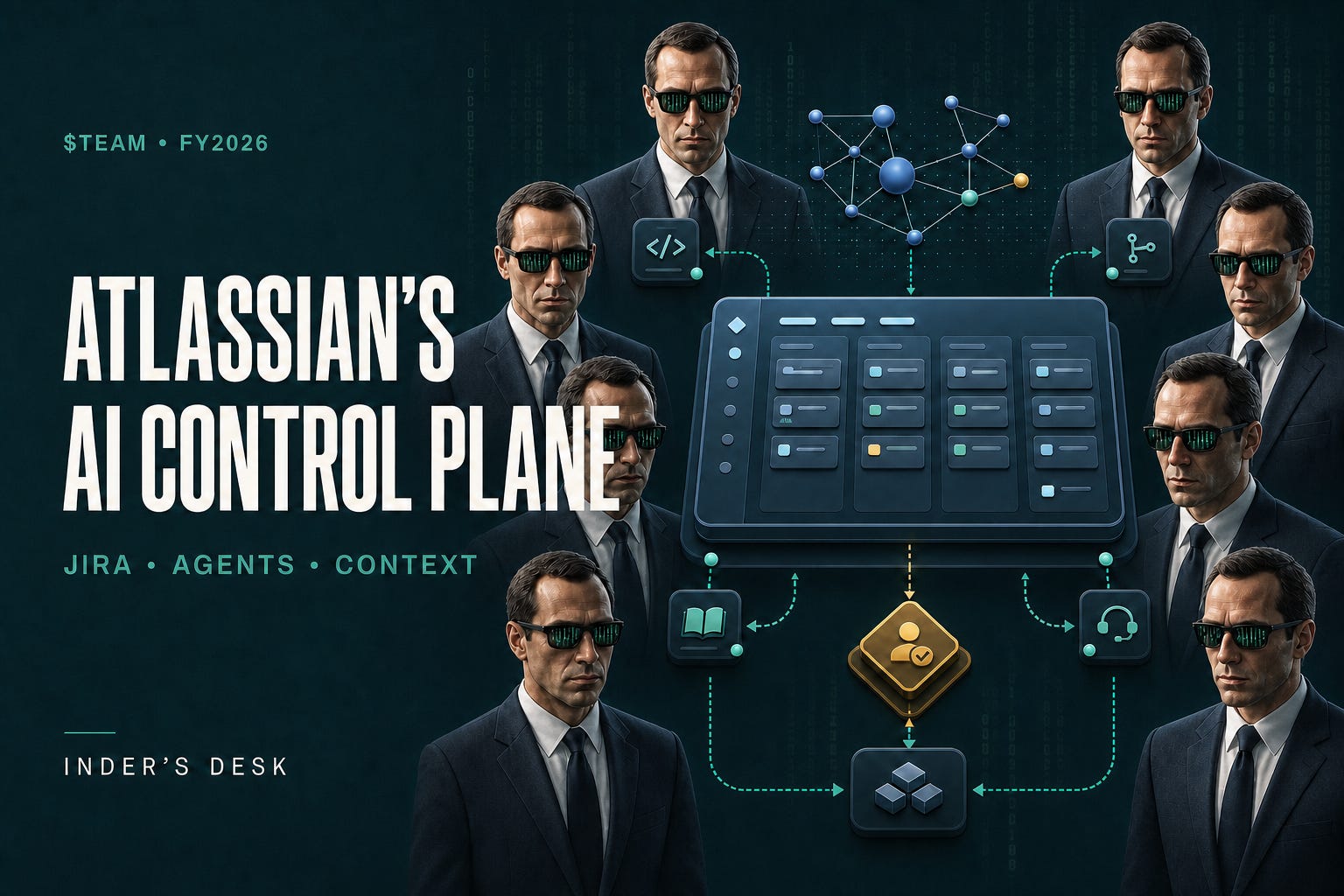
$TEAM: the market said AI agents would kill Jira. Atlassian is making Jira their boss.
Deep-dive into Atlassian. Published 2026-08-06 ET, covering the Q3 and Q4 FY2026 prints.
What The Company Does And How Does It Make Money
Atlassian TEAM 0.00%↑ sells work-orchestration software by subscription. Jira tracks work, Confluence holds knowledge, Jira Service Management runs IT support, and Rovo is the AI layer threaded through all three.
Cloud is the business now: 69% of Q4 revenue and the fastest-growing line. The older self-hosted Data Center product is being deliberately sunset in favor of it.
Subscription ARR is $6.6 billion, up 22.7% year over year.
What User Actually Do With It: Agentic Coding
The agentic coding workflow: assign a Jira issue to Claude or Cursor, by @-mention, the assignee dropdown, or an automation rule, and the agent clones the repo into a sandbox, works on its own branch, opens a draft pull request, and streams status back into Jira. Humans keep merge control, and the whole thing runs inside Jira’s own permissions and audit trail.
Atlassian is the control layer for the coding agents: Agent Sessions collects every agent’s activity into one view, grouped by what needs attention, Jira positions itself as “the control plane,” the place that knows who’s doing what, why, and when, once the work is being done by dozens of agents instead of a handful of engineers.
Adoption is compounding off a young base: the MCP server and Teamwork Graph CLI combined passed 1 million monthly active users, more than doubling in a single quarter, with MCP calls up over 400% quarter over quarter. Almost all of those users, 98%, are also active in the regular Jira interface the same month, and MCP adopters grow their subscription revenue twice as fast as everyone else.
Cisco’s VP of engineering operations put it this way: “The question we’re asking isn’t how do we get engineers to use more AI. It’s how do we build a system where humans and agents are working from the same context, toward the same goals.”
The Business
Q4 FY26 revenue was $1.77 billion, up 27.6% year over year, with a 12% GAAP operating margin (against a loss a year ago), a 36% non-GAAP operating margin, and free cash flow of $475 million.
The full year tells a different story: just $10 million of GAAP operating income and a $54 million GAAP net loss for FY26, mostly because a $280 million restructuring charge landed entirely in the first three quarters, Q4 is genuinely clean of it, and stock-based compensation ran $1.6 billion, roughly a quarter of total revenue.
Capital deployment: $1.8 billion of buybacks, more than double the prior year, plus $1.23 billion of unnamed acquisitions, about $3 billion deployed against $1.3 billion of free cash flow. Cash on the balance sheet was cut in half over the year, from $2.5 billion to $1.2 billion.
Why The Market Left It For Dead, And The Case It’s Redeeming Itself
The fear was real and specific. The stock fell roughly 70% peak to trough, including a reported 36% drop in February 2026 alone, on the thesis that AI coding agents, GitHub Copilot with 4.7 million paid users, Cursor at $2 billion in annual revenue, Claude Code, would let developers ship code directly and make ticket-based project tracking beside the point. Why route work through a board if the agent just writes the pull request?
Atlassian’s own leadership named that exact fear within weeks of the low, closing the Q3 shareholder letter with: “In a world where humans will run teams of agents, context is the only anchor to avoid chaos. So we’re asking our customers, are you building a company that forgets or one that compounds?”
The evidence since is dated and real. Cloud growth reaccelerated from 26% to 29% in the quarter reported right near the bottom, then to 31% in Q4, two straight quarters running against the deceleration story, alongside a genuinely clean profitable quarter and the MCP adoption numbers above.
The Bull Case
Contracted commitments are outrunning recognized revenue. Remaining performance obligations, money customers have committed to but Atlassian hasn’t recognized yet, grew 37% and then 44% across the last two quarters, while recognized revenue growth actually eased from 32% to 28%. Customers are committing further ahead even as reported growth cools.
The CEO announced, the same day as the Q4 print, that he intends to personally buy up to $250 million of stock through a scheduled open-market purchase plan. In scale, it’s about 72% the size of the company’s own Q4 buyback, unusually large for a personal insider purchase.
The underlying margin story is real. Non-GAAP operating margin expanded from 25% to 30% over the year, and Atlassian picked up three Gartner “Leader” placements and a Forrester Wave leadership position in the months around the print, plus a new Chief Product Officer hired from Elastic.
The Bear Case
The same guide that shows Cloud reaccelerating also shows the company’s overall growth and margin slowing down. Non-GAAP operating margin is guided from 30% down to 25%, and the very next quarter’s revenue guide implies a sequential decline.
The balance sheet absorbed the cost of all that buying. Deploying capital at more than twice free cash flow drained the cash balance, and stock compensation alone was large enough to keep the full year at a GAAP loss in what was otherwise the company’s best year of growth.
The core question the market was actually worried about is still open. If AI agents eventually take over the coordination work too, not just the coding, the “control plane” pitch stops mattering, and nothing in either quarter’s results settles that either way.
What Settles It
The next quarter’s print, expected around late October 2026: Cloud growth at or above its roughly 28.5% guide, with the agent-adoption numbers still climbing, supports the comeback story; a miss weakens it.
Whether the CEO’s buy plan actually executes. Insider filings showing real purchases over the coming months support the signal; months of silence would undercut it.
Whether the old Data Center product declines exactly on its guided path. Tracking the guide supports the “this is migration mechanics, not falling demand” read; a worse-than-guided slide would raise new questions.
Bottom Line
The disruption fear that took this stock down 70% was specific,, this wasn’t a vague multiple-compression story, it was a real question about whether AI agents make ticket-tracking software obsolete.
Two consecutive quarters of Cloud reacceleration, paired with a genuine product bet on being the coordination layer for agents rather than a casualty of them, is real evidence for the comeback.
The founder’s $250 million buy plan is a genuine signal, correctly sized: small next to the whole company, large next to what the company itself is spending on its own stock.
This says nothing about valuation. No peer comparison or multiple analysis was done here, durability and evidence quality only.
This research is grounded in Atlassian’s own earnings releases, shareholder letters, and product pages, not just the latest quarter.
Disclaimer: This article is for informational and educational purposes only and does not constitute financial, investment, tax, or legal advice. Any opinions, scenarios, price targets, or market observations reflect my personal views and may change without notice. Investing and trading involve substantial risk, including the possible loss of principal. You are solely responsible for your own investment decisions, position sizing, risk management, and trades. Conduct your own research and consult a qualified professional where appropriate.


