
The Micron Re-Rating
Micron’s price-to-book multiple previously peaked near 3.5x. Today it is approaching 10x. Has AI permanently changed memory economics?

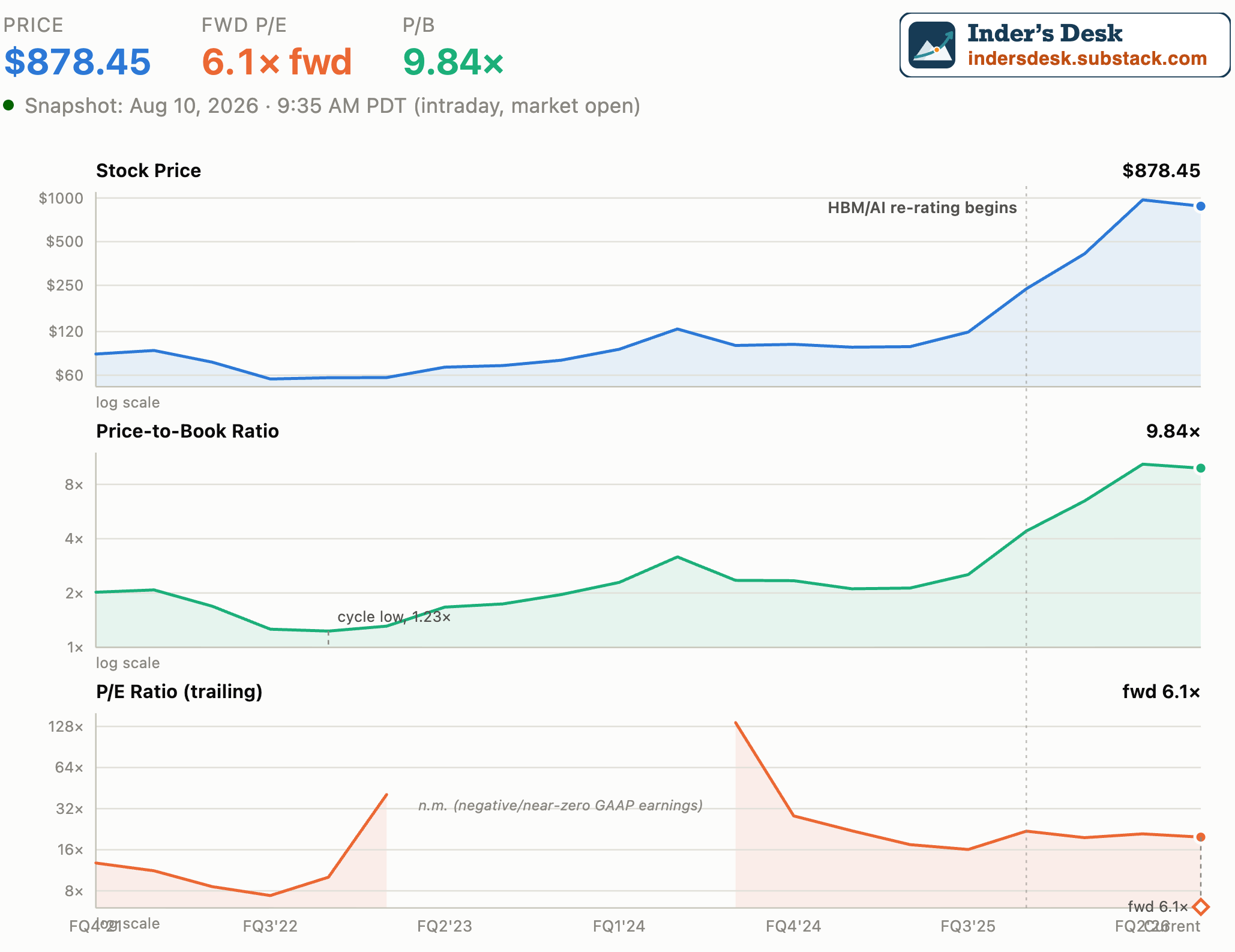
Micron’s MU 0.00%↑ valuation has broken out of its historical memory-cycle range. The stock approached 1x book near troughs and peaked around 3.5x during stronger periods. Today it trades near 10x after an 800% run this year. The market is pricing a future in which AI and HBM permanently change Micron’s earnings power and business quality.
Why the re-rating matters
Price-to-book compares Micron’s market value with the accounting value of its fabs, equipment and inventory. It is particularly useful for memory companies because DRAM and NAND earnings can swing from record profits to losses within a cycle, making trailing P/E unreliable.
Book value changes more slowly. That made P/B the market’s anchor: roughly 1x near troughs, 2-3x in ordinary recoveries and about 3.5x at previous peaks. Nearly 10x is not simply a stronger point in the old range. It represents a different valuation regime.
The re-rating reflects a clear thesis.
HBM and AI datacenter demand, combined with tighter industry supply discipline, may make Micron’s earnings structurally stronger and its business less cyclical than in previous memory cycles. If that is correct, the old ceiling no longer applies.
The risk is that the market has recognized the structural change and priced in too much of it. That does not make MU an automatic short. It changes the question: has AI permanently changed Micron’s economics enough to justify a multiple almost three times its previous peak?
For the complete industry framework, read

Disclaimer:
This article is for informational and educational purposes only and does not constitute financial, investment, tax, or legal advice. Any opinions, scenarios, price targets, or market observations reflect my personal views and may change without notice. Investing and trading involve substantial risk, including the possible loss of principal. You are solely responsible for your own investment decisions, position sizing, risk management, and trades. Conduct your own research and consult a qualified professional where appropriate.