



America is already exporting software and media digitally. Now it is beginning to export intelligence itself.
It is arriving as an answer: code, research, a drug candidate, a financial model or a factory design.
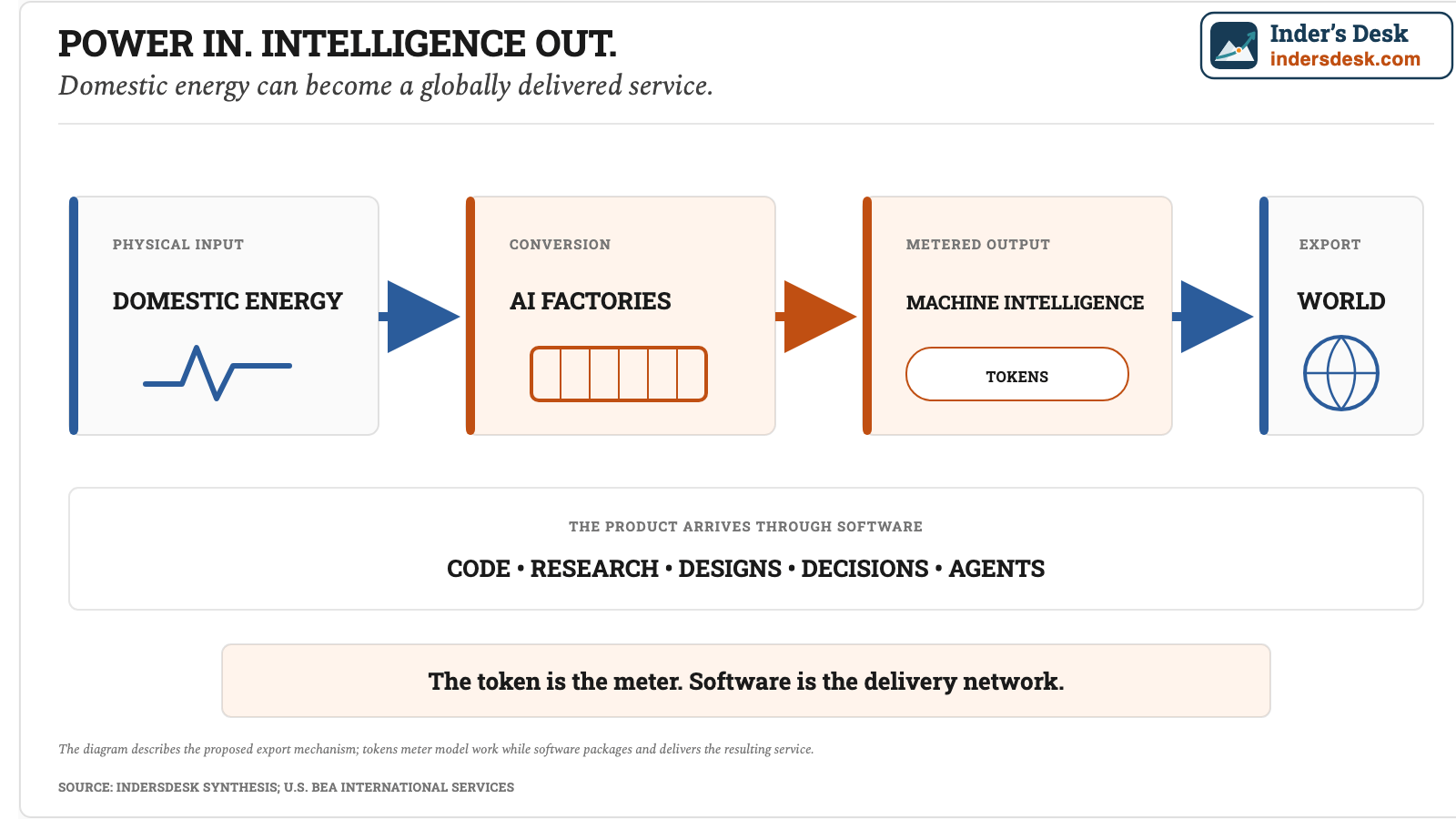
Underneath each service is the same industrial chain. Electricity enters a data center. Chips turn it into computation. Models turn computation into tokens. Software turns those tokens into useful work.
Power goes in. Intelligence comes out.
The United States is already building this system at scale. AI-enabled services could grow into one of its largest service exports. No official trade series currently isolates machine intelligence or token exports, so this is an investment thesis, not a measured current category.
The token will be its meter.
Token demand is moving from large to industrial
A token is a small unit of language processed or generated by an AI model. It is not a scientific measure of intelligence.
It is something more commercially useful: the unit in which machine intelligence is packaged, metered and sold.
Not every token has the same price or value. But tokens are the closest thing this new industry has to a common meter.
Google’s comparable disclosures show direct customer use of its first-party models more than doubled between the third quarter of 2025 and April 2026.
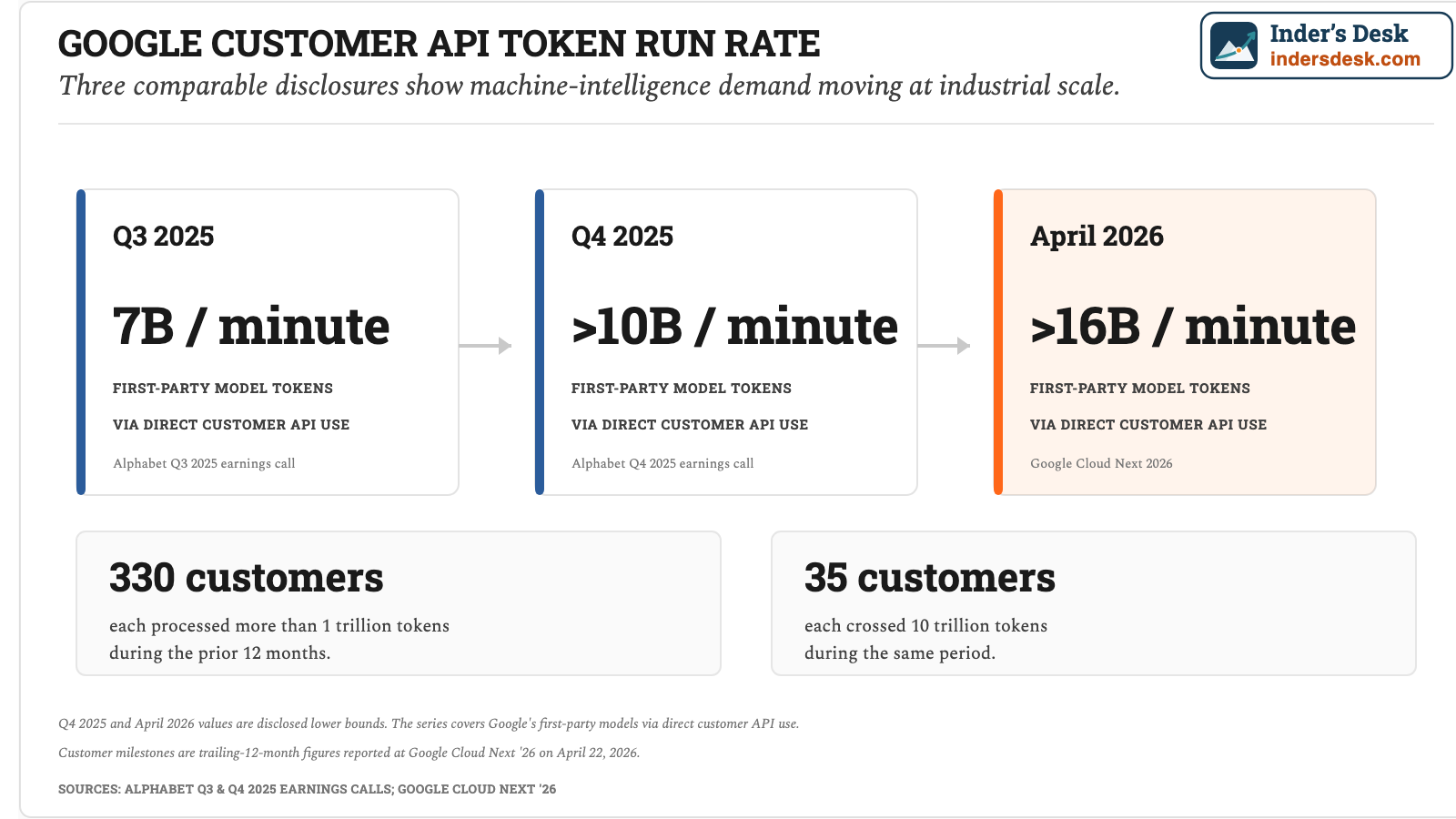
These are disclosed lower bounds from one provider, not a census of global AI activity. The direction is the story: enterprise token demand is already operating at industrial scale.
OpenRouter offers a second window across hundreds of AI models. Its public rankings show weekly token volume rising from 3.7 trillion in the week of August 25, 2025 to 75.3 trillion in the week of August 10, 2026. That is more than twenty times as much activity in less than a year. At the latest pace, OpenRouter would process roughly 3.9 quadrillion tokens a year.
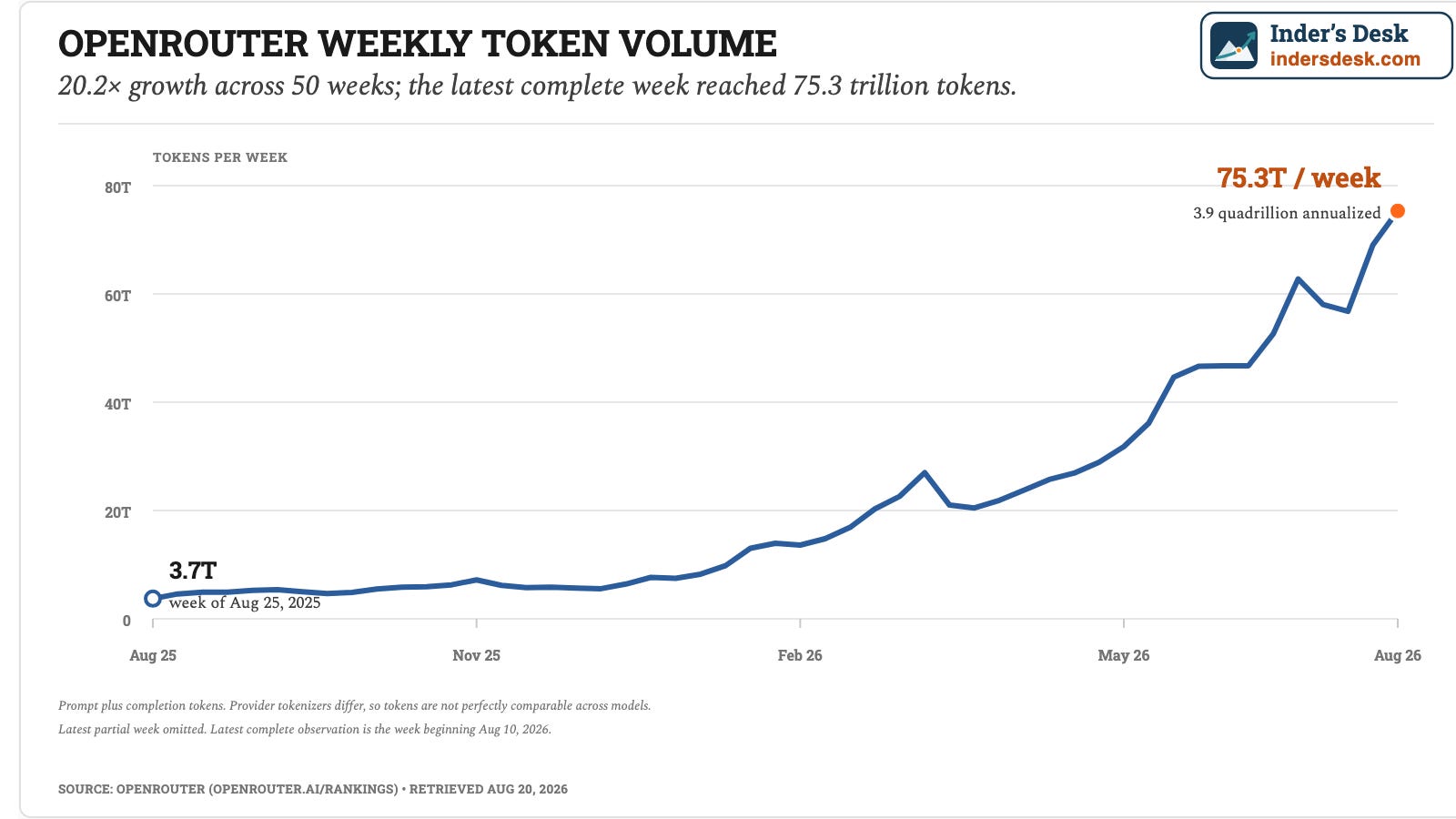
The message is simple: demand for AI is accelerating.
Stripe’s August 19 agreement to acquire OpenRouter shows that token routing, cost optimization and billing are becoming strategic infrastructure alongside payments.
At the same time, serving costs are falling sharply. Alphabet said it lowered Gemini serving unit costs by 78% during 2025 through model, efficiency and utilization improvements.
AI is moving beyond occasional conversations with a chatbot. Models are being embedded inside search and software development, then spreading through finance, medicine and industrial operations. In an agentic workflow, one user request can trigger many model calls as software plans, calls tools, checks results and tries again.
That is why token consumption can grow much faster than the number of people using AI.
One worker can deploy several agents. One company can run them continuously. Machines do not stop consuming tokens when the workday ends.
The next phase of token growth is coming from software using software.
What one megawatt begins to make possible
The link between a token and a power plant can feel abstract. A megawatt gives us a way to see it.
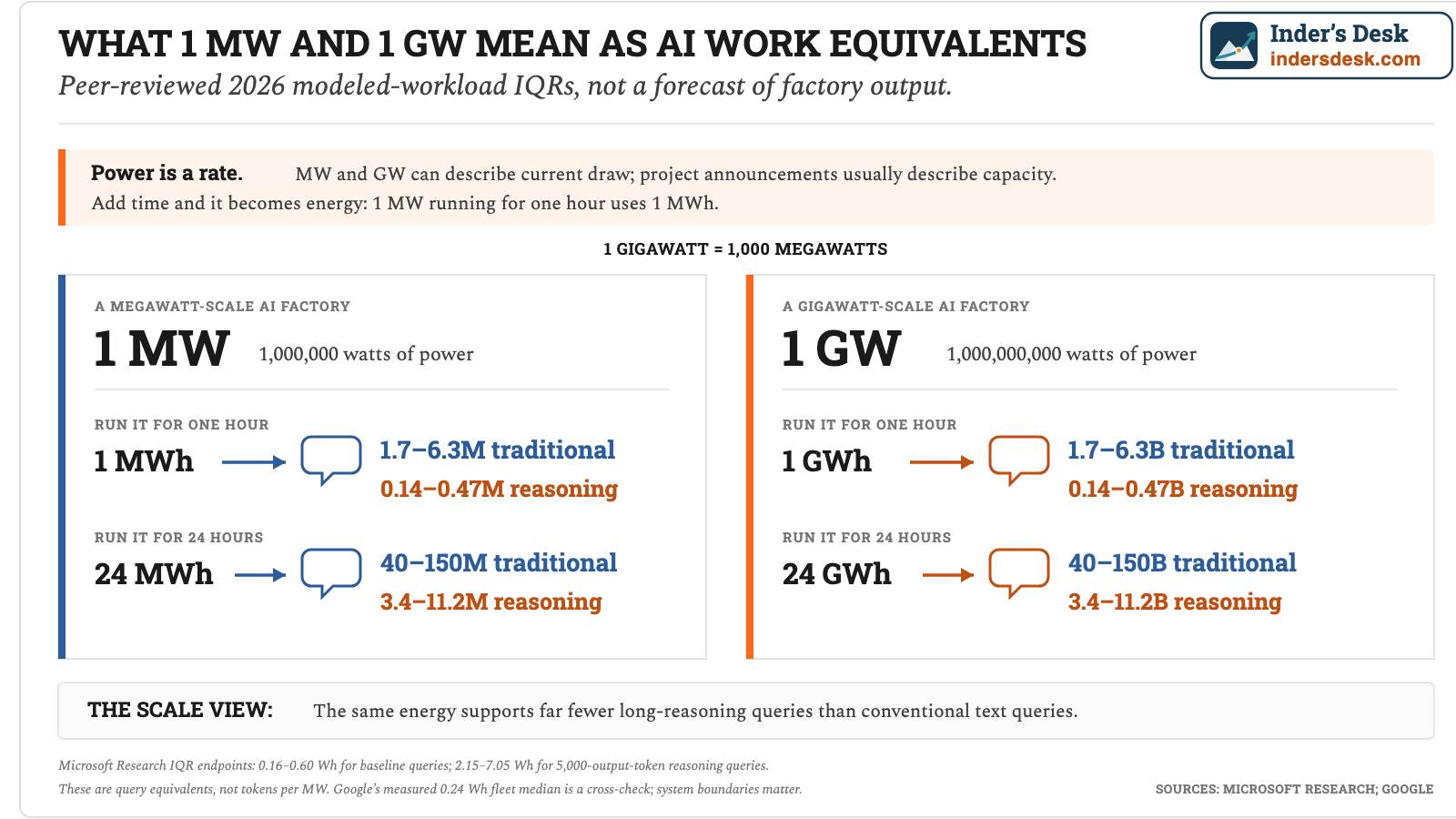
Microsoft Research has done the harder math for us. Its peer-reviewed 2026 study found that a long reasoning task can use more than ten times as much electricity as a standard text question.
One megawatt running for a full day could therefore support roughly 40 million to 150 million standard questions, or 3 million to 11 million long reasoning tasks.
Google’s own measurement points in the same direction. Its May 2025 Gemini Apps result works out to roughly 100 million ordinary text prompts for one megawatt running for a day.
The exact output will vary by model and workload.
For investors, the lesson is that all megawatts are not equally productive. The value of an AI factory depends on what work it performs, how efficiently it performs it and what customers will pay for the result.
A gigawatt is one thousand times larger.
This is why the data-center announcements now sound like energy projects. They are energy projects. Their eventual product, however, will not be electricity.
It will be machine intelligence.
The new industrial chain
The industrial logic is straightforward:
Energy → compute → tokens → software services → global revenue
A customer in another country does not need the electricity, the chips or the building to be local. The customer can call an API or open an application. The work arrives digitally, and the revenue flows back to the company providing it.
This is already how software and cloud computing can cross borders. The Bureau of Economic Analysis classifies software, cloud computing, data processing and hosting within international computer services, and separately tracks services that can predominantly be delivered remotely over digital networks.
AI adds a new layer. Software once delivered fixed instructions written by people. AI software can now generate new analysis, language and decisions when requested.
The export is no longer only the program.
It is the work the program performs.
Why America is building an early lead
The United States does not need to produce every token to lead this emerging trade.
It needs to build the strongest complete system.
That system begins with energy. It requires large sites, dependable generation and grid connections that can support dense computing loads.
It also requires the chips and networking equipment that turn power into computation. Several leading suppliers in that stack are U.S.-based.
Above the hardware sit the cloud platforms. They finance the factories, operate the infrastructure and distribute the output globally.
Then come the models and software companies. They convert raw computing capacity into services that businesses and consumers can buy.
America’s advantage is the concentration of these layers in one ecosystem.
U.S.-led compute projects can draw on enormous pools of global capital. In August 2026, Nvidia signed memorandums of understanding with Apollo, BlackRock, Blackstone, Brookfield, Goldman Sachs and KKR for platforms targeting more than $500 billion of third-party capital over time. This is a target under preliminary agreements, not committed or deployed funding.
Long-term customer commitments can also support new supply.
Constellation’s 20-year Microsoft agreement supports the planned restart of the 835-megawatt Crane Clean Energy Center, whose output will enter the PJM grid and match Microsoft’s regional data-center use rather than directly power one named facility.
SpaceXAI separately reports roughly 1.0 gigawatt of company-defined compute power across Colossus and Colossus II and a 1.2-gigawatt permanent generation plant under construction. Those compute and generation measures are not interchangeable or additive.
American semiconductor and cloud companies cover several critical layers. Nvidia and AMD design accelerators. Broadcom and Marvell supply custom silicon, networking and connectivity. Amazon Web Services, Microsoft Azure and Google Cloud finance and operate the fleets that turn those components into globally available compute.
This export engine is already operating. Microsoft and Salesforce are embedding AI into products they already sell around the world. OpenAI and Anthropic sell access to their models directly. A new generation of AI-native companies is using those models to create services that did not exist a few years ago.
The International Energy Agency expects the United States to account for the largest share of global data-center electricity-demand growth through the end of the decade. The industrial base is being assembled.
Who gets paid before the first token
An AI factory is not a single asset. It is the endpoint of a power chain.
Before a server can produce its first billable token, electricity must reach it through some combination of merchant generation, regulated utility service and on-site supply. Equipment companies must make that power usable, while powered-site owners assemble the land, interconnection rights and construction plan.
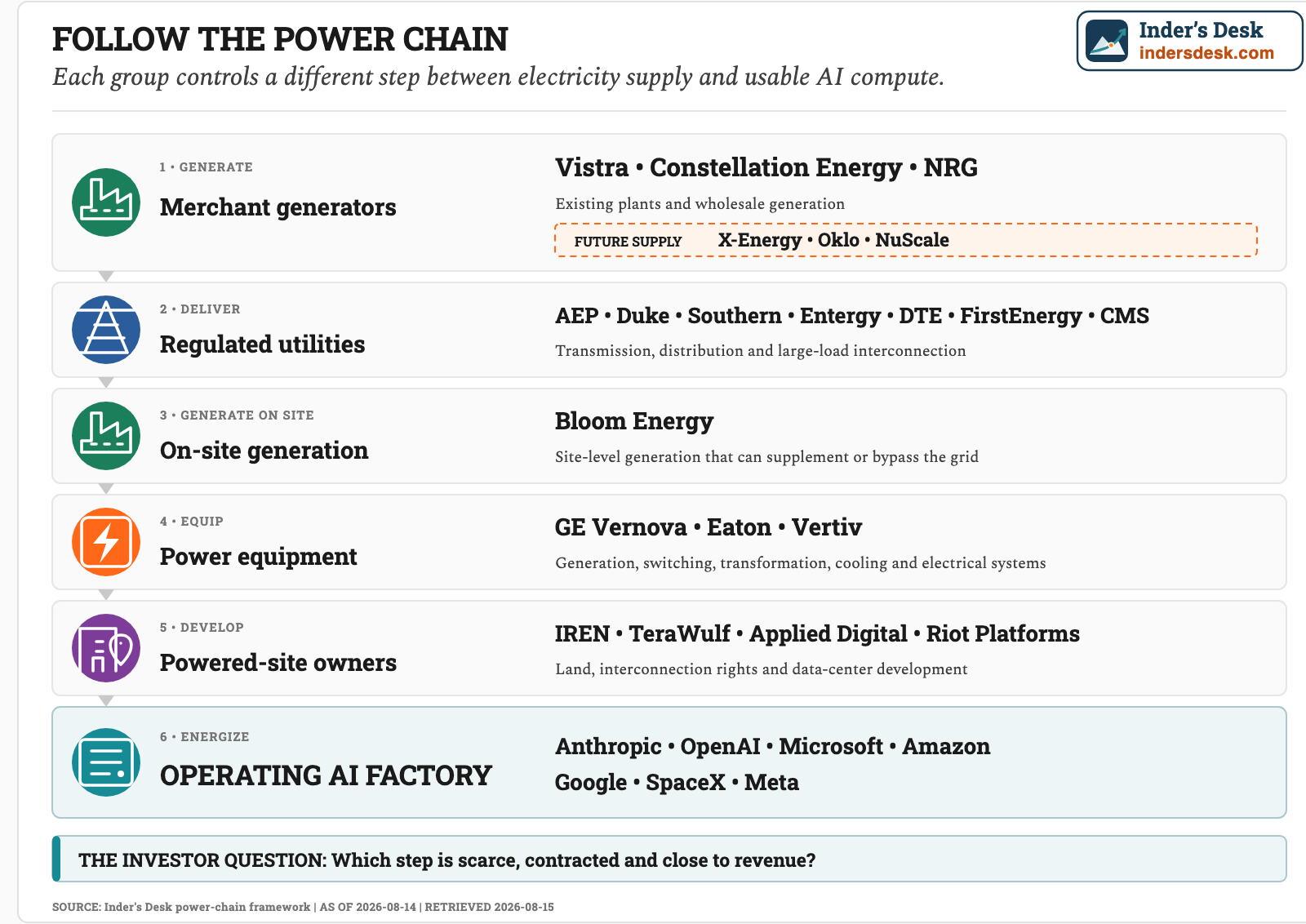
This is where the buildout becomes an investment map.
Land alone is not enough. An announced megawatt is not operating compute. The valuable asset is a credible path from power supply to an energized server.
That is why powered-site owners can have an advantage when interconnection and generation are already secured. It is also why the advantage is conditional. A site can still be delayed by utility service, equipment, permits or construction.
The investor’s job is to follow the next scarce step. In one market it may be generation. In another it may be transmission, transformers or an already powered site.
The flywheel is not yet connected
The grid powers AI. AI has not yet repaid the favor.
The usual criticism of this buildout begins with electricity.
AI factories will consume enormous amounts of power. They will compete for grid capacity, equipment and generation. Communities will ask who pays for the new infrastructure. Regulators will have to decide how costs are allocated.
But the argument usually stops one step too early.
The electricity entering an AI factory does not simply disappear. It is converted into a tool that can be sent back into the energy system.
AI can help energy companies interpret geological data and improve exploration. It can monitor equipment, predict failures and reduce downtime. Grid operators can use it to forecast demand, balance variable generation and find faults faster. Better sensors and software can allow existing transmission infrastructure to carry more power.
The longer-term opportunity may be even larger. AI could accelerate the search for stable solar materials such as perovskites. It could also help battery factories analyze billions of data points. That may reveal faults sooner. It may improve performance forecasts and reduce the risks of new chemistries.
The first generation of AI is being powered by today’s energy system. The next generation may help redesign it.
That creates the possibility of a new industrial flywheel:
Energy produces compute. Compute produces intelligence. Intelligence improves the energy system. A more productive energy system supports more compute.
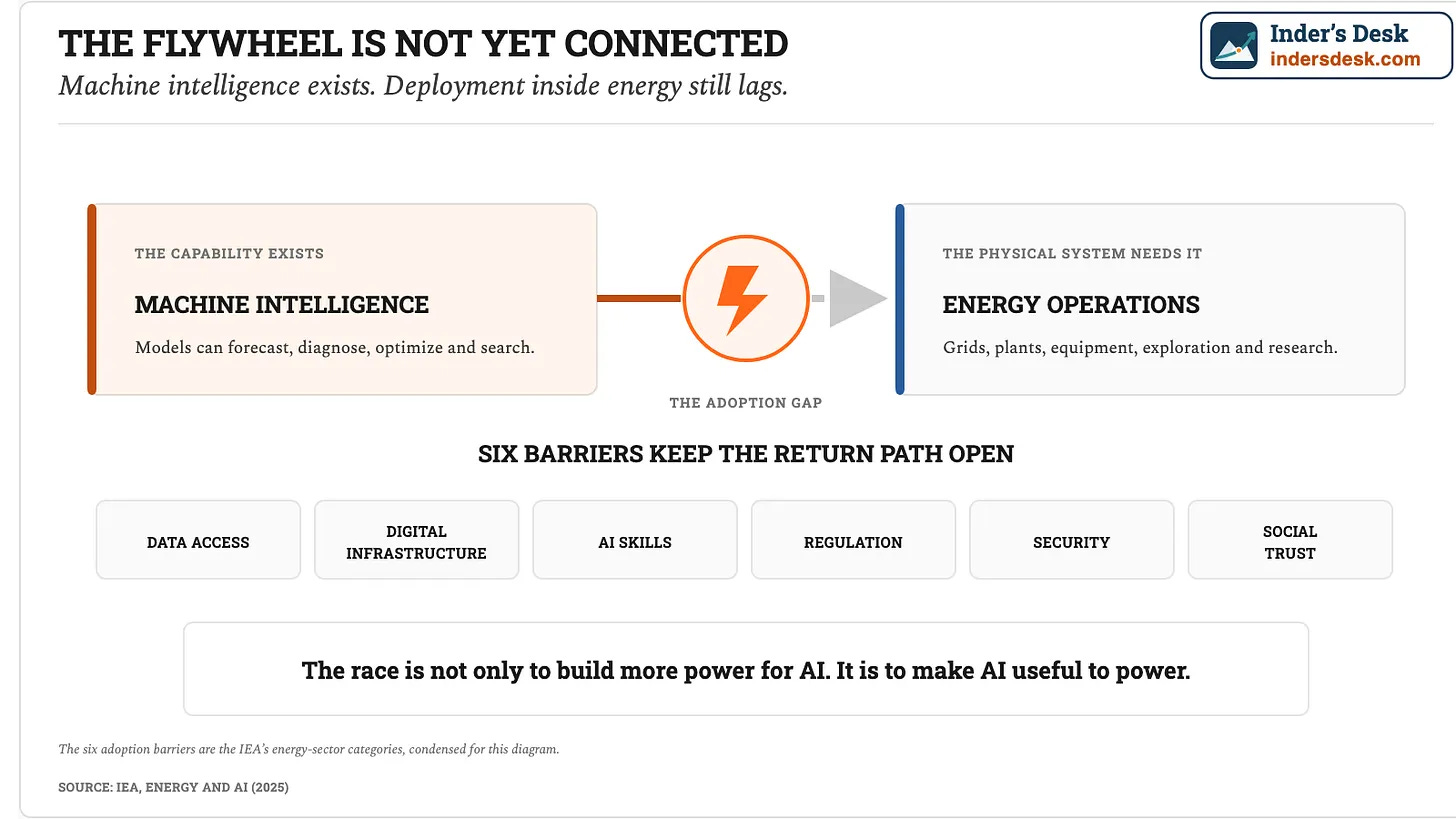
The loop does not require AI to make electricity free. It requires intelligence to make the system beneath it more productive. Better forecasting can reduce outages. Better monitoring can improve generator availability. Faster research can accelerate new materials.
Each gain creates more usable capacity, lowers friction or shortens the path to new supply.
The surprising possibility is that an energy-intensive technology could become one of the most powerful tools for improving energy productivity.
The loop is not connected yet. The energy industry itself is still not making full use of AI. The barriers are familiar: data, digital infrastructure, skills, regulation, security and social trust.
This is not merely a policy problem. It is the next investment opportunity.
The first wave of the AI trade financed chips, data centers and electricity supply. The next may reward companies that connect intelligence back to the physical system through grid software, automation, power electronics and energy research.
The race is not simply to build more power for AI. It is to make AI useful to power.
The export is already traveling through software
America has spent more than a century converting natural resources, engineering and capital into products the world buys.
Oil left through pipelines and tankers.
Aircraft left through factories and airports.
Software crossed borders through networks.
America already exports digitally deliverable services at enormous scale. AI is now riding the same network.
Machine intelligence combines all three traditions. It is energy-intensive like heavy industry, capital-intensive like aerospace and globally distributable like software.
A foreign business may never see the American power plant or data center serving its request. It will see a useful result inside an application. It may pay per token, per task, per agent or through a software subscription.
Some countries will insist that data and inference stay local. The American export can still be the model, agent or software layer rather than the electricity or server.
The underlying export is intelligence on demand.
What this means for investors
The opportunity extends beyond the companies training the largest models.
If intelligence becomes America’s biggest export, value can accrue across the chain. It begins with generation and grids, moves through electrical equipment and semiconductors, then reaches data centers, cloud infrastructure and software.
The most important companies may not be those announcing the largest numbers. They may be the ones that close the loop.
The winners will secure power, turn it into reliable compute, distribute useful intelligence at attractive economics and feed that intelligence back into the physical system. They will make each layer reinforce the next.
For investors, four numbers matter more than an announced gigawatt: contracted power, time to energization, utilization and gross profit per unit of useful AI work.
Power in. Intelligence out.
The last industrial age exported machines, aircraft and barrels of oil.
The next one is beginning to export intelligence, one token at a time.
If this article helped you see the AI buildout differently, subscribe to Inder’s Desk. If you already subscribe, share it with one investor who still sees data centers only as a power-demand problem.
Sources and further reading
Alphabet, Q3 2025 earnings call
Alphabet, Q4 2025 earnings call
Google Cloud, Welcome to Google Cloud Next ‘26
OpenRouter, LLM Rankings
OpenRouter, Daily token totals for top 50 models
Stripe, Agreement to acquire OpenRouter
Nvidia, AI compute infrastructure financing platforms to mobilize over $500 billion
Constellation Energy, Crane Clean Energy Center and Microsoft power purchase agreement
SpaceX, June 2026 EU prospectus
SpaceXAI, Greater Memphis site updates
Broadcom, AI infrastructure
Microsoft, Fiscal 2026 third-quarter earnings call
Salesforce, Agentforce
Microsoft Research, Energy use of AI inference, efficiency pathways, and test-time scaling
International Energy Agency, Energy and AI: Executive Summary
International Energy Agency, AI for energy optimisation and innovation
U.S. Bureau of Economic Analysis, International Services
Google, Measuring the environmental impact of delivering AI at Google Scale
Disclaimer
This article is for informational and educational purposes only and does not constitute financial, investment, tax, or legal advice. Any opinions, scenarios, price targets, or market observations reflect my personal views and may change without notice. Investing and trading involve substantial risk, including the possible loss of principal. You are solely responsible for your own investment decisions, position sizing, risk management, and trades. Conduct your own research and consult a qualified professional where appropriate.


