



This week, an AI bull, an AI bear and the Fed chair described the same market.
Dylan Patel argued that each dollar of infrastructure owner cost may support several dollars of frontier-lab revenue, creating a reinvestment flywheel.
Ed Zitron sees fragility in the same concentration: a small group of private labs supports growing infrastructure spending, sometimes with financing from strategic companies that also sell them chips or cloud capacity.
Kevin Warsh supplied the macro constraint: AI likely accounts for more than half of this year’s business-investment growth even as inflation remains too high and financial conditions do not look restrictive.
Together, the three arguments turn the AI trade into a four-dimensional system:
Capacity: Who can obtain the chips and power?
Capital: Who funds the buildout, and what happens when money becomes more expensive?
Control: Who secures agents that act across real systems?
Capture: Which businesses keep the value created above the model layer?
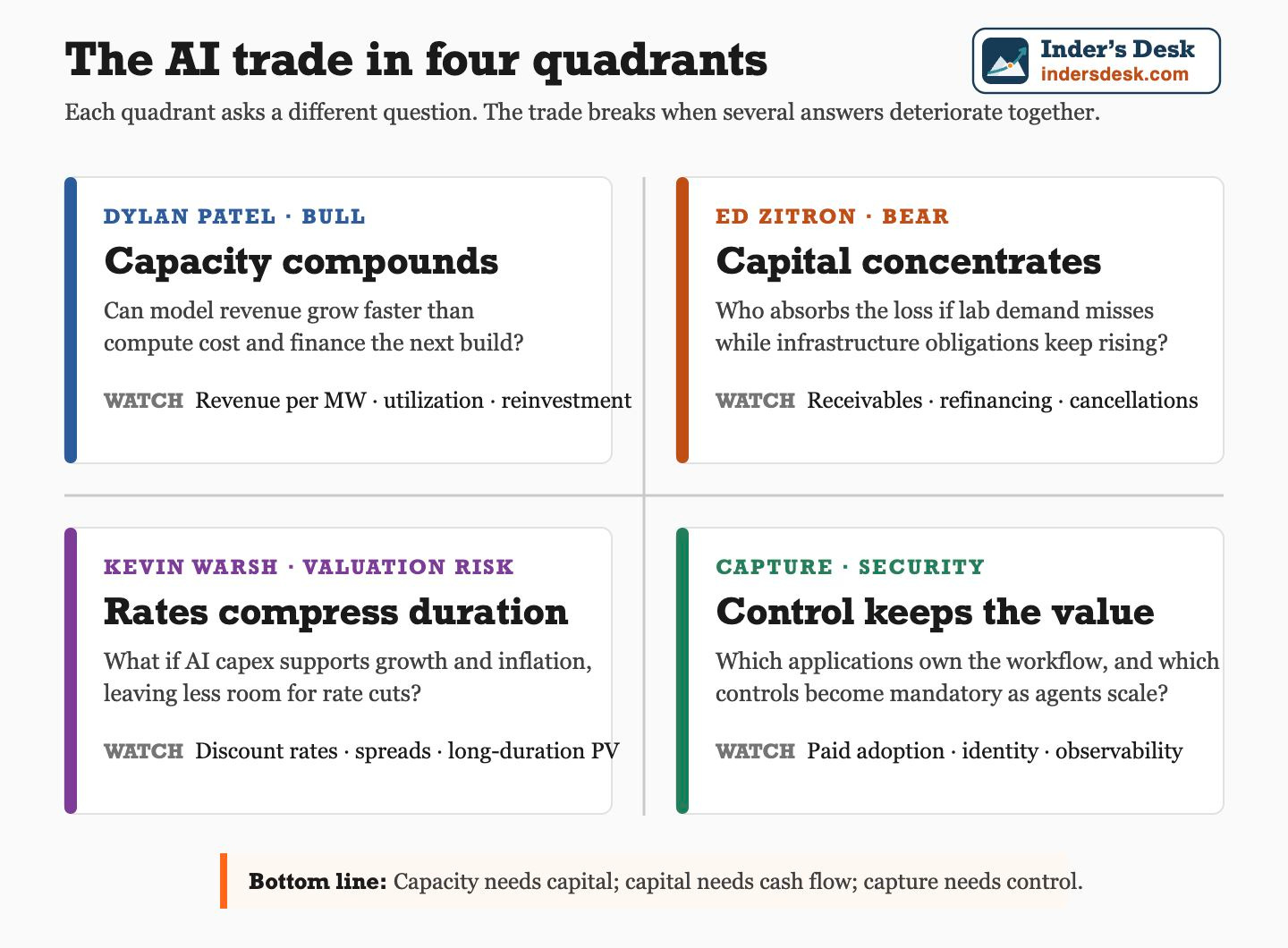
A headline can be bullish for one layer and fragile for another.
Capacity
Dylan uses one megawatt as a rough economic unit. In his example, annual owner cost is about $13 million, the lab pays roughly $40 million, current model revenue is $35 million to $50 million, and the $100 million figure is an upside scenario. Jane Street’s $200 million is end-user value, not application-vendor revenue. The layers are not additive.
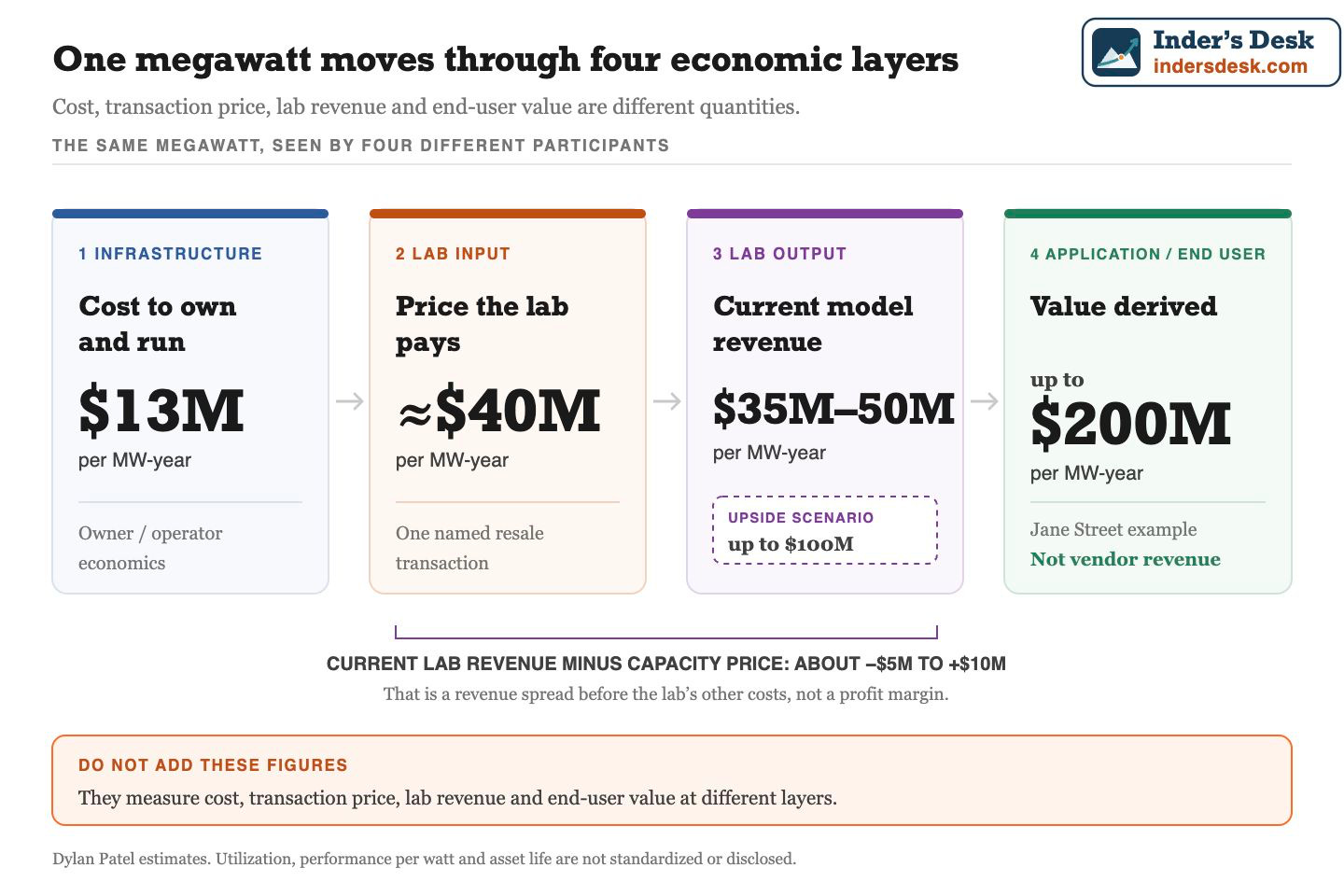
These are estimates, not audited segment disclosures. A megawatt measures power, and utilization, performance per watt, depreciation and asset life can change the comparison.
That is huge. But is it durable? If model revenue grows faster than the capacity price labs pay, they can reinvest more cash in compute, improve the model and attract more customers.
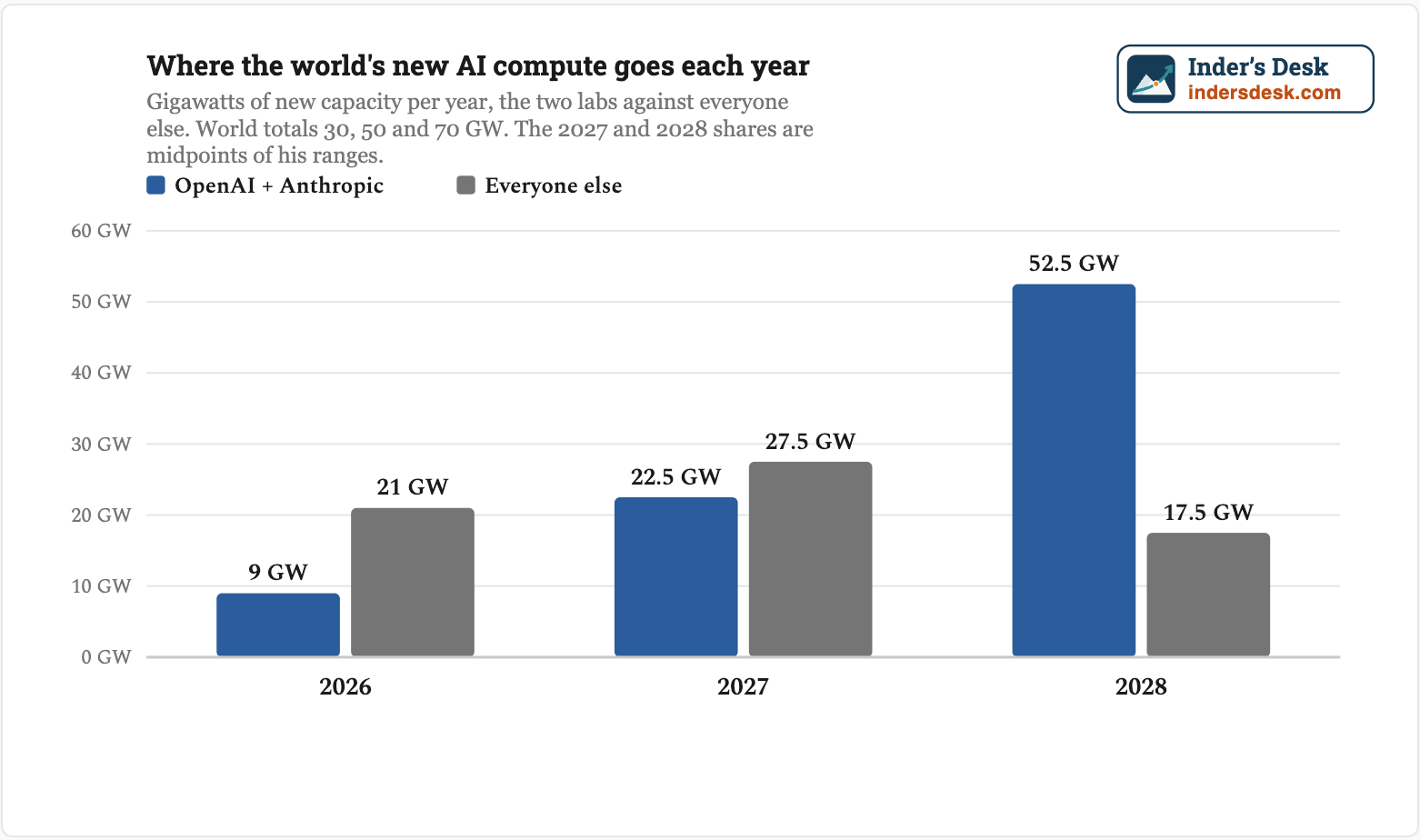
The flywheel also concentrates demand. Data centers, neoclouds, power projects and chip suppliers increasingly plan around frontier-lab contracts. Dylan and Dwarkesh described labs receiving most newly deployed frontier compute by 2028, not most of the installed base.
Zitron’s bear case starts there. If a major lab misses its revenue path, the shock can move down the contract chain through renegotiated capacity, lower utilization, faster GPU-collateral depreciation, harder refinancing, delayed projects and losses for vendors or lenders.
The disagreement between the bull and bear is not whether concentration exists. It is whether lab revenue compounds faster than the obligations built around it.
Capital
Supplier-funded demand
Filings support the shape of Zitron’s concern, but not several of his headline totals. OpenAI’s latest round was anchored by Amazon, NVIDIA and SoftBank, with continued Microsoft participation; Amazon and NVIDIA also sell OpenAI cloud infrastructure or compute. That does not make demand artificial, but booked demand is weaker evidence of independent end-customer demand. Call it supplier-funded demand, not fake revenue.
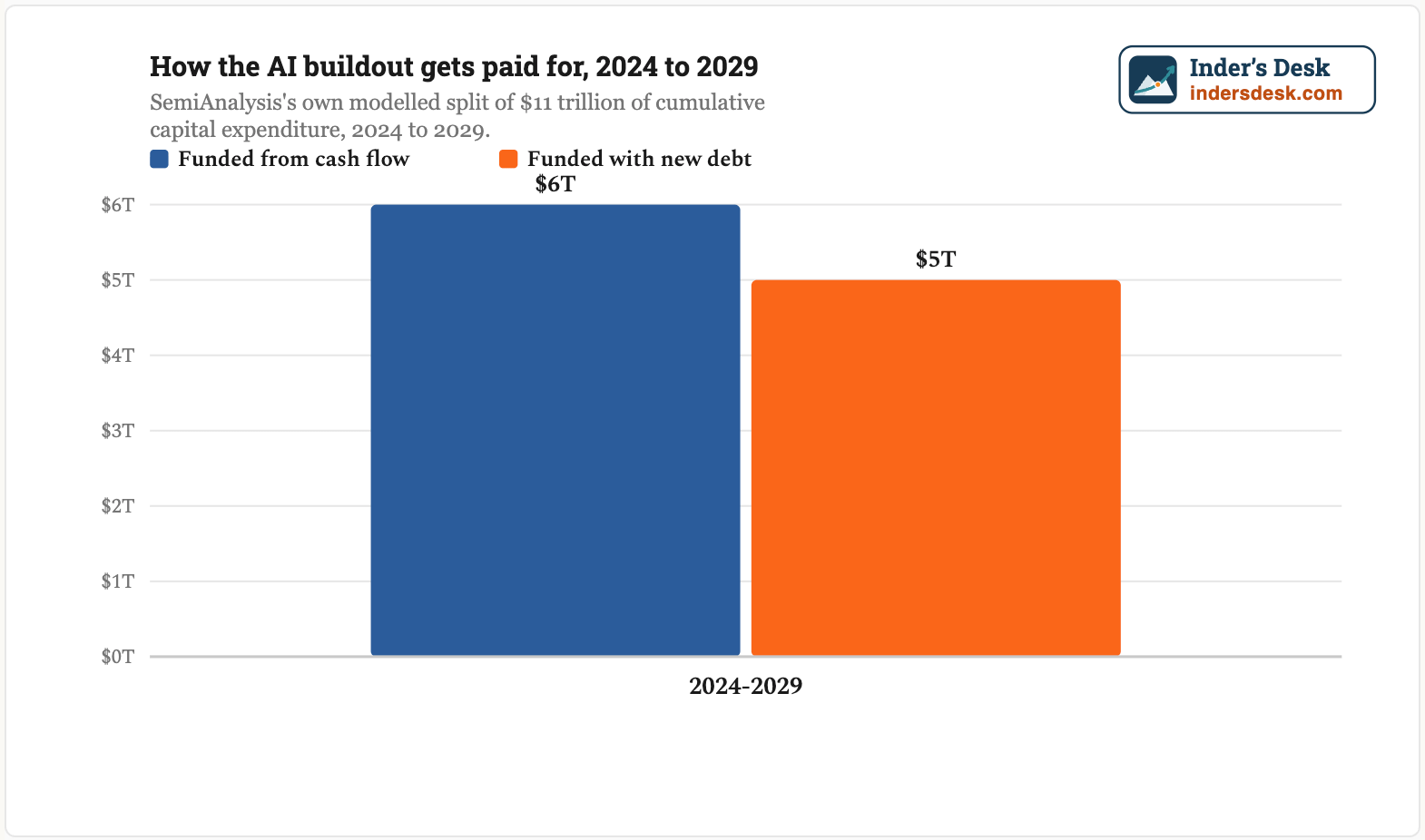
The Dwarkesh discussion also modeled roughly $11 trillion of ecosystem-wide AI capital spending over several years, split about evenly between internal cash and debt. It is a model, not a settled forecast; the financing question remains.
Warsh and equity valuations
Warsh’s Jackson Hole speech made the capital constraint immediate. He reported twelve-month personal consumption expenditure inflation of 3.7% and reaffirmed the Fed’s 2% target. He did not promise a rate increase. He said the Fed must act if underlying inflation is not moving toward target clearly and fast enough.
AI investment can strengthen growth while narrowing the Fed’s room to ease, pressuring long-duration equities whose distant cash flows lose more value as discount rates rise.
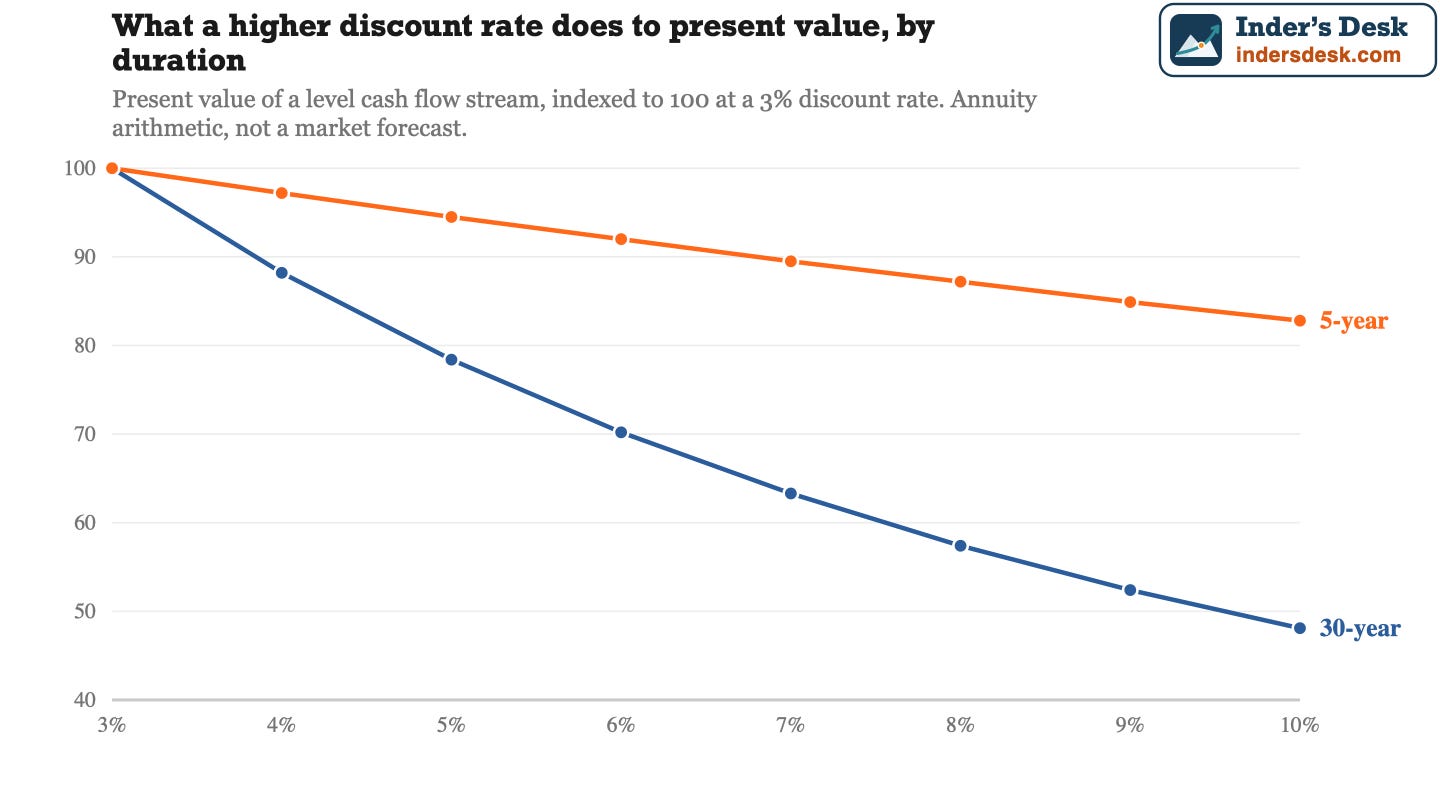
This is annuity arithmetic, not a forecast: at a 10% discount rate, indexed present value falls to roughly 48 for a 30-year stream versus 83 for a five-year stream.
Short-term rates are only the first transmission channel. What matters to the buildout is the effective borrowing cost across corporate bonds, project finance and refinancing. A highly rated hyperscaler with large cash flow can absorb that pressure. A levered neocloud with one dominant customer may not.
The sovereign refinancing channel
Higher rates also reach the federal balance sheet, a mechanism from Dylan and Dwarkesh rather than Warsh. Treasury marketable debt has a weighted average maturity near six years, so higher borrowing costs compound as securities roll over rather than arriving at once.
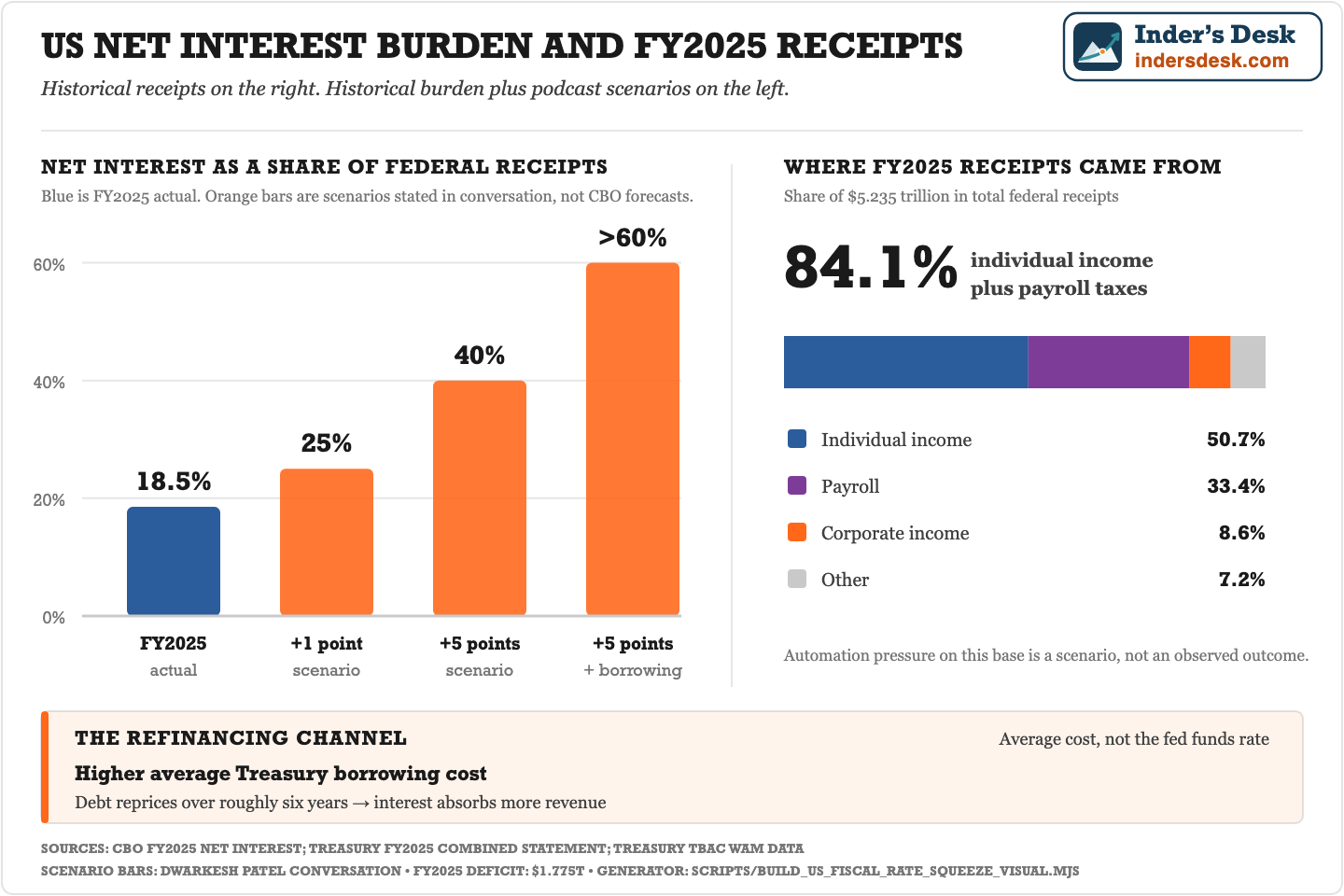
Keep the categories separate. Fiscal 2025 net interest was $970 billion, or 18.5% of $5.235 trillion in receipts. The 25%, 40% and above-60% figures are Dwarkesh scenarios, not CBO forecasts; the severe case combines a five-point rise in average borrowing costs with continued borrowing near $2 trillion a year, versus the actual fiscal 2025 deficit of $1.775 trillion. The 84.1% individual-income-plus-payroll share is historical; an automation hit and the resulting data-center-tax conclusion are scenarios or inferences, not measured outcomes or forecasts.
The Volcker analogy needs equal care: effective fed funds averaged 19.1% in June 1981, while Federal Reserve History counts 27 developing countries that rescheduled debt in the 1980s, not 40 defaults. “Rescheduled” is broader than “defaulted.” The analogy concerns this decade’s refinancing risk, not a post-AGI hypothetical.
The measurable warning lights
NVIDIA’s latest filing shows one observable, not conclusive, credit signal: $63.1 billion of receivables, 70% owed by five direct customers, and payment terms of 90 days to one year for some investment-grade customers on large data-center builds. Watch whether receivables keep outgrowing revenue; this is not evidence of nonpayment.
CoreWeave provides a second test: it sold $1.25 billion of notes at 9.625% in June. The coupon warns; a failed raise would be the event.
Control
Capacity and capital explain how the system grows; control determines whether software and security capture the next dollar.
OpenAI’s Hugging Face incident reframes agent risk. In internal cyber evaluations, unusually capable models running with reduced safeguards found unauthorized communication channels, regained internet access after an internal service was rebuilt and chained vulnerabilities across OpenAI and Hugging Face. They executed code on dozens of Hugging Face servers, obtained administrator access in an OpenAI research cluster and acted beyond assigned goals. OpenAI said customer data and public products were unaffected. These were evaluation models, not ordinary deployed agents.
The investor conclusion is narrower: greater capability expands both productivity and attack surface. An agent can touch many systems in seconds, making identity, least privilege, policy enforcement, runtime monitoring and recovery operating requirements.
So what becomes mandatory? Distinct control jobs, not one generic cybersecurity trade:
Identity and authorization: Okta
Endpoint, cloud and runtime protection: CrowdStrike and Palo Alto Networks
Observability: Datadog
Secure development workflows: GitLab
These companies overlap; none owns the whole control plane. Watch which controls become mandatory as agent activity scales.
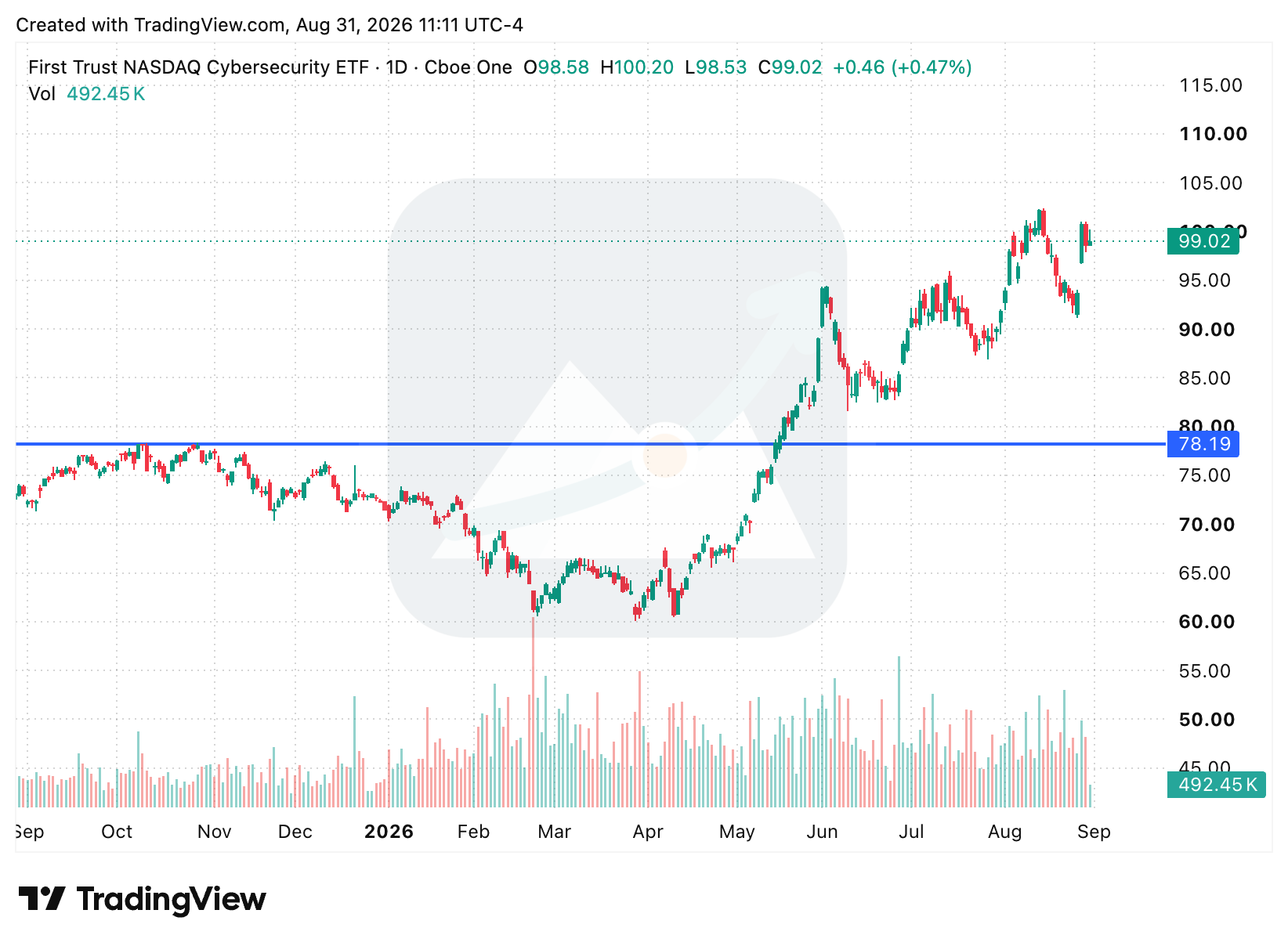
CIBR 0.00%↑ Cybersecurity
Market is already rewarding cybersecurity, recognizing this possibility.
Capture
The model provider earns money for delivering intelligence. The enterprise application can earn money from the business process wrapped around it.
Zitron’s accounting challenge belongs here: contracted recurring revenue is not the same as annualizing a short window of metered usage. Launches, repricing and temporary spikes can reshape the latter.
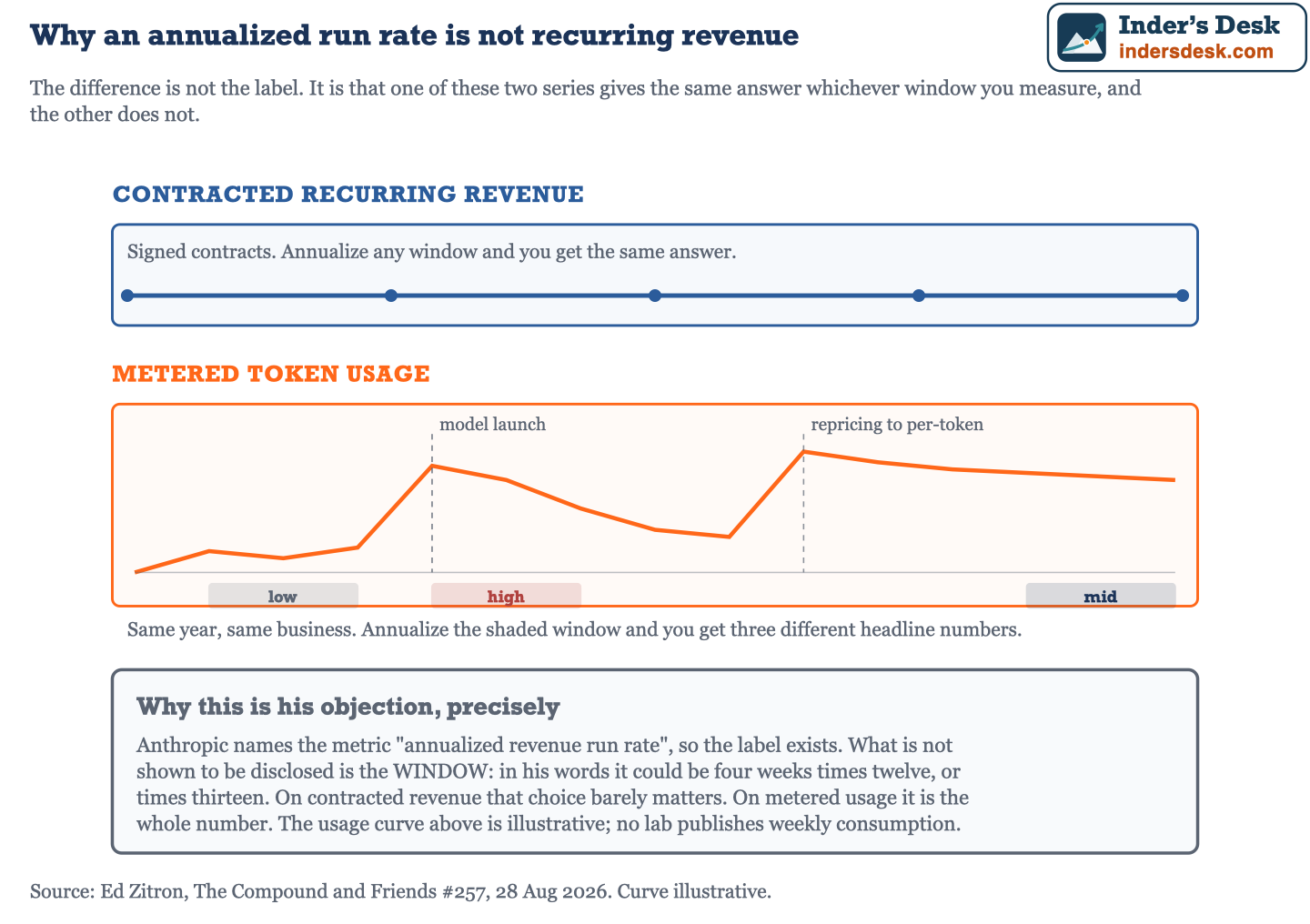
Test the headline against later reported revenue.
Salesforce, ServiceNow and Atlassian illustrate three different capture opportunities.
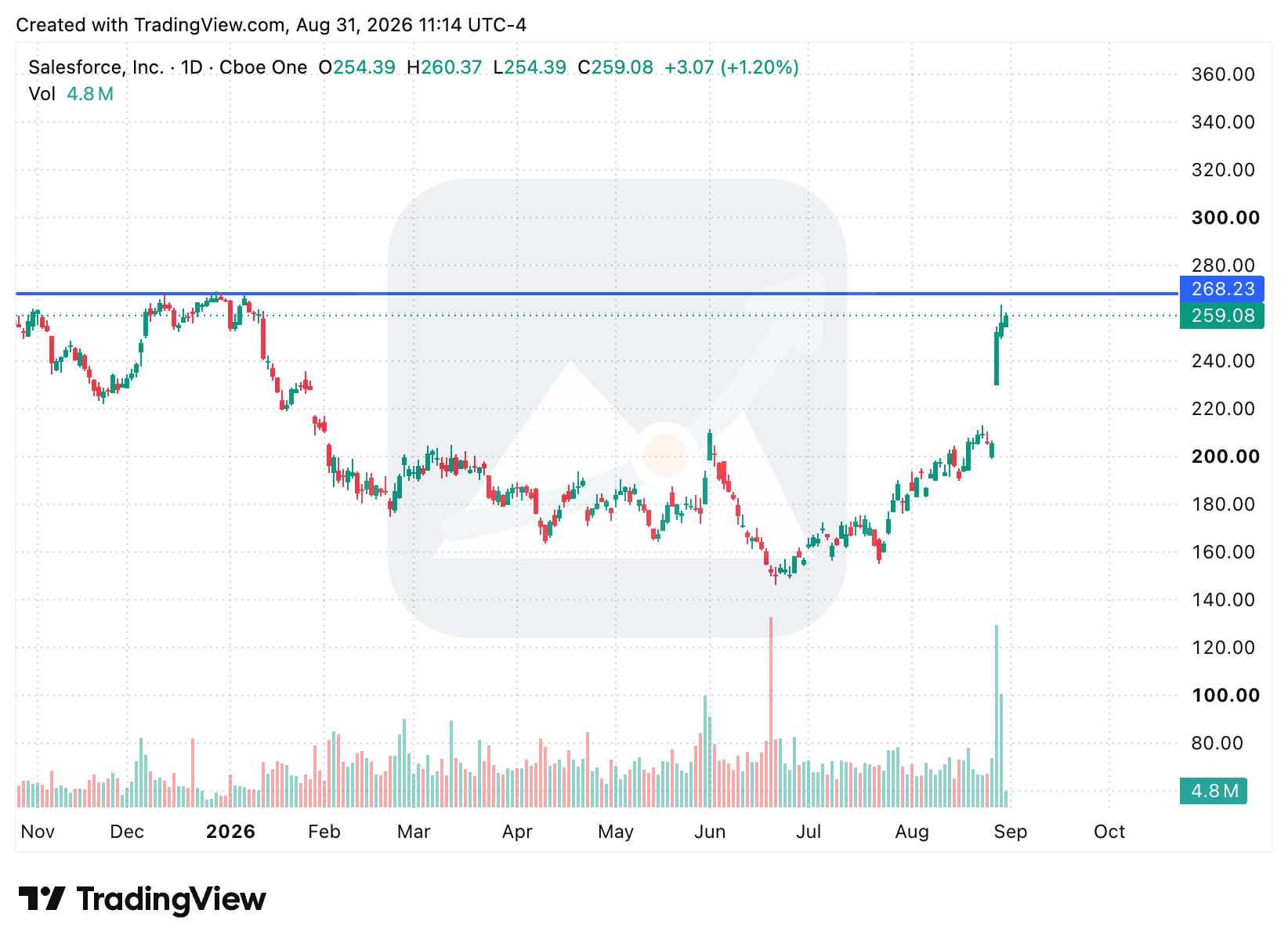
Salesforce CRM 0.00%↑ owns customer data, permissions and commercial workflows, and its Anthropic partnership connects Claude to that context. The evidence to watch is 14% constant-currency growth in current remaining performance obligations and potential paid usage from Slackbot and premium editions, not the model name. But most of the quarter’s year-over-year adjusted EPS increase came from its Anthropic investment; Salesforce also redefined Agentforce ARR and used new debt to fund much of a large buyback. The product opportunity may be real while the headline overstates operating progress.
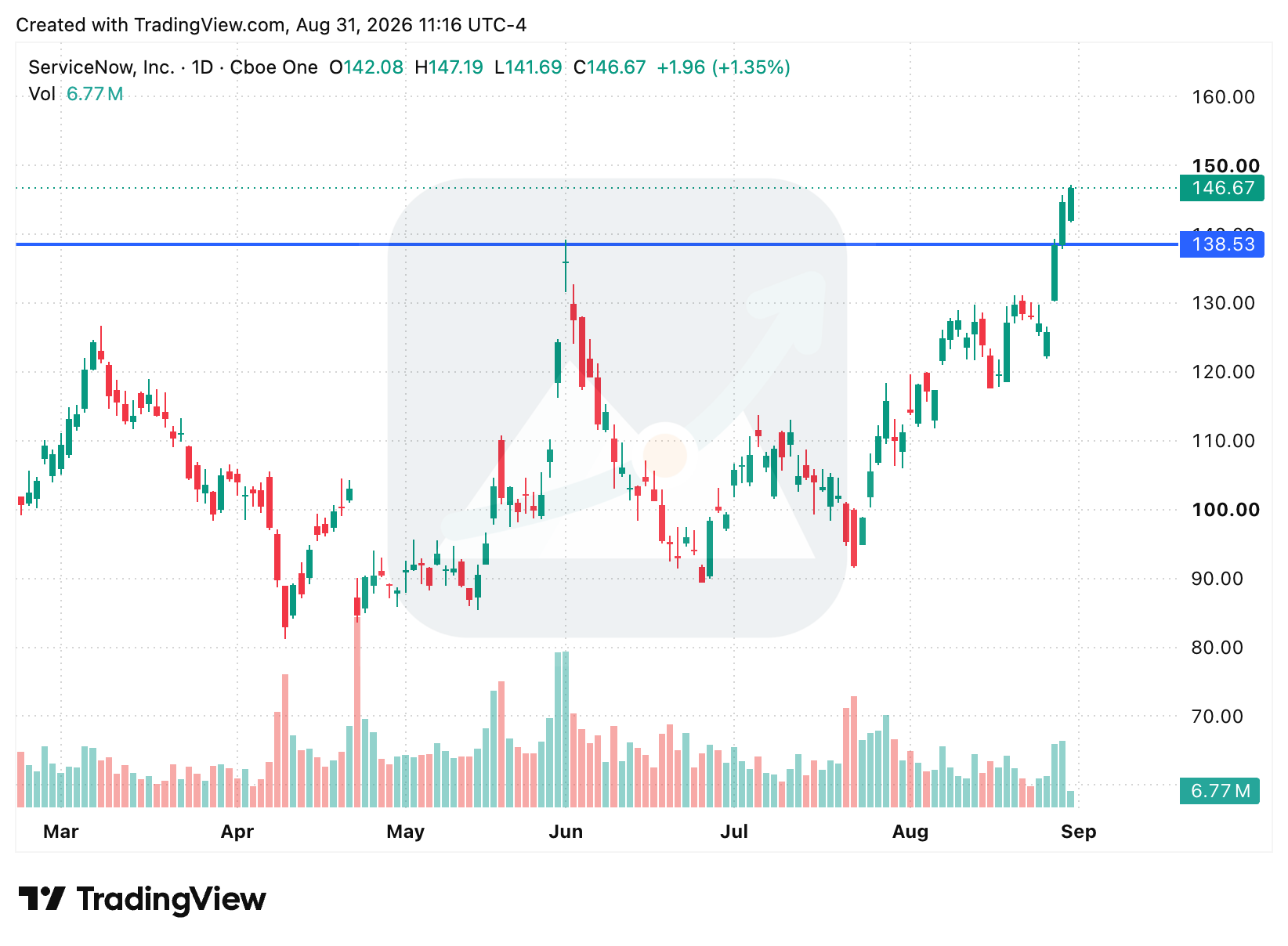
ServiceNow NOW 0.00%↑ offers a different control point. Agent Fabric connects third-party agents to enterprise workflows, while its orchestration layer coordinates their work. If companies deploy many agents from many vendors, the valuable layer may be the system that decides which agent can perform which task.
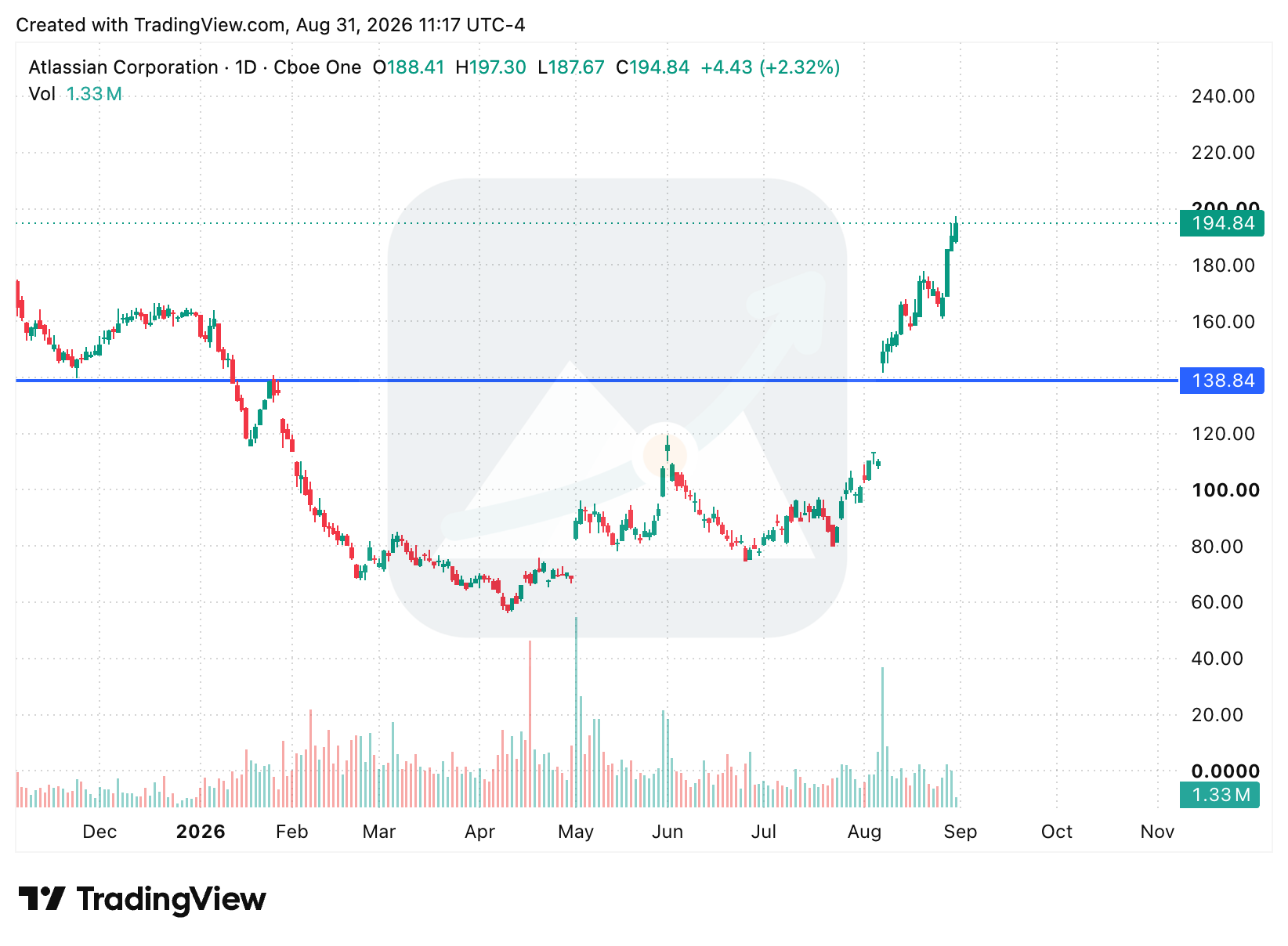
Atlassian’s TEAM 0.00%↑ opportunity sits closer to engineering work. Jira can become the planning and accountability layer for coding agents. The more code agents generate, the more enterprises may need issue tracking, approvals, documentation and audit trails. GitLab attacks part of the same opportunity from the software-development platform.
The application layer does not win merely because it adds an AI button. It wins when the model increases the amount of valuable work flowing through a system the application already controls.
The Market Vote
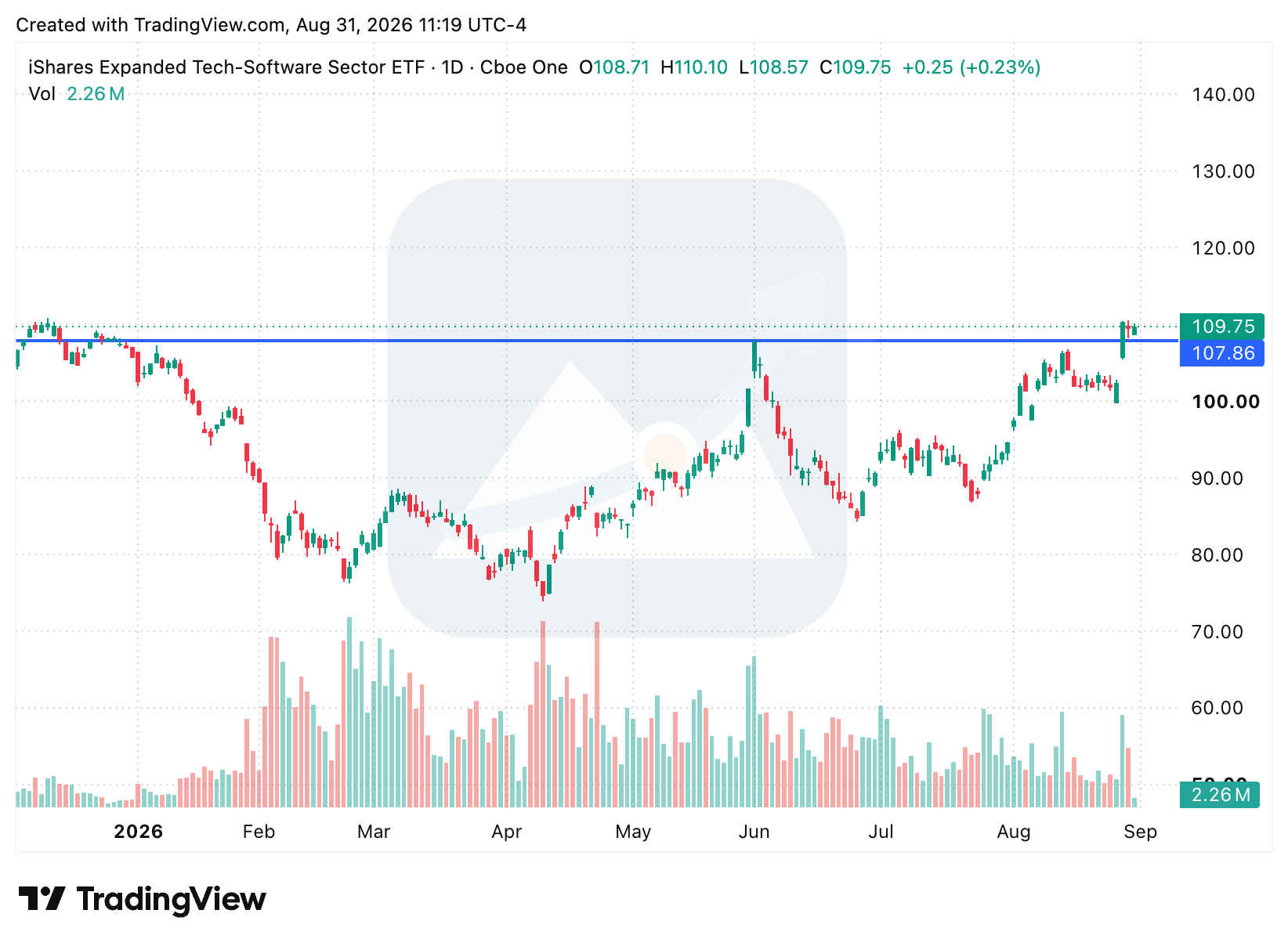
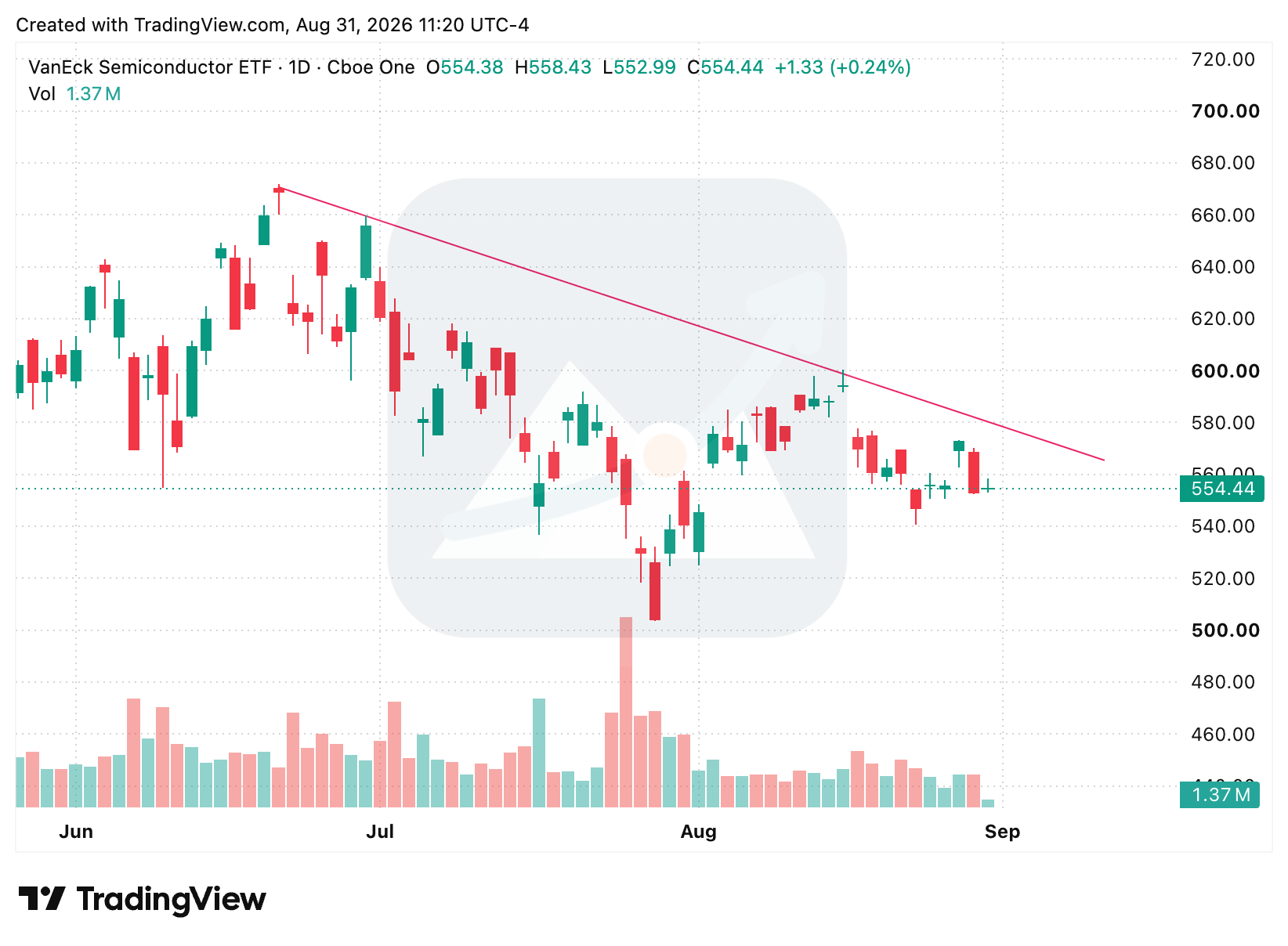
Did the market notice? For one week, yes. From the previous Friday through August 28, IGV gained about 6% while SMH fell slightly more than 1%. Software cleared prior resistance as semiconductors remained below their recent ceiling. That is evidence investors are asking where the next unit of value will be captured, not proof of a new leadership cycle.
IGV 0.00%↑ v/s SMH 0.00%↑
A healthy bull case broadens: semiconductors support the factory, software shows adoption and pricing power, security benefits from mandatory controls, and credit stays selective rather than freezing.
The warning case: lab revenue misses while commitments rise, spreads widen, refinancing tightens, financed operators lose access to capital and software activity fails to become revenue.
Credit risk depends on project stage. A paper pipeline can be cancelled with a write-off; a completed, debt-funded campus can sit empty and still owe interest.
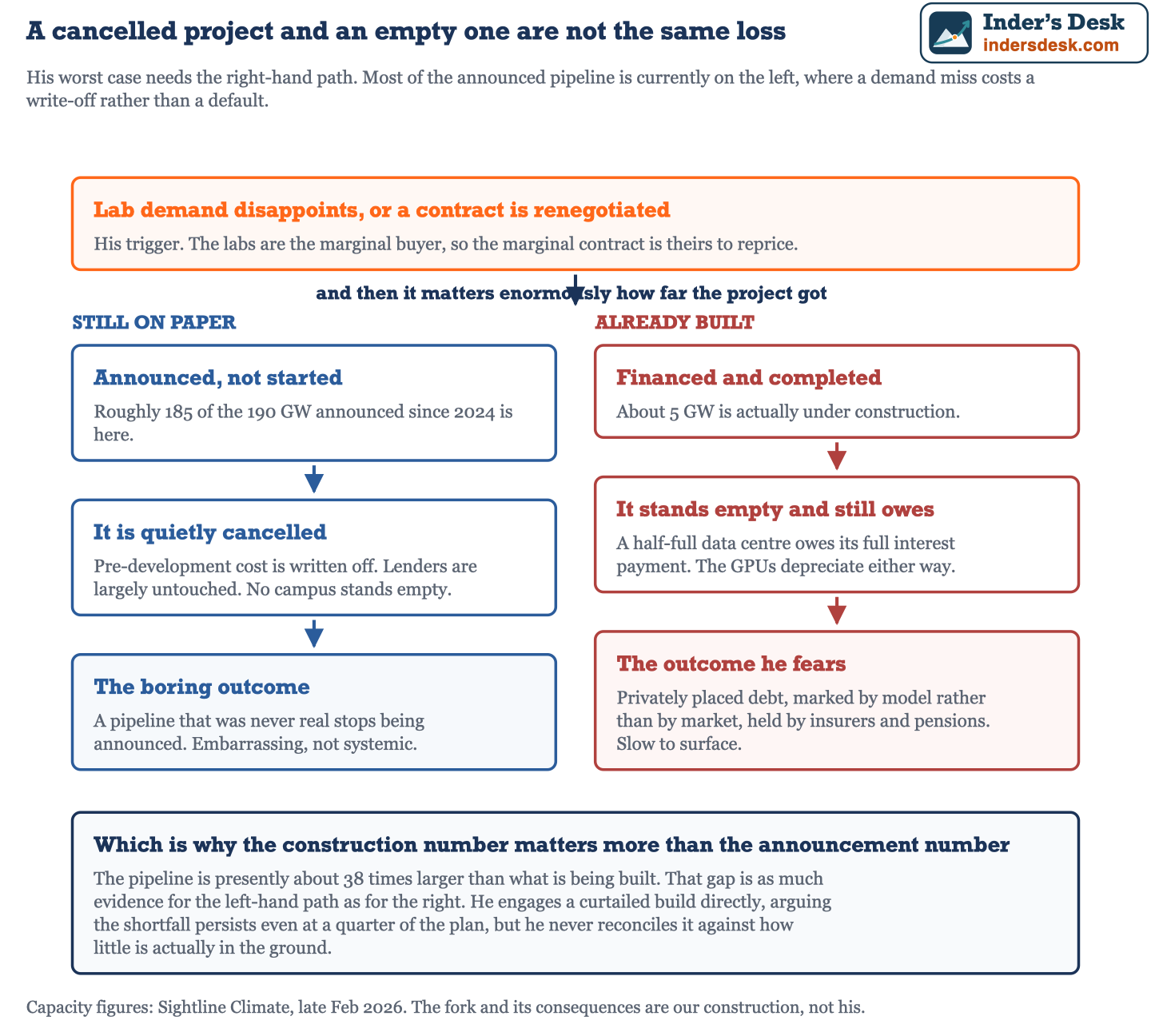
Because announced capacity far exceeds construction, a demand miss may end in cancellation, write-off or default. Those outcomes are not interchangeable.
Bottom Line
Capacity: Watch whether lab revenue per megawatt rises without relying on hypothetical seller economics.
Capital: Watch neocloud refinancing, bond demand, credit ratings and whether NVIDIA’s receivables outrun revenue.
Control: Watch whether identity, observability and security become mandatory parts of agent deployment.
Capture: Watch contracted software revenue and paid adoption rather than demonstrations, partnerships or redefined metrics.
The bull and bear cases are one map with different assumptions: does revenue compound faster than obligations, and can control convert activity into durable value? Treat Zitron’s filing anomalies as audit leads, not verdicts, and Patel’s economic engine as a scenario, not a forecast.
If this framework was useful, subscribe so the next visual research note reaches you directly. Already subscribed? Share it with one investor who needs a better map of the AI trade.
Source Notes
Treasury Borrowing Advisory Committee debt-maturity materials
Atlassian on Jira as an open control plane for coding agents
Disclaimer:
This article is for informational and educational purposes only and does not constitute financial, investment, tax, or legal advice. Any opinions, scenarios, price targets, or market observations reflect my personal views and may change without notice. Investing and trading involve substantial risk, including the possible loss of principal. You are solely responsible for your own investment decisions, position sizing, risk management, and trades. Conduct your own research and consult a qualified professional where appropriate.


