



The artificial-intelligence buildout is entering a new phase.
The largest cloud companies are still increasing capital spending. NVIDIA has now gone one step further: it announced partnerships with Apollo, BlackRock, Blackstone, Brookfield, Goldman Sachs and KKR intended to mobilize more than $500 billion of third-party capital for AI infrastructure over time.

That is not another chip order. It is an attempt to turn compute itself into a financeable asset class.
Power scarcity is creating stranger signals too. Investor Gavin Baker recently highlighted an unusual one: buyers taking engines from old private jets and repurposing them as turbines for data centers. The example is anecdotal, but the underlying industrial response is real. Aircraft-engine specialists and data-center developers have publicly described refurbishing aeroderivative engines for AI power.


When Wall Street is organizing half a trillion dollars of financing and used aircraft engines are finding a second life beside data centers, the question is no longer whether money is entering the AI factory.
The question is where it goes and which layer keeps it.
This week’s Market Signals is built around two Money Slides. The first follows the physical dollar through the AI factory. The second follows the software workloads created when inference gets cheaper. Together, the maps show how capital becomes infrastructure and how infrastructure becomes economic value.
The AI Factory Buildout Is Accelerating
The first signal is the hyperscaler spending curve.
Microsoft, Alphabet, Amazon and Meta spent a combined $165 billion in the second quarter of 2026. Current company guidance and management commentary imply further growth through the back half of the year. The exact quarterly estimates will move, but the direction is clear: the largest buyers of AI infrastructure are still adding capacity.
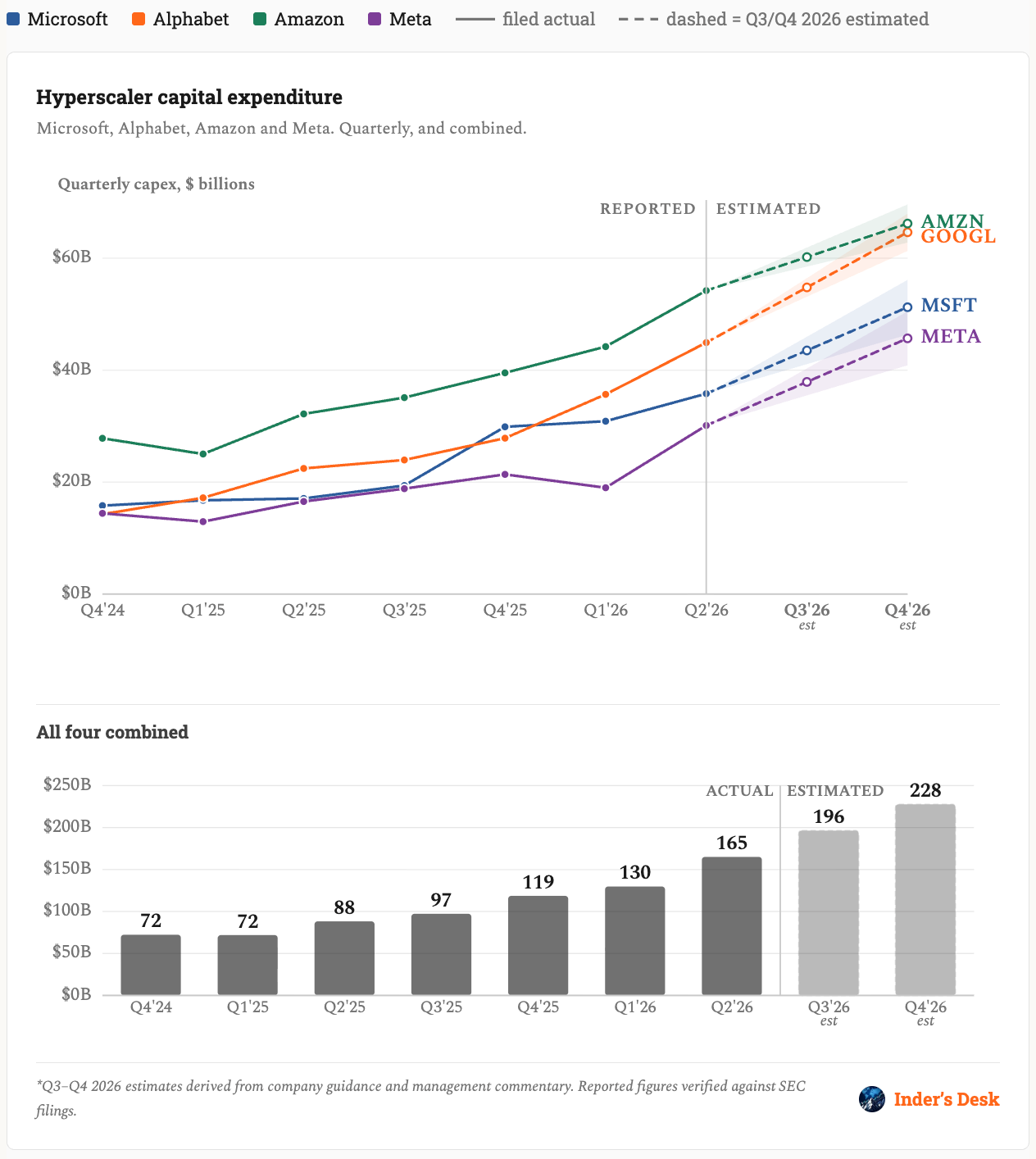
Reported company capital expenditure through Q2 2026; dashed quarters are estimates derived from company guidance and management commentary.
The demand signal is already visible in customer commitments. Microsoft reports $678 billion of commercial RPO. Google Cloud reports $514 billion of backlog, while Amazon reports $496 billion of long-term commitments. SpaceX adds a more targeted AI-compute signal: its Q2 earnings release disclosed $14.1 billion of contracted cloud sales, defined as the non-cancellable enforceable portion of signed agreements. Meta has no external cloud order book because its AI capacity is for internal use.
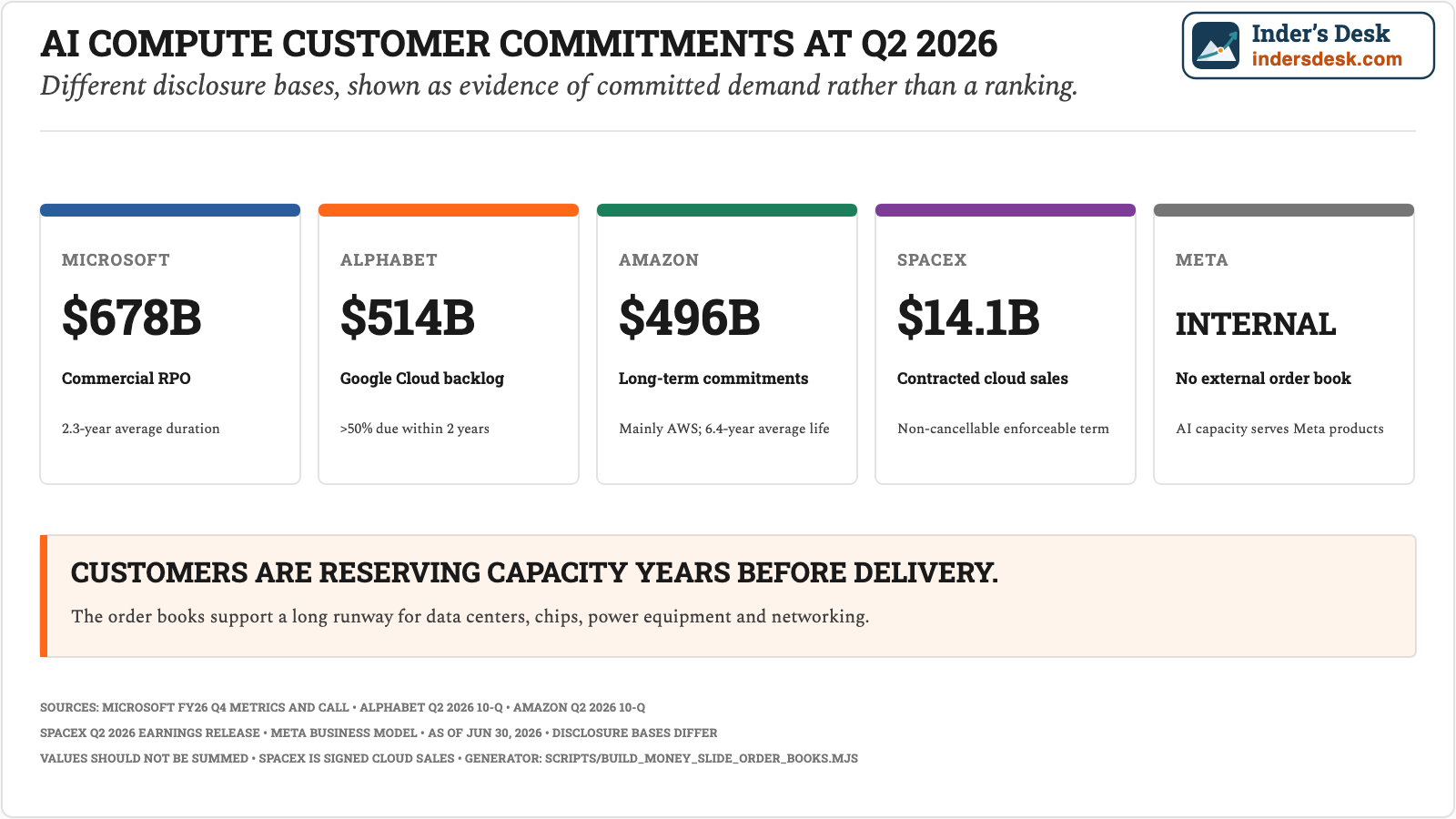
The disclosure bases differ, but the signal is consistent: customers are reserving capacity before the infrastructure is delivered.
Our AI Factory Buildout research examined a substantial sample of major U.S. AI data-center owners and developers. It spans purpose-built GPU campuses and converted high-power compute sites, including projects from Applied Digital and Crusoe. Across 28 phases with comparable disclosures, only 414.5 megawatts of 4,754.5 megawatts was operating at the August 14 cutoff. That is 8.7%.
More than 91% of the disclosed capacity remained under construction or at the contracted and financed stage. That pipeline implies an enormous capital runway. If these projects arrive as disclosed, the AI buildout is still near the beginning of its journey.
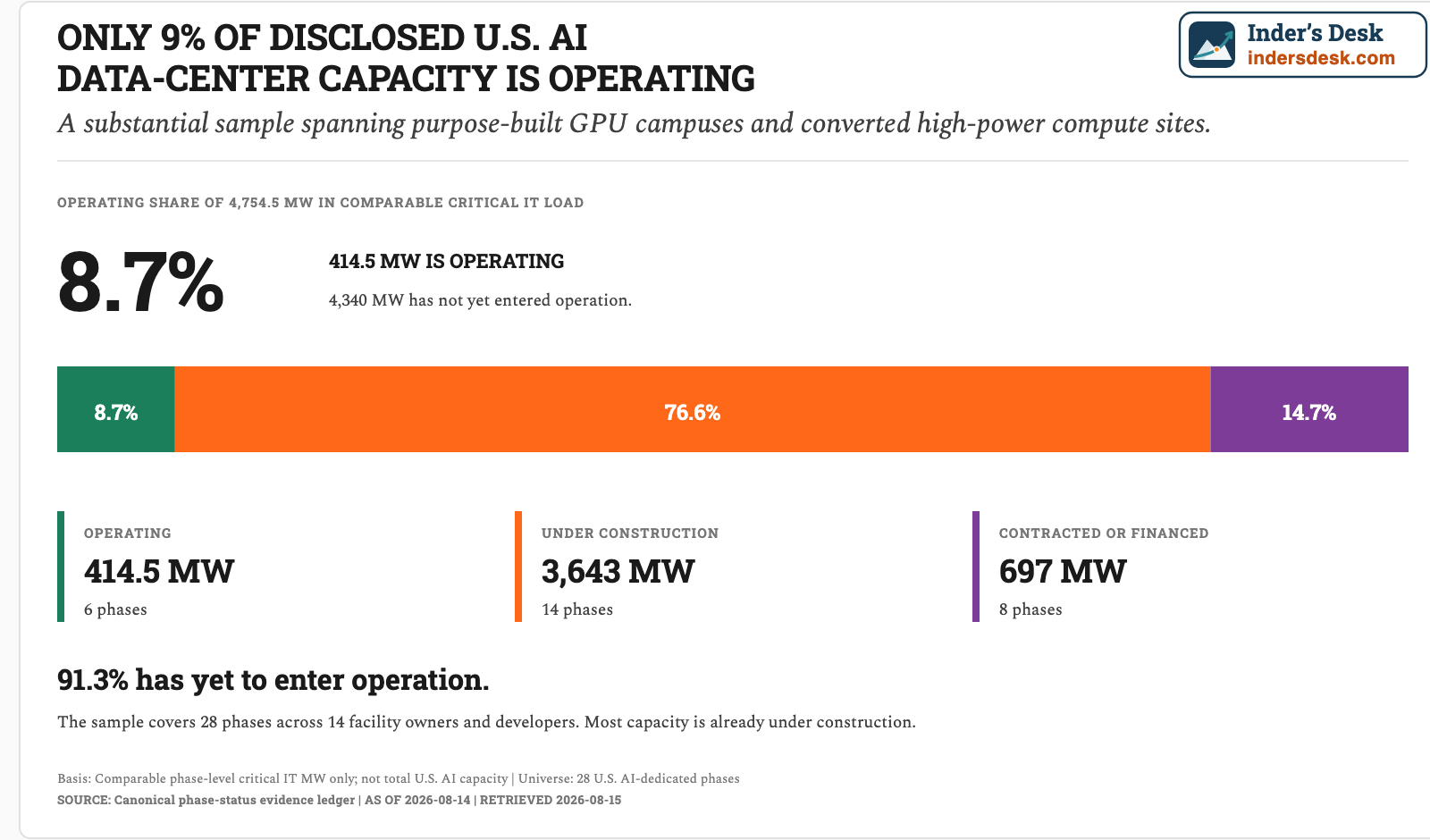
The buildout can accelerate while individual projects disappoint. Signed contracts must still survive financing, construction, interconnection, commissioning and utilization. That is why the Money Slide begins with the flow of money rather than a list of stocks.
Build Your Own AI Factory
Imagine that you had to assemble the AI factory yourself.
You would need customers willing to pay for intelligence. You would need an operator to turn that demand into usable compute. Then you would need three physical systems: power and sites, silicon and memory, and networks that keep the machines working together.
As the resulting intelligence becomes cheaper, you would also need the software layers that govern the new work it creates.
Those are the two maps.
Money Slide One: The Physical AI Factory
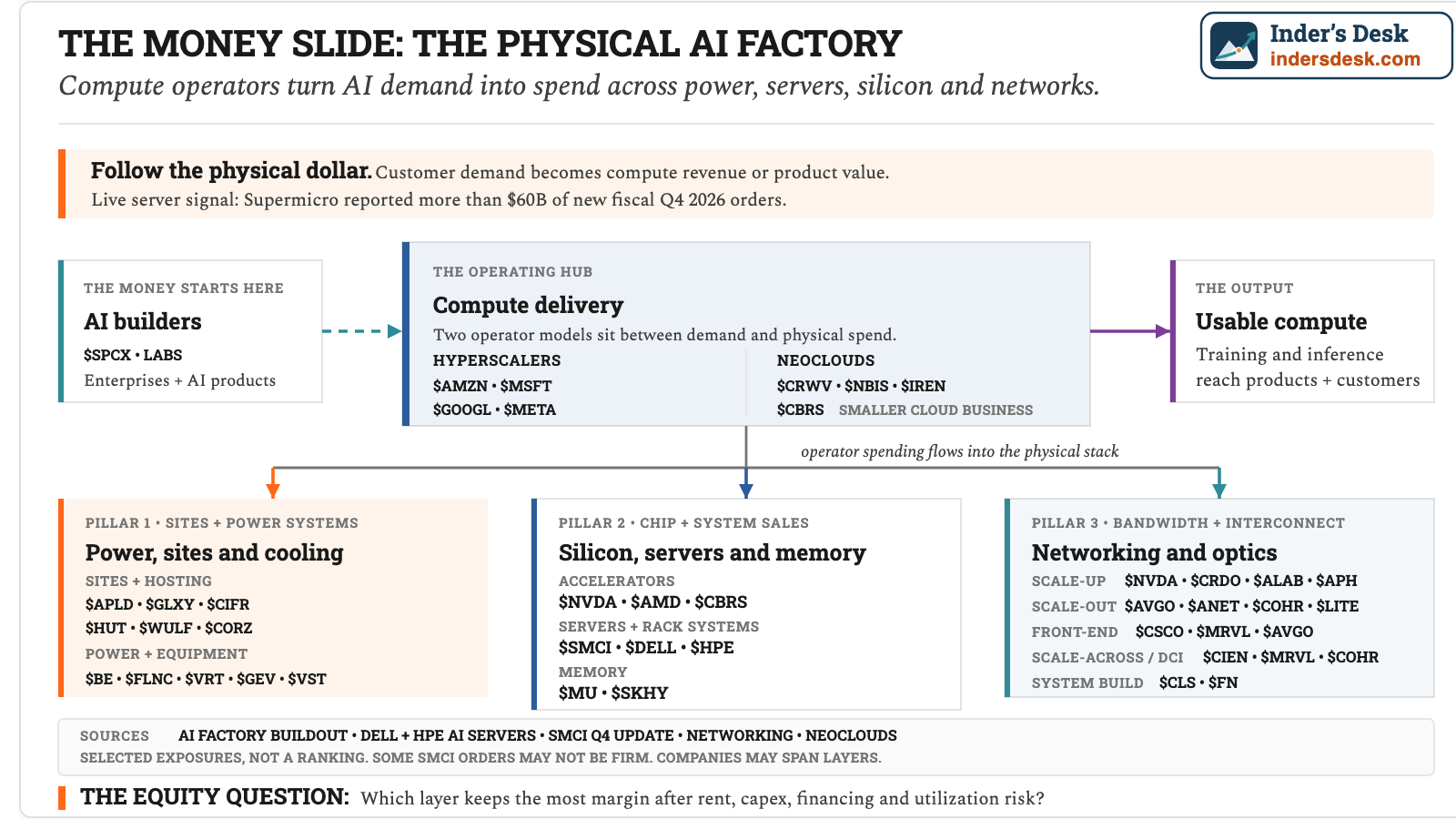
The physical dollar begins with AI builders, enterprises and products. It passes through the companies delivering compute: hyperscalers and neoclouds. It becomes spending across three pillars.
Power, sites and cooling
Before a GPU can produce revenue, it needs usable land, power, electrical equipment and cooling.
Applied Digital, Galaxy, Cipher, Hut 8, TeraWulf and Core Scientific represent selected exposure to sites and hosting. Bloom Energy, Fluence, Vertiv, GE Vernova and Vistra represent different parts of the power and equipment chain.
These companies do not share one business model. Some control scarce sites. Some sell equipment. Some supply or manage power. Their appearance on the map identifies their role; it does not rank the stocks or remove financing, customer and execution risk.

Silicon, servers and memory
NVIDIA, AMD and Cerebras represent accelerators. Dell, Hewlett Packard Enterprise and Supermicro turn those chips into servers and rack-scale systems. Micron and SK hynix represent memory.
Supermicro said it received more than $60 billion of new orders in fiscal Q4 2026 for delivery over future quarters. Some orders may not be firm, but the scale shows how much AI spending is reaching complete systems. The factory is only as productive as its bottlenecks allow. A powerful accelerator waiting on memory or data movement is an expensive idle asset. That gives the supporting components economic value, but it also exposes them to customer concentration, inventory swings and changes in system architecture.

Networking and optics
Each layer plays a different role in the networking stack. Scale-up links accelerators inside a system or rack. Scale-out connects racks across the AI cluster. Front-end networking delivers the resulting intelligence to applications and users. Scale-across and data-center interconnect move traffic between facilities.
A fast model is only as useful as the network that can move its data and deliver its intelligence.
As AI factories grow, the networking opportunity broadens from internal accelerator fabrics to Ethernet, optics and interconnect. NVIDIA, Broadcom and Arista appear across selected layers of this stack. So do Marvell, Credo and Astera Labs. Amphenol, Coherent and Lumentum serve additional connectivity roles. Cisco, Ciena and Fabrinet also appear on the map. Celestica represents system build.
For the full layer-by-layer framework, listen to or read:

Money Slide Two: The AI Trade Moves Up the Stack
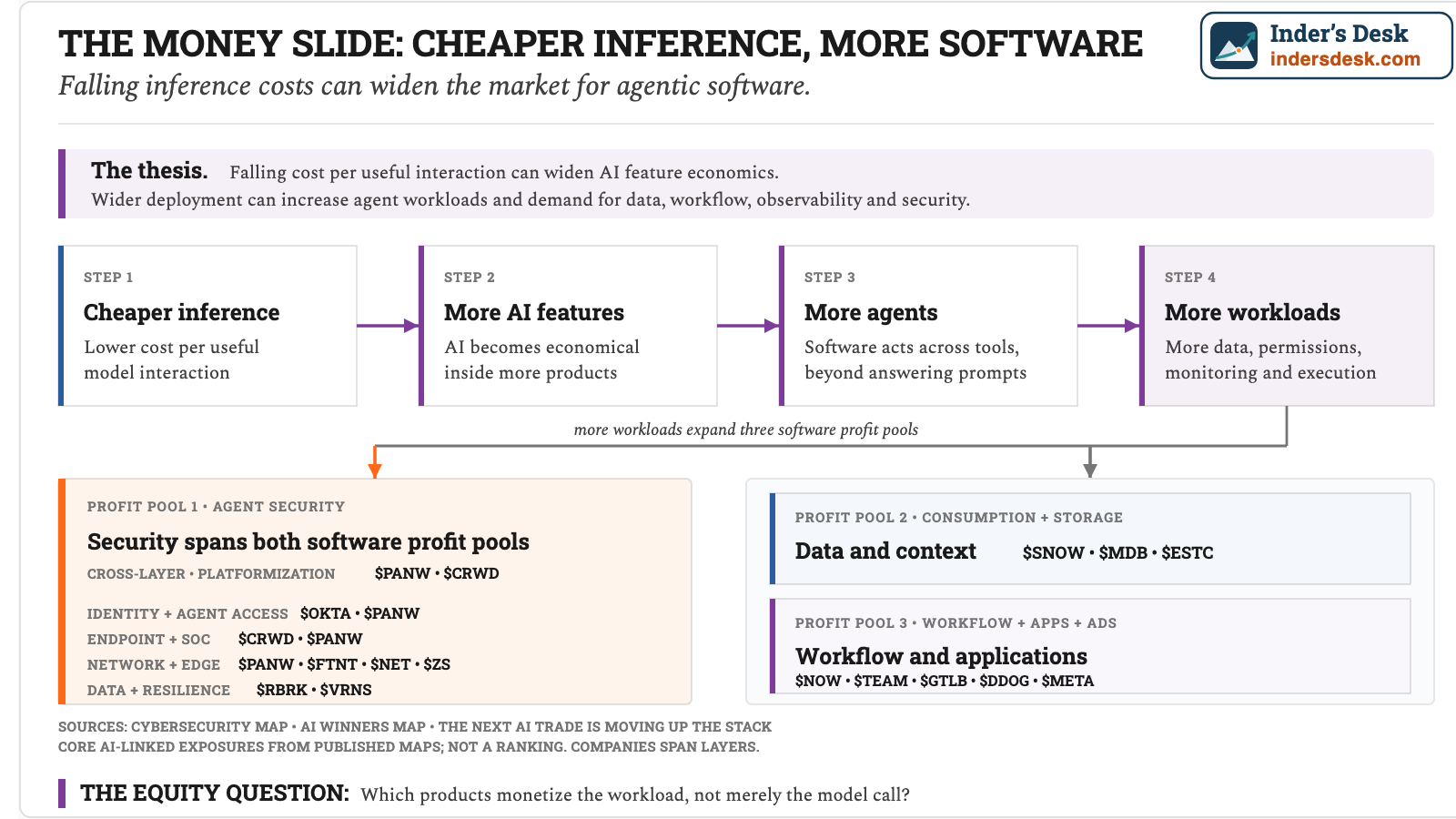
Last week’s Market Signals, The Next AI Trade Is Moving Up the Stack, argued that AI value is broadening into software, workflow and security. This Money Slide shows how that shift can happen:
Cheaper inference → more AI features → more agents → more workloads.
Lower cost per useful model interaction can make AI economical inside more products. As software moves from answering prompts to taking actions across tools, each agent needs context, permissions, monitoring and control.
That can enlarge three software profit pools.
Security and control
An employee may use several applications during a day. An agent may touch many systems in seconds. The company must decide what the agent can access, what it may do, how its actions are observed and how those actions can be stopped or reversed.
Okta, Palo Alto Networks, CrowdStrike, Fortinet, Cloudflare, Zscaler, Rubrik and Varonis represent selected exposure across identity, endpoint, security operations, network controls and data resilience.
Data and context
Agents need governed business context, not raw model intelligence alone. Snowflake, MongoDB and Elastic can participate when more AI workloads increase data consumption, retrieval, search and storage.
The opportunity is real only if the vendor monetizes that usage faster than infrastructure cost and commoditization consume it.
Workflows and applications
ServiceNow, Atlassian, GitLab, Datadog and Meta represent different ways to monetize the work created above the model layer. Some own enterprise workflows. Some manage software development or observability. Some distribute AI features across enormous existing product surfaces.
The equity question changes as we move up the stack:
Which products monetize the workload, not merely the model call?
The model provider can earn money each time intelligence is invoked. The application and control layers may earn money from the larger business process around that invocation. If inference continues to get cheaper, the second pool can expand even while the price of the underlying model call falls.

The Technicals
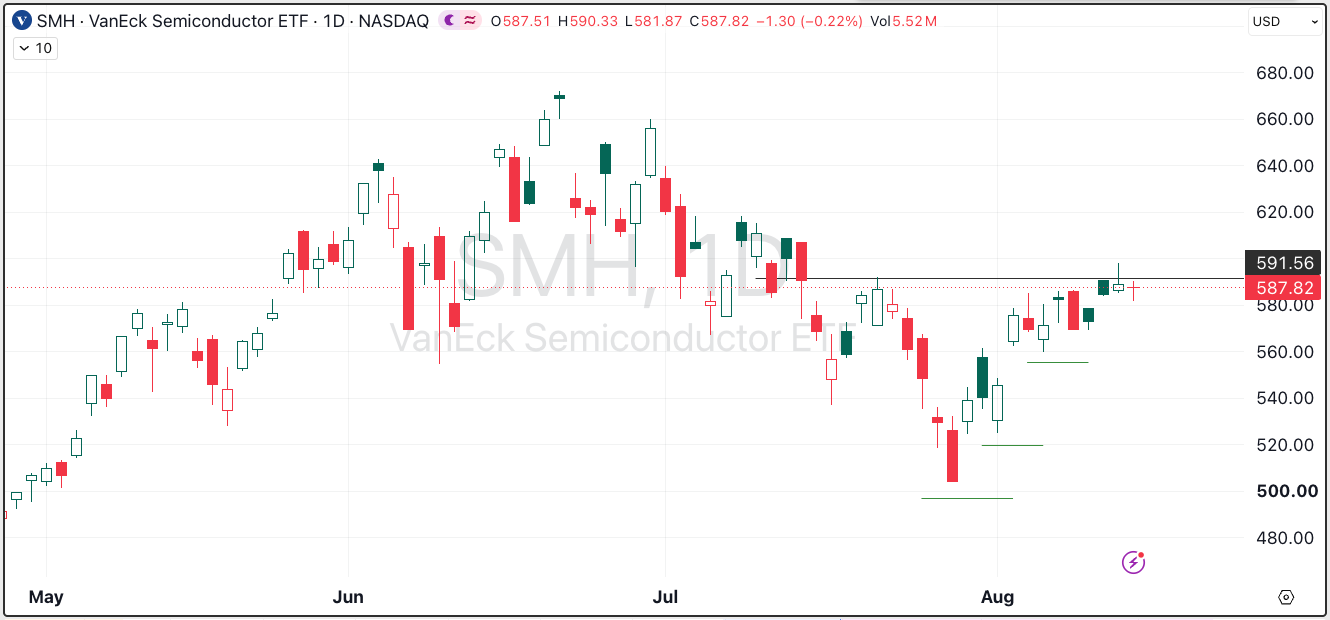
Technicals must confirm the fundamentals. Since the July 29 bottom, SMH has established two higher lows over the past two weeks.
A close above 592 would clear the previous high. It would provide stronger confirmation that the rally is regaining momentum.
Follow the Factory
The buildout starts with customer demand and ends with intelligence delivered to a user. Everything between those points is the AI Factory.
Demand reserves capacity. Capital builds it. Power energizes it. Silicon computes. Networks deliver. Software monetizes.
Half a trillion dollars of proposed financing and old jet engines pressed back into service point to the same reality. The AI trade is becoming an industrial buildout.
Only 9% of the disclosed capacity in our sample is operating today. If the pipeline arrives, the AI Factory is still near the beginning of its journey.
Follow the factory. That is where the money is going.
Sources and methodology
SEC filing discussing refurbished aeroderivative engines for AI data-center power
The 4,754.5-megawatt AI-factory figure is a selected evidence-set subtotal, not total U.S. capacity.
Disclaimer:
This article is for informational and educational purposes only and does not constitute financial, investment, tax, or legal advice. Any opinions, scenarios, price targets, or market observations reflect my personal views and may change without notice. Investing and trading involve substantial risk, including the possible loss of principal. You are solely responsible for your own investment decisions, position sizing, risk management, and trades. Conduct your own research and consult a qualified professional where appropriate.


