



1. The Expensive Space Heater
Picture the AI factory: warehouse floors stacked with racks, the fridge-sized cabinets that each hold dozens of GPUs wired together so tightly that software treats a whole cabinet as one giant chip. A GPU that can’t talk to the other 99,999 GPUs on that floor is just an expensive space heater.
That wiring problem, at every scale from inside one cabinet to between cities, is what this primer maps. You do not need to be a network engineer to invest in AI infrastructure. You need to understand how AI traffic moves, where it encounters bottlenecks, and which companies get paid to remove them.
2. Why the Bottleneck Keeps Growing
A chatbot answers a question and goes idle. An autonomous agent behaves more like an employee who never logs off: it looks things up, calls tools, checks its work, coordinates with other agents, and generates output around the clock. That is why cheaper inference does not shrink infrastructure demand; it expands usage faster than it cuts unit cost, because cheap tokens make it economical to embed those always-on agents inside more products.
Training networks are built around large, synchronized bursts of traffic. Agents add a more continuous stream as they retrieve data, call tools, preserve context and coordinate with other agents. GPUs create the intelligence. The network determines how efficiently that intelligence reaches users. The network stops being plumbing and becomes a bottleneck, attracting a rising share of hyperscaler capital spending.
This remains the “other AI trade”: equipment suppliers that can benefit across multiple models and accelerator architectures.
Distance determines the technology. The technology determines who gets paid.
Copper carries data across the shortest distances. Optical fiber connects racks across a data hall. Coherent optics connects separate buildings and cities. Almost every company in this primer gets paid at one of those boundaries.
3. The Four Networks Inside the AI Factory
“AI networking” is not one market. An AI cluster uses four distinct networks, each with different technology, economics and suppliers.
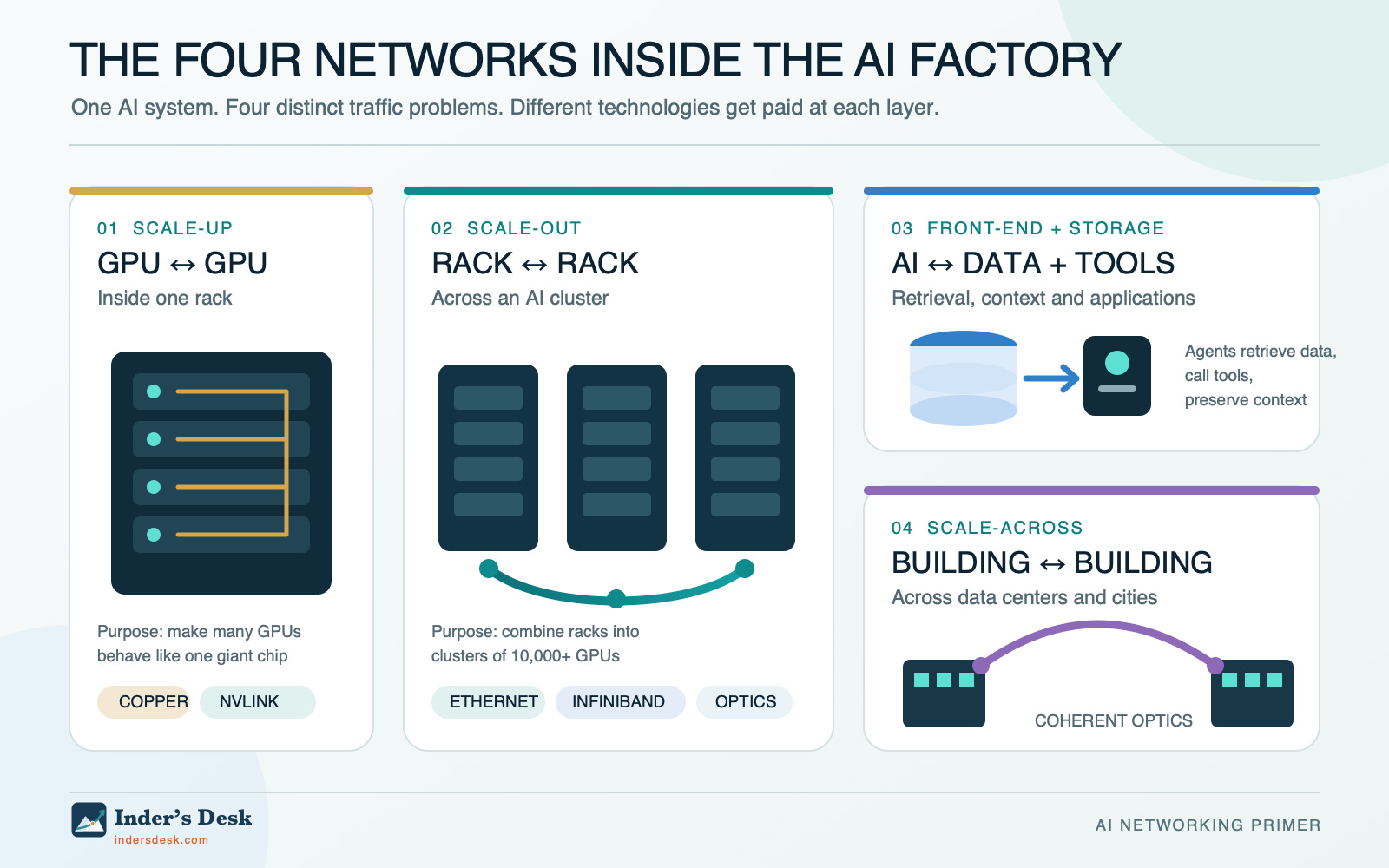
Scale-up, inside the rack: Connects GPUs so they can work as one large system. It requires the highest bandwidth and lowest latency, making NVIDIA’s NVLink one of its strongest competitive advantages. These short connections primarily use copper.
Scale-out, rack to rack: Connects individual racks into clusters containing tens of thousands of GPUs. This is the main battleground between NVIDIA’s InfiniBand and the more open, multi-vendor Ethernet ecosystem.
Front-end and storage: Connects AI systems to data, applications and tools. Agents use this network continuously as they retrieve information, load context and take actions. That creates steadier traffic and benefits vendors supplying standard Ethernet switches and network-interface cards.
Scale-across, data center to data center: Connects separate facilities when one location reaches its power limit. Coherent optics allows multiple buildings, or even distant data centers, to operate as one larger AI system.
NVIDIA appears in several layers deliberately. It sells the GPUs and many of the cables, network cards and switches connecting them.
Why Agents Change the Front-End and Storage Network
Training jobs typically touch storage in bursts: load the data, save a checkpoint and repeat. Agents retrieve information, call tools and load context throughout the day. That turns a previously less important Ethernet layer into a source of continuous production traffic. It is less differentiated than the back-end network, but it is no longer ignorable.
4. Distance Determines the Technology
Why do different physical connections win in different parts of the system? One tradeoff governs everything: the faster you push a signal, the shorter the distance it survives. Each time signaling speed doubles, the distance copper can carry a clean signal roughly halves. At today’s speeds, a plain copper wire reaches about one meter; a “boosted” copper cable with retimer chips (small chips that clean up and re-strengthen the signal) reaches about 2.5–3 meters.
Beyond that, you must convert to light and pay for optics. Copper is cheaper, more reliable, and uses far less power, so architects use it everywhere it physically works, which is almost exactly the inside-of-one-rack regime. That reach cliff is why the copper/optics boundary exists and why it is monetizable.
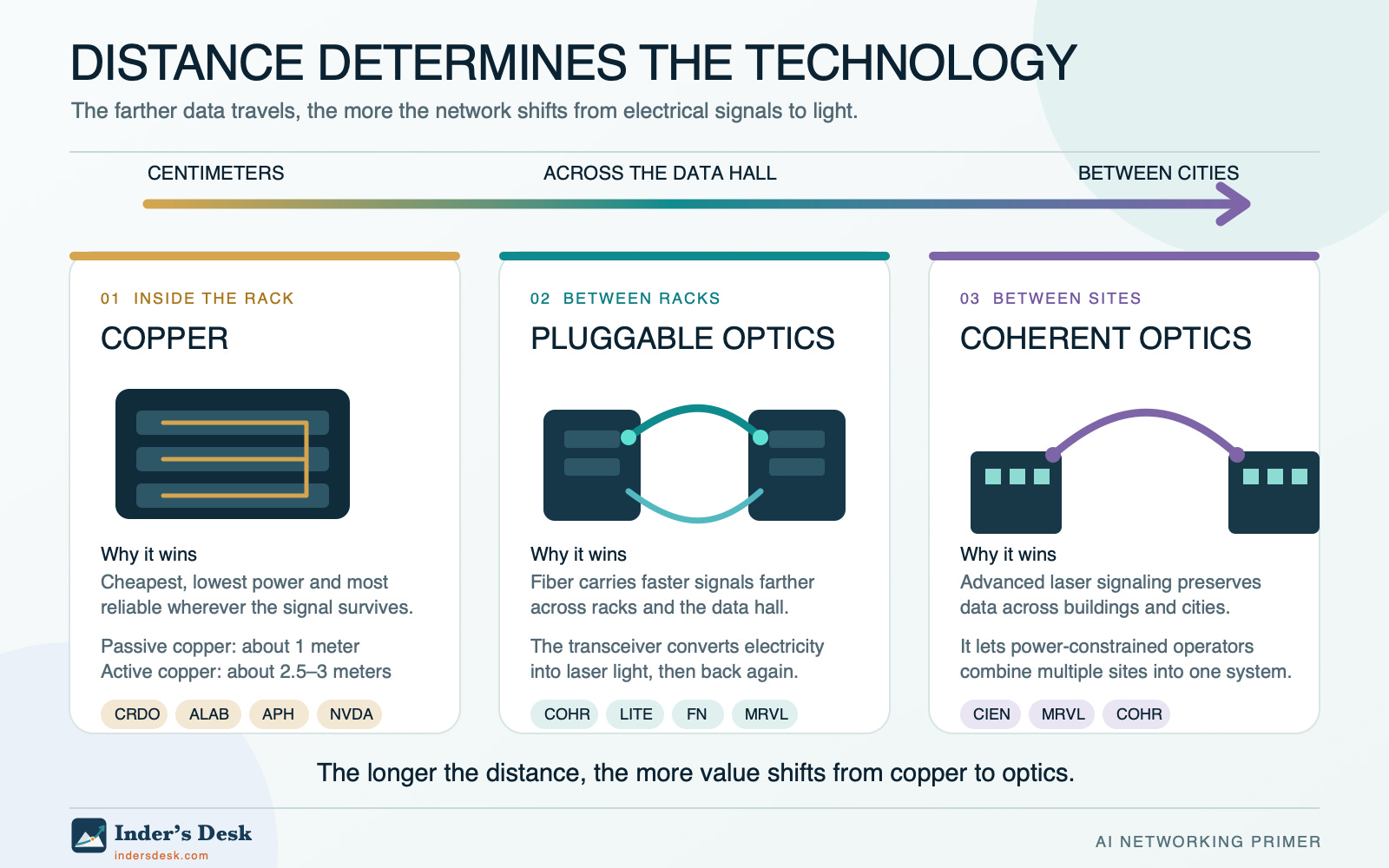
NVIDIA proves the principle: the GB200 NVL72 scale-up spine is ~5,000 copper NVLink cables, about two miles of wire inside one cabinet, with no optics inside the rack. NVIDIA chose copper because in-rack optics at these speeds are less reliable, more power-hungry, and would have added tens of kilowatts per rack. Copper-in-rack is a deliberate architecture, not a legacy holdover.
5. Optics: AI’s Most Direct Networking Opportunity
Optics has the clearest direct leverage to AI cluster growth. Each GPU added to a large cluster requires multiple high-speed optical connections, so more GPUs mean more transceivers. The industry is also moving from 800G to 1.6T, doubling bandwidth while increasing the value of each connection. Agentic inference adds another driver by keeping those networks active throughout the day.
What Gets Paid Now: Transceivers, Lasers and DSPs
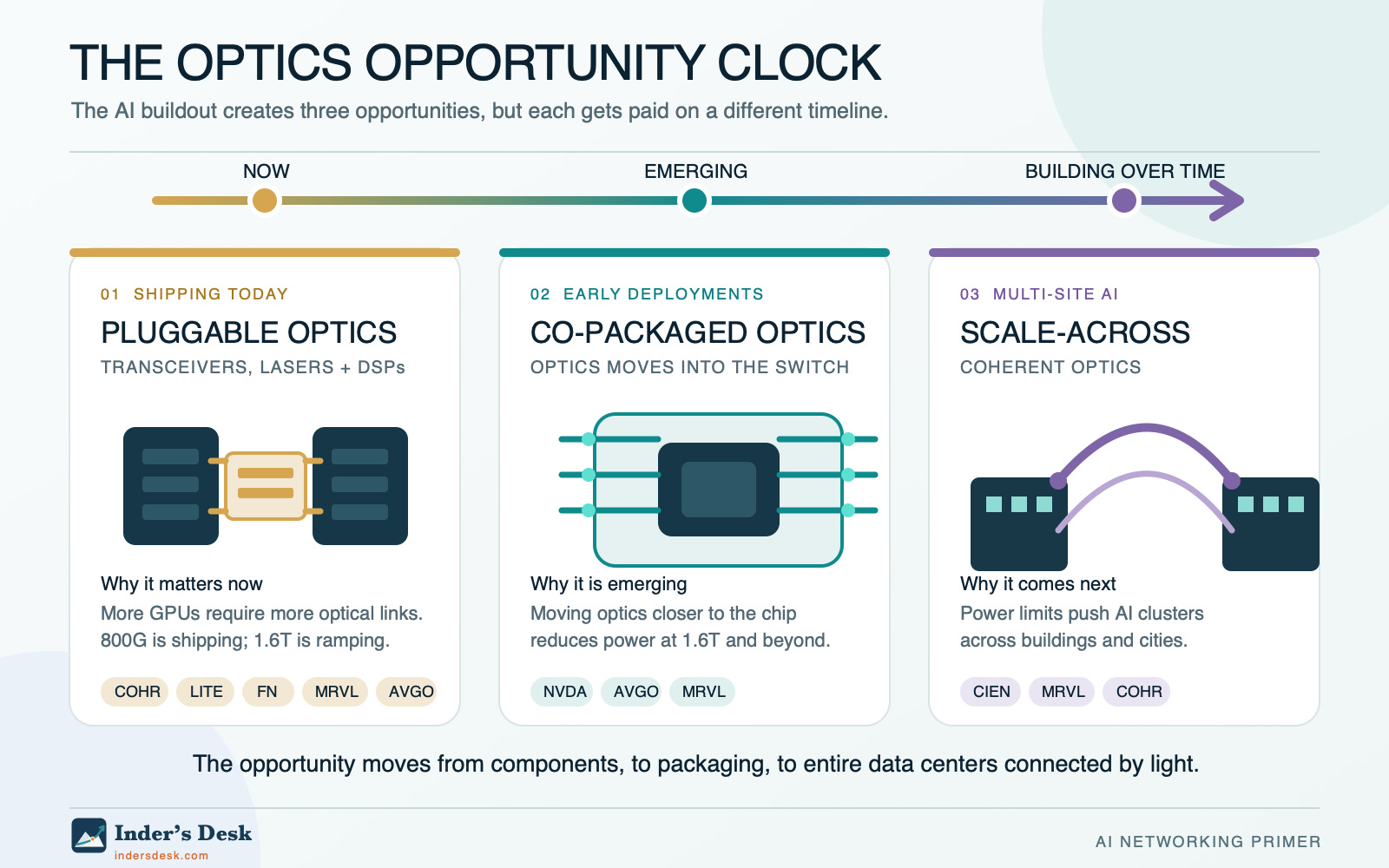
Transceivers and lasers (now). Transceivers are the thumb-sized plugs that convert a switch’s electrical signals into laser light on fiber. 800G is today’s workhorse; 1.6T is ramping in 2026. Attach rate is topology-dependent, cited anywhere from ~2.5 to ~9 transceivers per GPU, so treat it as a range, not a constant.
Coherent COHR 0.00%↑ is the top Western vendor, differentiated by owning its own laser fab (it makes its own laser chips rather than buying them, the best position for 1.6T supply security). Lumentum LITE 0.00%↑ is more a laser/chip + module play. Fabrinet FN 0.00%↑ is the contract assembler for NVIDIA/Cisco/Coherent, but customer-concentrated. China’s Innolight (#1) and Eoptolink (#2) dominate units.
The real bottleneck is the laser, not the module: the 200G/lane EML (the tiny laser chip that actually flashes the data onto the fiber) gates 1.6T supply; capacity sits with Lumentum, Coherent, Sumitomo, Mitsubishi. That’s the durable-margin choke point; module assembly commoditizes.
Optical DSPs (now). The DSP (digital signal processor) cleans up and re-times the signal inside each transceiver. Marvell is #1, Broadcom #2, together the large majority of the merchant market. Marvell shipped the first 1.6T DSPs, and NVIDIA invested $2B in Marvell (March 2026) alongside an NVLink Fusion partnership and silicon-photonics collaboration. The threat is LPO, a design that skips the DSP to save power; real but bounded, consensus is it takes a slice of short-reach 800G links, not a wholesale replacement (mechanics in the Technical Appendix). The DSP vendors are hedged: they also sell SerDes and are building CPO.
What Is Emerging: Co-Packaged Optics
Co-packaged optics (emerging). CPO builds the fiber-optic connection directly into the switch-chip package instead of snapping a plug into the faceplate, cutting interconnect power at 1.6T and beyond; NVIDIA and Broadcom both have platforms (packaging details in the Technical Appendix).
NVIDIA’s Spectrum-X Ethernet Photonics approaches commercial availability in the second half of 2026 with named early-adopter deployments, and NVIDIA cites 5x higher power efficiency and 10x improved mean time between incidents versus pluggable designs.
The honest read: 2026 brings commercial availability and early adopters, not the 2027+ non-event our first edition implied, but also not displacement. Pluggables remain the large majority of switch ports near-term; the transceiver boom is not being disrupted this cycle, but the timing cushion for COHR/LITE/FN is thinner than it looked in July. Watch CPO port attach, not press releases.
Adjacent land grab: Marvell is acquiring Celestial AI for ~$3.25B (announced Dec 2025) to push optics into the scale-up domain; startups Ayar Labs ($500M Series E led with AMD/NVIDIA, joined NVLink Fusion) and Lightmatter are the private optical-I/O plays.
What Comes Next: Scale-Across and Coherent Optics
Scale-across and coherent optics (building over time). Coherent optics encodes data in the phase and amplitude of laser light so it survives hundreds of kilometers of fiber, the same core technology behind undersea cables. The demand driver: single sites are hitting power ceilings, so operators stitch multiple datacenters into one logical training-and-inference fabric. NVIDIA’s Spectrum-XGS connects facilities separated by hundreds of kilometers, automatically adjusting congestion thresholds to the actual inter-datacenter distance, and claims 1.9x cross-datacenter performance; Spectrum-6 (announced July 21, 2026) is pitched explicitly at “gigascale AI factories.” The AI factory is becoming a multi-building system by design. Dell’Oro now says high-end router demand is “increasingly influenced by datacenter connectivity, less by telecom.” Ciena (CIEN) is the pure-play (Q2 FY26 revenue +40% YoY); Nokia (via Infinera) and Marvell’s coherent DSP also participate. Coherent-pluggable demand is “outstripping supply.”
Optics explains how the data moves. The next two sections explain who controls the network carrying it.
6. Inside the Rack: NVIDIA vs the Open Ecosystem
Scale-up is the hardest networking layer to disrupt because the GPUs must communicate with exceptionally high bandwidth and almost no delay. NVIDIA owns this layer today.
NVIDIA’s Moat: NVLink
NVLink (proprietary, shipping, dominant): 1.8 TB/s per GPU today, 3.6 on the roadmap. NVLink Fusion is NVIDIA’s offensive move, licensing the interconnect so third-party CPUs and custom chips plug into its fabric, co-opting would-be defectors rather than losing them.
AMD and the Open Ecosystem: UALink
AMD AMD 0.00%↑ and the open ecosystem are chasing NVIDIA inside the rack. UALink is their open alternative to NVLink, designed to connect accelerators so they operate as one large system. It has broad industry support, but NVIDIA’s faster, already-shipping ecosystem remains well ahead. AMD is the clearest public challenger, while Astera Labs supplies connectivity across several competing architectures.
Arista Enters With Broadcom
Arista ANET 0.00%↑ is entering the rack-scale market with Broadcom. Its new 7060XE7 switches use Broadcom’s Tomahawk 6 silicon and support both inside-the-rack scale-up and rack-to-rack scale-out networking. The first model ships in Q4 2026, followed by higher-density systems in Q1 2027. Until now, Arista competed mainly in scale-out. This gives Broadcom and Arista a direct route into territory dominated by NVIDIA.
Who Gets Paid Inside the Rack
Credo CRDO 0.00%↑ : the pure-play in AECs (active electrical cables: copper cables with signal-boosting chips built into each end). Explosive growth, revenue +206% (FY26), +157% last quarter, >80% growth guided. The catch: extreme customer concentration (one customer ~67% of FY25 revenue; top-10 ~90%). A single hyperscaler program pause is a cliff.
Astera Labs ALAB 0.00%↑ : in plain terms, the signal-booster chips that let copper run farther, spanning PCIe/CXL/Ethernet (the standard links servers use to attach accelerators and memory), plus Scorpio fabric switches. Its structural hedge: Astera is positioned across several competing scale-up standards, including PCIe, CXL, Ethernet, NVLink Fusion, and UALink.
Amphenol APH 0.00%↑ : the diversified giant in connectors, copper cable, and backplanes; the plugs and sockets everything else snaps into. IT Datacom is ~41% of sales and grew +81% organically. Lowest single-name AI risk of the copper trio.
7. Between Racks: InfiniBand vs Ethernet
The scale-out network is where the biggest protocol fight in AI networking is playing out. InfiniBand is NVIDIA’s proprietary, tightly integrated network, while Ethernet is the open standard supported by a broader group of chipmakers, equipment vendors and cloud companies. The investment question is whether customers continue paying for NVIDIA’s complete system or shift more spending toward the multi-vendor Ethernet ecosystem.
InfiniBand: NVIDIA’s Integrated System
InfiniBand is engineered to move data with extremely low delay and without dropping packets. It won the first generation of AI clusters because NVIDIA could sell customers a complete system that worked out of the box. NVIDIA remains the only major commercial supplier.
Ethernet Becomes a Production AI Fabric
Ethernet was built as the open, multi-vendor standard for everyday networking. It has now been redesigned for AI and is carrying production workloads across some of the world’s largest GPU clusters. The Ultra Ethernet Consortium and production protocols such as MRC are helping open Ethernet perform work once reserved for InfiniBand.
Who gets paid: Broadcom supplies the switch chips, Arista sells the finished systems, Cisco is the incumbent trying to catch up, and NVIDIA profits from both InfiniBand and its own Ethernet product, Spectrum-X. NVIDIA is effectively fighting on both sides of its own war.
The Evidence Ethernet Is Gaining
Datacenter Ethernet-switch revenue grew 61% in Q1 2026 to more than $10 billion. The fastest 800G equipment represented 36% of switch sales, ten times its level a year earlier. NVIDIA became the largest datacenter-Ethernet vendor at $2.1 billion, narrowly ahead of Arista at $2.07 billion and Cisco at $1.78 billion.
Ethernet now represents roughly two-thirds of AI back-end switch revenue. InfiniBand represents the remaining third, and its sales more than tripled during the quarter as NVIDIA’s integrated systems grew. This is not a winner-take-all transition. Ethernet is gaining share, but both markets are expanding.
Why Ethernet Keeps Gaining
Broadcom makes high-end switch silicon available to multiple equipment vendors, reducing dependence on one supplier. Some Ethernet designs can also reach cluster scale with fewer layers of switches and fewer optical transceivers. Most importantly, the hyperscalers want credible alternatives to NVIDIA’s proprietary networking stack.
8. The Company Map
The technology map now becomes an investment map. The companies below sell different parts of the same system.
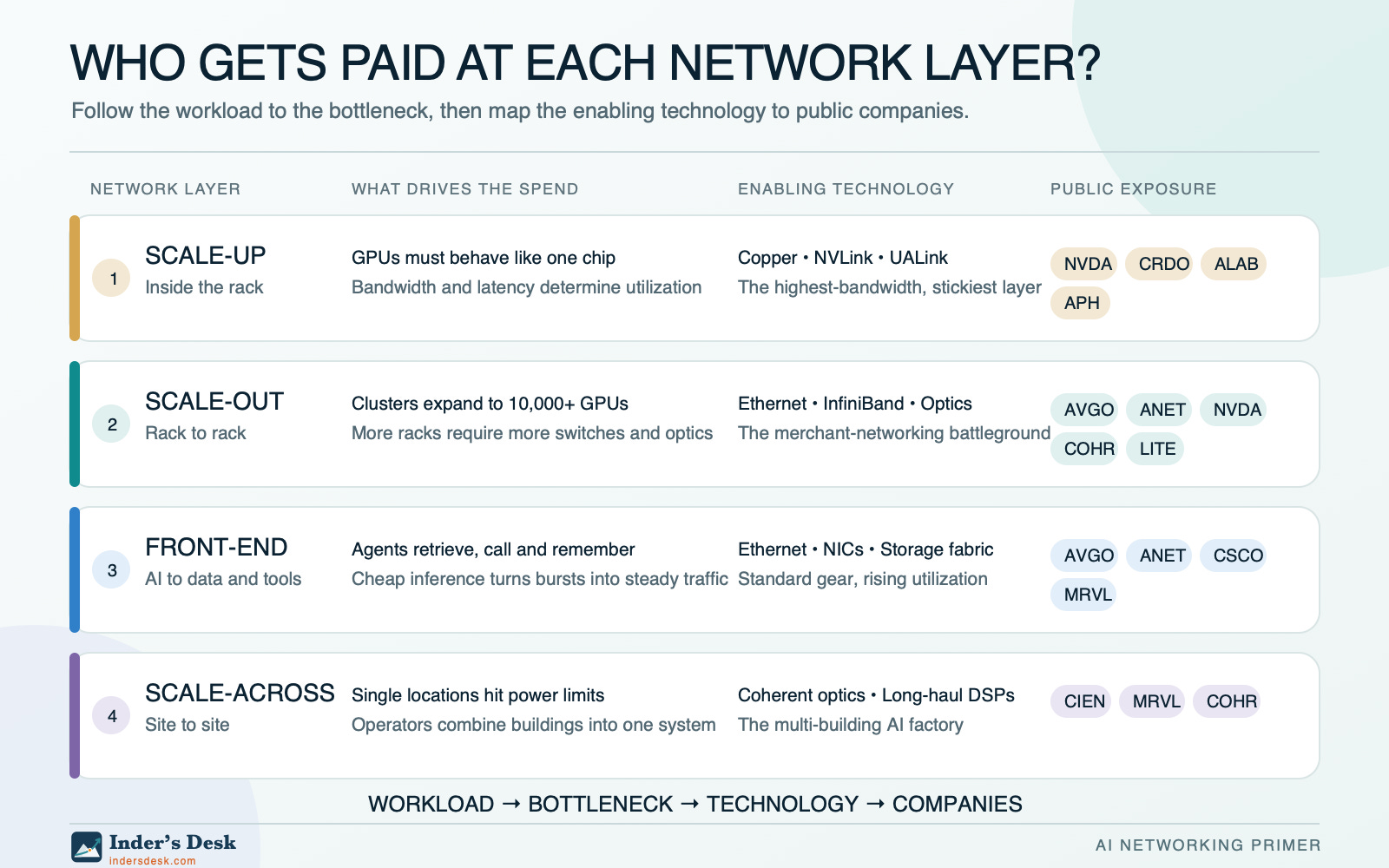
Broadcom AVGO 0.00%↑ : Supplies the chips inside most non-NVIDIA switches and designs custom AI chips for cloud companies.
NVIDIA NVDA 0.00%↑ : Sells the GPUs and many of the network cards, cables and switches connecting them.
Marvell MRVL 0.00%↑ : Makes signal-processing chips inside optical transceivers and participates in custom silicon, coherent optics and emerging scale-up optics.
Arista ANET 0.00%↑ : Builds finished Ethernet switches and the software used to operate them. It is now entering scale-up.
Cisco CSCO 0.00%↑ : The incumbent networking giant, using Silicon One and faster Ethernet products to pursue the AI buildout.
Coherent COHR 0.00%↑ : Makes optical transceivers and the laser chips inside them.
Lumentum LITE 0.00%↑ : Supplies lasers, optical chips and modules.
Fabrinet FN 0.00%↑ : Assembles optical products for companies including NVIDIA, Cisco and Coherent.
Credo CRDO 0.00%↑ : Makes active electrical cables that extend copper connections over short distances.
Astera Labs ALAB 0.00%↑ : Makes signal-boosting chips and fabric switches across several competing interconnect standards.
Amphenol APH 0.00%↑ : Makes the connectors, sockets and copper cables used throughout the system.
Ciena CIEN 0.00%↑ : Builds coherent optical equipment connecting separate data centers.
Celestica CLS 0.00%↑ : Manufactures unbranded switches and servers designed by hyperscalers.
How I Rank the Opportunities
Best combination of growth and durability: Broadcom and Arista. Switch chips and finished systems benefit from AI growth without depending on one optical or protocol transition.
Most direct optical exposure: Coherent and Lumentum. The modules may become more standardized, but constrained laser supply can preserve margins.
Highest upside and fragility: Credo and Astera Labs. Their growth can be explosive, but customer concentration creates sharp two-way risk.
Lower-risk optionality: Cisco and Ciena. Both participate in AI networking while retaining more diversified businesses.
Most valuation-sensitive: Celestica and the concentrated component suppliers. These businesses have less protection if AI spending or investor sentiment slows.
Market context: Optical transport was approximately a $16 billion market in 2025 and grew 16%. High-end routing and aggregation switching could reach about $19 billion by 2030, while datacenter physical infrastructure spending recently grew 28% year over year.
9. What Could Go Wrong
NVIDIA could keep more of the stack. Its combination of GPUs, NVLink, InfiniBand, Spectrum-X and ConnectX remains the most integrated system. The open merchant ecosystem is credible, but the outcome is not settled.
The agent-traffic thesis could disappoint. If autonomous-agent adoption develops more slowly, the utilization argument for front-end, storage and scale-across weakens first. The training-network thesis would still stand.
Customer concentration is extreme. Credo, Arista, Fabrinet, Astera Labs and Celestica depend heavily on a small number of hyperscalers. One delayed program can materially change growth.
White-box equipment could pressure branded vendors. Hyperscalers can combine Broadcom chips, open software and contract manufacturers to build their own switches, reducing the share available to Arista and Cisco.
Co-packaged optics could arrive faster than expected. A rapid transition would shorten the current growth window for pluggable-transceiver suppliers.
Hyperscaler spending could eventually pause. Current results suggest demand is still outrunning supply, but any digestion cycle would hit the most concentrated component suppliers first.
10. Investor Takeaway
Networking is the “other AI trade”: equipment suppliers can benefit across several models, cloud platforms and accelerator architectures. The entire system can be understood through one rule: distance determines the technology, and the technology determines who gets paid.
Optics has the most direct leverage to expanding GPU clusters and the transition from 800G to 1.6T. Broadcom and Arista offer a more durable combination of switch-silicon and systems exposure. Credo and Astera Labs offer greater upside sensitivity, but also much greater customer-concentration risk.
NVIDIA still controls the most valuable proprietary layers. Ethernet is becoming a production AI fabric, UALink is organizing the open challenge inside the rack, and Arista is entering scale-up with Broadcom. These are credible competitive moves, not completed victories.
What I Am Watching
The Ethernet-versus-InfiniBand share trend in the back-end network.
The adoption of co-packaged optics through the second half of 2026.
Whether hyperscaler capital-spending guidance continues rising.
Whether autonomous agents create the continuous production traffic the thesis assumes.
Technical Appendix: The AI Network by Layer
The appendix is organized around the four networks so each technical term has a clear place in the system.
Shared Foundation
SerDes and PAM4. SerDes (serializer/deserializer) circuits convert data so it can move rapidly on and off chips and between systems; they are the speed-limiting step in any switch. PAM4 is the signaling scheme modern links use to pack more bits into each electrical or optical pulse. As clusters grow, faster SerDes becomes essential, benefiting Broadcom, Marvell, Credo, and Astera Labs. The physics tradeoff: each doubling of SerDes speed roughly halves copper reach, which is what creates the copper/optics boundary in §4 (at 224G/lane: passive copper ~1m, active copper ~2.5–3m). Arista’s 7060XE7 runs 224G SerDes on Broadcom Tomahawk 6.
Scale-Up: Inside the Rack
UALink’s four specifications (April 7, 2026). Board backers on the release: Alibaba, AMD, Apple, Astera Labs, AWS, Cisco, Google, HPE, Intel, Meta, Microsoft, Synopsys. The Common Specification 2.0 headline is In-Network Compute (the switch performing parts of the computation), targeting distributed training and inference. Companions: a split-out 200G physical-layer spec (UALink 200G DL/PL 2.0, so the wire-level spec can iterate independently); a Manageability Specification 1.0 (a centralized control and management plane); and a Chiplet Specification 1.0, UCIe 3.0-compliant, for building UALink into chiplet-based processors, ones assembled from several smaller dies instead of one big one.
Scale-Out: Rack to Rack
RDMA, RoCE, and lossless Ethernet. RDMA (remote direct memory access) lets one server read another’s memory directly without waking its CPU, slashing latency; RoCE runs that technique over Ethernet. Combined with congestion control and packet spraying (splitting a message’s packets across many paths at once), this is how the Ultra Ethernet stack makes open, multi-vendor Ethernet behave like a lossless AI fabric.
Ultra Ethernet Consortium specification history. Members include AMD, Arista, Broadcom, Cisco, Meta, Microsoft, and Oracle, among others. Version 1.0 published June 11, 2025; 1.0.1 on September 5, 2025; 1.0.2 on January 28, 2026; 1.0.3, the current recommended version, on July 16, 2026.
MRC (Multipath Reliable Connection). Released May 5, 2026 through the Open Compute Project; co-developed by OpenAI with AMD, Broadcom, Intel, Microsoft, and NVIDIA. It takes the packets of a single transfer and sprays them across hundreds of network paths, detecting and routing around failures on a microsecond timescale. Deployed in production on OpenAI’s GB200 supercomputers at Oracle Cloud Infrastructure (Abilene, Texas) and Microsoft’s Fairwater machines.
Front-End and Storage
NICs and SmartNICs. A network-interface card connects a server to the network. More advanced SmartNICs handle networking and security work that would otherwise consume CPU or GPU capacity.
North-south traffic. This is data moving into and out of the AI cluster, including retrieval, tool calls, application requests and storage access. Agent workloads make this traffic more continuous.
Optics and Scale-Across
LPO (linear-drive pluggable optics). The switch chip’s own SerDes drives the laser directly, removing the transceiver’s DSP and cutting roughly 30–50% of module power. The catch: without the DSP’s signal cleanup, maintaining signal integrity gets hard at 1.6T speeds, which is why consensus confines LPO to a slice of short-reach 800G links rather than a wholesale DSP replacement.
CPO packaging. Co-packaged optics moves the optical engine into the same package as the switch ASIC (the switch’s main chip), eliminating pluggable modules and their DSPs on those ports. NVIDIA builds its version (Quantum-X/Spectrum-X Photonics) on TSMC’s COUPE packaging; Broadcom’s platform is Bailly. Spectrum-6 ships in both pluggable and co-packaged form factors.
Coherent optics. Coherent systems encode more information into laser light so data can travel between buildings, cities and distant data centers without losing signal quality. This is the technology that allows separate facilities to behave like one larger AI system.
For educational purposes only. This is not financial advice. Please do your own research.
Learn more from Inder’s Desk
The Next AI Trade Is Moving Up the Stack
Why cheaper inference and autonomous agents are shifting value beyond the GPU.The Capex Number Nobody Can Call a Peak Anymore
The hyperscaler spending cycle funding the AI infrastructure buildout.Who Is Actually Getting Paid From SpaceX’s AI Buildout?
A real-world example of separating current beneficiaries from future optionality.
Disclaimer:
This article is for informational and educational purposes only and does not constitute financial, investment, tax, or legal advice. Any opinions, scenarios, price targets, or market observations reflect my personal views and may change without notice. Investing and trading involve substantial risk, including the possible loss of principal. You are solely responsible for your own investment decisions, position sizing, risk management, and trades. Conduct your own research and consult a qualified professional where appropriate.


