



"Neocloud" has become shorthand for a much broader AI-infrastructure trade. Strip away the label and three businesses emerge:
AI Infrastructure as a Service
Infrastructure Landlord
Hyperscaler.
Not all of them sell computing. Hyperscalers also sit outside the neocloud category, even as they shape the economics of everyone inside it.
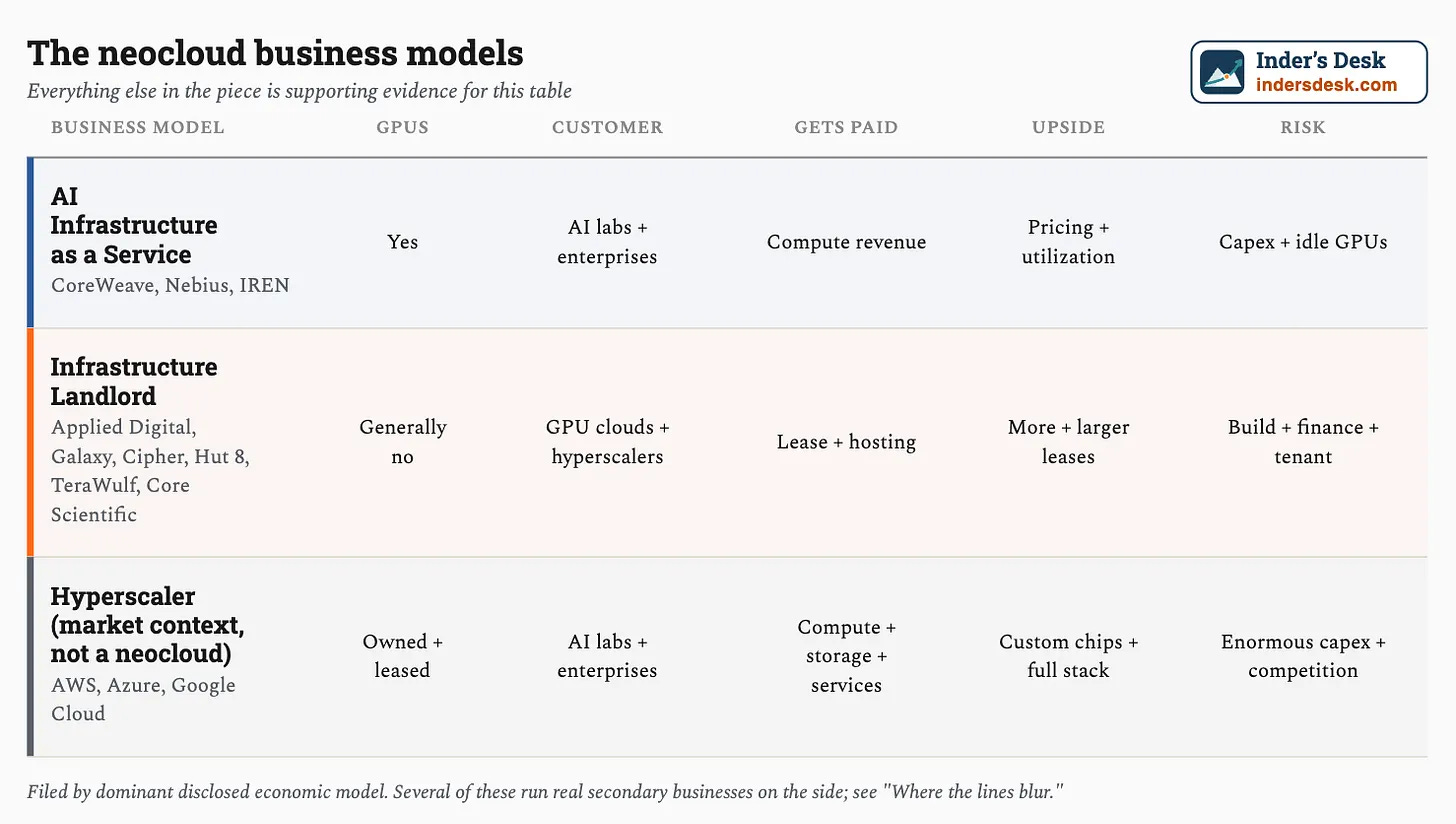
This is not a balance-sheet piece. It is a business-type piece. Who owns the GPUs? Who is the customer? Who gets paid? The table below answers those three questions. Every name below cashes the same "AI infrastructure" narrative check. They just cash it in different currencies. Here is the actual product; everything else in this piece is supporting evidence for this table.
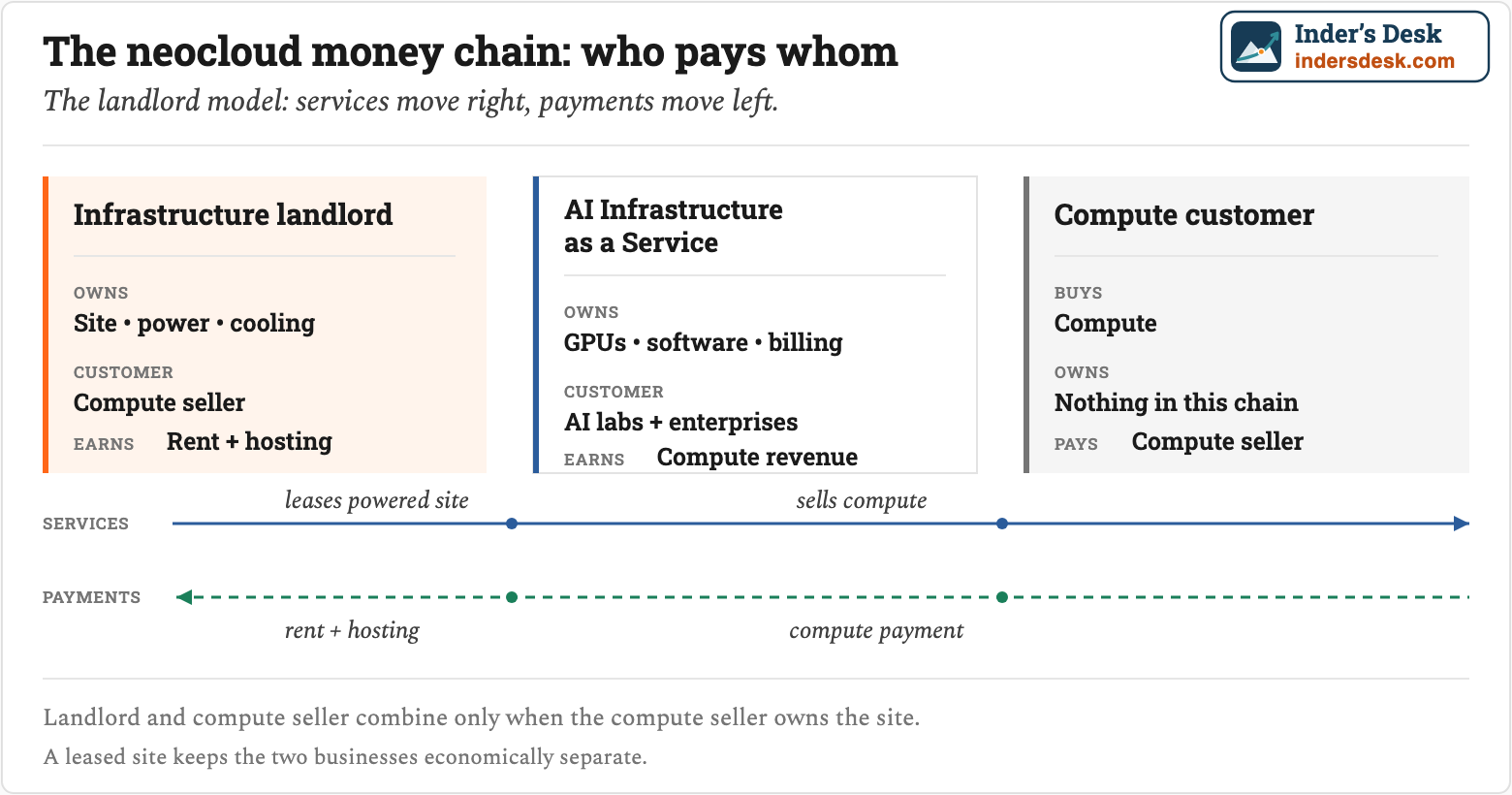
Services move right. Payments move left. Follow that chain to see who owns the customer and where each dollar lands.
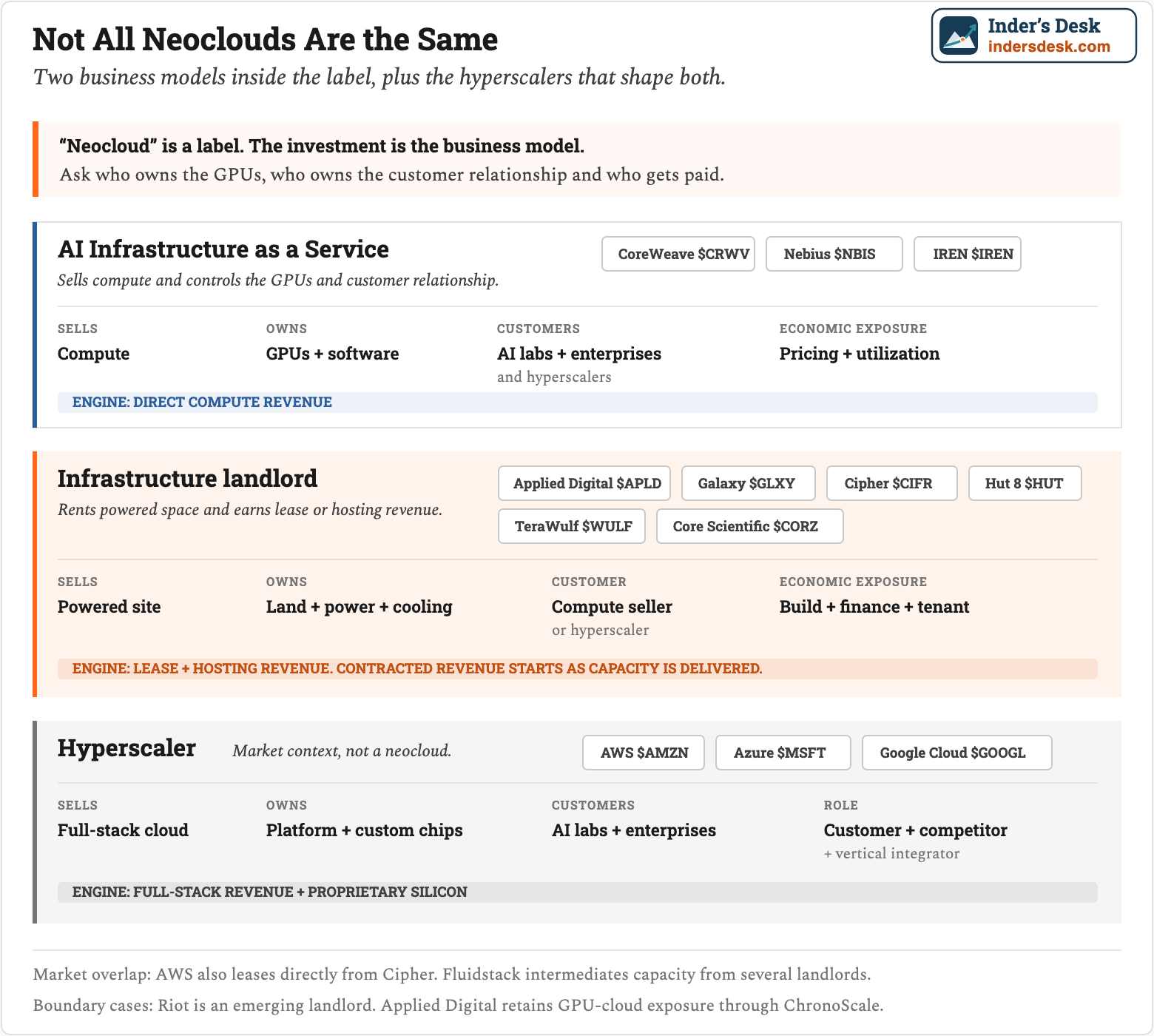
Now place the public companies on that chain: two operating models, plus hyperscalers that shape both.
AI Infrastructure as a Service:
CoreWeave, Nebius, IREN
This is AI Infrastructure as a Service. These companies own or control the GPUs, whether those GPUs are bought, leased, or built. They write their own software and sell computing directly.
That computing can be sold through self-service capacity or through a large dedicated contract. The mechanism does not change the model. Either way, the GPUs and the customer relationship stay with the provider. That is what separates this group from the landlords below.
CoreWeave uses the filing language “The Essential Cloud for AI.” Microsoft, OpenAI, and Meta are its customers, not its landlords. CoreWeave also built its own orchestration software rather than reselling someone else’s. Q2 2026 revenue was $2,575M, up approximately 112% year over year.
Nebius calls itself “the AI cloud company” and says it is building “the full-stack platform.” It goes deeper into the hardware as well, designing its own servers and racks in-house. Q2 2026 revenue was $582.3M, up 454% year over year. The AI cloud made up 98% of the company.
IREN began as a bitcoin miner. That history explains why it owns cheap power and large sites, but it does not describe the company’s current business model. As of its May 2026 quarterly filing, IREN had approximately 150,000 GPUs installed or on order. It has since guided to more than $3.7 billion in targeted year-end AI-cloud ARR, or annualized recurring revenue.
That target covers both a self-service GPU-cloud product and very large dedicated contracts. One is a $9.7B deal giving Microsoft access to GB300 systems, which are NVIDIA Blackwell-generation servers. The agreement runs for five years, and Microsoft will prepay 20%.
IREN also has a separate agreement with NVIDIA itself. That agreement gives NVIDIA five-year investment rights to purchase up to 30 million IREN shares. The exercise price is $70.
Those rights vest in tranches as NVIDIA GPU infrastructure is deployed across IREN’s campuses, with full vesting tied to 600,000 GPUs -- a vesting milestone for the investment rights, not a firm commitment to host 600,000 GPUs at any single site.
Across these arrangements, IREN owns both the GPUs and the facility. It does not hand either one to a tenant in the way the landlords below do.The defining trait across all three names is pricing exposure, not a guaranteed structural advantage. In May, CoreWeave’s CFO said the company is “largely sold out of our 2026 capacity with prices increasing across the board.” That same month, Nebius’s sales chief said, “we just raised prices again in the latest quarter... 4 or more customers competing for every GPU we bring online.”
Both comments describe a real benefit from the current scarcity. Neither establishes a permanent edge. Long-term contracts, customer concentration, and being sold out all limit how quickly higher pricing can keep flowing through.
The engine:sell the computing itself, control the accelerator fleet and own the compute-customer relationship, and carry direct exposure to GPU pricing and utilization.
Infrastructure Landlord
Applied Digital, Galaxy, Cipher, Hut 8, TeraWulf, Core Scientific
This is the powered-shell model. The landlord supplies the building, power, and cooling. It generally does not control the GPU fleet. It generally does not own the end-customer relationship either.
These companies come from the bitcoin-mining and crypto-infrastructure world. They are repositioning that footprint as long-term leased AI capacity. The revenue comes from leases and hosting, not from selling computing directly.
One standardization note before the figures: every megawatt below is labeled gross power or critical IT load explicitly, using each company’s own disclosed terminology. Applied Digital, Galaxy, and Cipher state this distinction directly. Hut 8 discloses “IT capacity.” TeraWulf discloses “critical IT load,” while Core Scientific discloses “net critical IT capacity.” All six companies label their figures, but they do not all use identical wording.
Applied Digital: As of June 8, 2026, its contracted portfolio covers five AI Factory campuses. Together, those campuses represent 1.4 gigawatts of critical IT load. That corresponds to approximately 2.15 gigawatts of gross grid-connected utility power.
The portfolio represents approximately $36 billion in total contracted base-term lease revenue. Roughly 70% of that revenue is backed by U.S.-based investment-grade hyperscalers.
The newest lease covers 210 megawatts of critical IT load at a fifth campus. It uses a 15-year take-or-pay structure, meaning the tenant pays whether it uses the capacity or not.
That provision is confirmed for this lease specifically. We have not independently verified take-or-pay terms lease by lease across the other four campuses. Treat take-or-pay as established for the newest lease, not for the entire $36B portfolio.
Separately, Applied Digital completed a corporate separation of its cloud-compute business in May 2026. That business became ChronoScale Corporation (Nasdaq: CHRN). Applied Digital retained approximately 97% ownership -- see “Where the lines blur” below.Galaxy: Its Helios campus in West Texas was built out from a bitcoin-mining site acquired in December 2022. The campus delivered its first phase to CoreWeave under a 15-year lease. CoreWeave has committed to 526 megawatts of critical IT load there.
Galaxy’s own guidance says the arrangement should average more than $1B a year. It anticipates an average lease-level EBITDA margin near 90% -- a margin figure, distinct from NOI, or net operating income, and from a gross-yield-on-cost figure.Cipher: Cipher has approximately 700 megawatts of gross contracted HPC capacity across three leases. Those leases represent 454 megawatts of critical IT load.
The AWS lease at Black Pearl covers 300 MW gross and 216 MW of critical IT load. The Fluidstack-Google lease at Barber Lake covers another 300 MW gross and 168 MW of critical IT load.
A newer AWS lease at Stingray covers 100 MW gross and 70 MW of critical IT load. That lease represents approximately $2.0B of contracted revenue over a term of more than 15 years. Cipher’s own disclosures label each figure as gross or critical IT explicitly.Hut 8: Hut 8 has a 15-year Fluidstack lease at its River Bend campus. The lease covers 245 megawatts of IT capacity, per Hut 8’s own disclosure. It is backed by Google and has a total contract value of $7.0B. Fluidstack also has a first offer on more than 1,000 megawatts beyond that.
TeraWulf: TeraWulf has approximately 438 megawatts of critical IT load contracted at its Lake Mariner campus. Of that total, 60 MW is with Core42. Approximately 378 MW is with Fluidstack, which is backed by Google.
TeraWulf also has a new 20-year lease with Anthropic at its Justified Data campus. That lease covers 401 megawatts of critical IT load. It is expected to generate approximately $19 billion of contracted revenue over the initial term.
In July 2026, TeraWulf agreed to sell its 50.1% interest in the 168-megawatt Abernathy joint venture. The buyer was an investor group led by TeraWulf’s partner, Fluidstack. The sale monetized TeraWulf’s roughly $450 million investment.Core Scientific: CoreWeave’s commitment to Core Scientific now totals approximately 590 megawatts of net critical IT capacity across five data-center sites. That is Core Scientific’s own disclosed label. Approximately 900 megawatts of gross grid capacity has been secured for the same projects.
The commitment is an expansion of the original 16-megawatt Austin contract the companies signed in February 2024. Projected revenue over the 12-year term is more than $10 billion.
Note the chain. Core Scientific hosts CoreWeave. CoreWeave then serves Microsoft and OpenAI. Core Scientific is two steps removed from the actual AI customer.
Contracted revenue is not the same as operating revenue. The figures above describe revenue expected once the relevant facilities are delivering power. They do not describe what these companies are earning today.
Before rent starts, each facility still has to be financed, built, and energized. It also depends on a grid-connection timeline that the landlord does not fully control. A signed lease is real, but it is a claim on future cash flow, not current cash flow. Construction delays, financing costs, and interconnection queues all stand between the contract and the first rent check.
The engine:lease and hosting revenue. The landlord controls the physical infrastructure but generally does not control the accelerator fleet, sell compute, or participate directly in downstream compute pricing. Construction and financing risk sit between signing and the first dollar of rent.
Hyperscalers
AWS, Azure, Google Cloud
Hyperscalers control the cloud platform and the customer relationship. Their infrastructure combines owned and leased facilities, purchased NVIDIA GPUs, and internally designed accelerators. Those accelerators include AWS’s Trainium, Google’s TPU, and Microsoft’s Maia.
This gives hyperscalers a lever nobody else in this stack has. When NVIDIA capacity is expensive, they can steer suitable workloads onto proprietary silicon.
Hyperscalers appear on this map in three roles at once. First, they are customers of the landlords. AWS leases 300 megawatts directly from Cipher at Black Pearl. It leases another 100 megawatts at Stingray.
Second, hyperscalers are competitors of the AI Infrastructure as a Service providers. They sell the same AI computing that CoreWeave and Nebius sell. Third, they are vertical integrators because they have their own custom chips.
Fluidstack adds another layer to the picture. It is a Google-backed GPU cloud that leases capacity from Hut 8, TeraWulf, and Cipher, then rents that capacity onward. Google itself is not the contractual tenant on those specific leases. Fluidstack is.
Why the model is the whole ballgame
The business model decides four things. That is why the map matters:
What revenue you capture. The AI Infrastructure as a Service model sells the computing itself and carries pricing exposure. CoreWeave and Nebius both described tightening prices this spring, on the record.
The Infrastructure Landlord model is different. Its economics are substantially set by the contract. Galaxy anticipates a 90% lease-level EBITDA margin at Helios. That is a strong real-estate number, but the economics are largely fixed by what was signed. They do not move directly with GPU pricing afterward.Who eats GPU-cycle risk. The AI Infrastructure as a Service model owns the chips. Empty capacity and falling GPU prices are therefore its problem.
In the Infrastructure Landlord model, the tenant generally controls the chips. The landlord’s revenue is contracted for the term. Applied Digital’s newest lease, for example, is explicitly take-or-pay.
The landlord gives up much of the spot-pricing upside in exchange for longer-term visibility. In its place, the landlord takes tenant risk, along with the construction and financing risk described above.What “AI boom” means for the stock. For the AI Infrastructure as a Service model, a demand supercycle feeds through into pricing and new contracts.
There is one honest caveat. CoreWeave says it is largely sold out for 2026, so even its near-term book is committed. For CoreWeave, the boom therefore shows up mostly through new capacity and new deals.
For the Infrastructure Landlord model, the current boom is already in the signed leases. The bull case is signing MORE long leases at good terms. That is a dealflow story, not a spot-price story.How a glut transmits. A pricing air pocket reaches an AI Infrastructure as a Service provider directly. It hits through pricing and utilization on machines the provider owns.
A landlord feels the effect through its contracts: at the next signing or renewal, and in the meantime through tenant health and construction timelines. Same headline, different transmission path.
Where the lines blur
This is a useful map, not a rigid one. Honest smudges:
Hut 8 runs a real GPU-as-a-Service arm alongside its landlord book. It has deployed more than 1,000 NVIDIA H100s directly to AI clients. That business is small next to its lease revenue, but it is real.
Applied Digital completed a corporate separation of its cloud-compute business in May 2026. That business became ChronoScale Corporation (Nasdaq: CHRN), and Applied Digital retained approximately 97% ownership.
Operationally, Applied Digital itself is now landlord-led. Economically, its shareholders retain substantial GPU-cloud exposure through the ChronoScale stake. That exposure runs through a subsidiary rather than through the parent’s own operations.Riot Platforms has long been excluded from this map as a pure bitcoin miner. It is no longer purely that.
Riot’s Q2 2026 results disclosed a 20-year lease at its Rockdale campus. The lease covers 191 megawatts of critical IT load and is with an undisclosed “leading frontier AI lab.” Riot’s own release does not name the counterparty. Some media reports have attributed it to Anthropic, but Riot’s own filing does not confirm that attribution.
The lease is expected to generate approximately $9.1 billion in contract revenue. Riot also has a relationship with AMD: it has delivered an initial 25 critical-IT megawatts, and a second 25 megawatts is under construction. The arrangement includes an option to expand toward 200 megawatts.
Riot is now an emerging Infrastructure Landlord. Its current economics, however, remain mixed with bitcoin mining. That makes Riot a transitional case rather than a clean peer today.Hyperscalers sit on multiple sides of the market at once, as described above. The landlords’ fortunes are therefore partly a bet on hyperscaler appetite. Sometimes that demand is routed through an intermediary like Fluidstack instead of being signed by the hyperscaler itself.
The model a company occupies today is not permanent. IREN’s own history shows that. In a few years, it moved from being a bitcoin miner to being a genuine, vertically integrated AI Infrastructure as a Service provider. Where a company is heading can matter more than where it sits today.
Bottom Line
“Neocloud” is a label, not a business model. Before you buy the AI-infrastructure story, know what you actually own: an AI Infrastructure as a Service provider, an Infrastructure Landlord, or a Hyperscaler sitting outside both.
The AI Infrastructure as a Service names are CoreWeave, Nebius, and IREN. They control the accelerator fleet and own the compute-customer relationship. That gives them pricing exposure and leaves them carrying utilization risk.
The Infrastructure Landlord names are Applied Digital, Galaxy, Cipher, Hut 8, TeraWulf, and Core Scientific. They collect lease and hosting revenue. Their upside comes from signing more leases, while construction and financing risk sit between signing and the first rent check.
Know who your landlord’s tenant actually is. Rent comes from direct neocloud tenants, direct hyperscaler tenants, and intermediaries. CoreWeave leases from Galaxy and Core Scientific. AWS leases from Cipher. Fluidstack is hyperscaler-backed but signs its own leases.
When the next GPU headline hits, ask which business it actually touches and through what mechanism. Owned computing feels it directly. A leased shell feels it through contracts, counterparties, and the actual progress of construction.
Sources:
CoreWeave SEC Form 8-K (filed August 11, 2026); Nebius Group SEC Form 6-K (filed August 12, 2026);
IREN Limited SEC Form 6-K/quarterly report for the period ended March 31, 2026 (filed May 2026) and "IREN Expands AI Cloud Capacity to 150,000 GPUs" press release (March 2026);
Core Scientific investor filing (2026); Applied Digital press releases,
"Applied Digital Signs 210 MW Lease at Delta Forge 2" (June 8, 2026) and "Applied Digital Completes Separation of Cloud Business, Establishing ChronoScale as Independent Public Company" (May 5, 2026); Cipher Mining SEC filings,
April 2026 and June 2026; Galaxy Digital Q1 2026 financial results press release; TeraWulf FY2025 Form 10-K (Lake Mariner/Core42/Fluidstack figures);
TeraWulf press release, "TeraWulf Announces Anthropic Lease at Justified Data Campus and Sale of Majority Interest in Abernathy Joint Venture to Fluidstack" (July 6, 2026);
Hut 8 press release, "Hut 8 Signs 15-Year, 245 MW AI Data Center Lease at River Bend Campus" (December 2025);
Riot Platforms Q2 2026 financial results (August 10, 2026). Companion to Inder's Desk's "GPU Pricing & EV/MW" report (August 6-7, 2026), which introduced this framework.
Learn more from Inder’s Desk
Was this useful? I would love to get your feedback so I can make Inder’s Desk better.
Disclaimer:
This article is for informational and educational purposes only and does not constitute financial, investment, tax, or legal advice. Any opinions, scenarios, price targets, or market observations reflect my personal views and may change without notice. Investing and trading involve substantial risk, including the possible loss of principal. You are solely responsible for your own investment decisions, position sizing, risk management, and trades. Conduct your own research and consult a qualified professional where appropriate.


