



Most investors are making a category error with CoreWeave and Nebius.
They see two neoclouds buying NVIDIA GPUs, reporting triple-digit growth and announcing tens of billions of dollars in future business.
So they treat CRWV 0.00%↑ and NBIS 0.00%↑ as two versions of the same AI trade.
They are not the same.
Growth tells you why both stocks can work. Capital structure tells you how much adversity each equity can survive.
For CoreWeave, a lot must go right at the same time.
1. The same boom, different financial architecture
CoreWeave is the bigger business by revenue. Nebius is growing much faster from a smaller base, more than quintupling year over year.
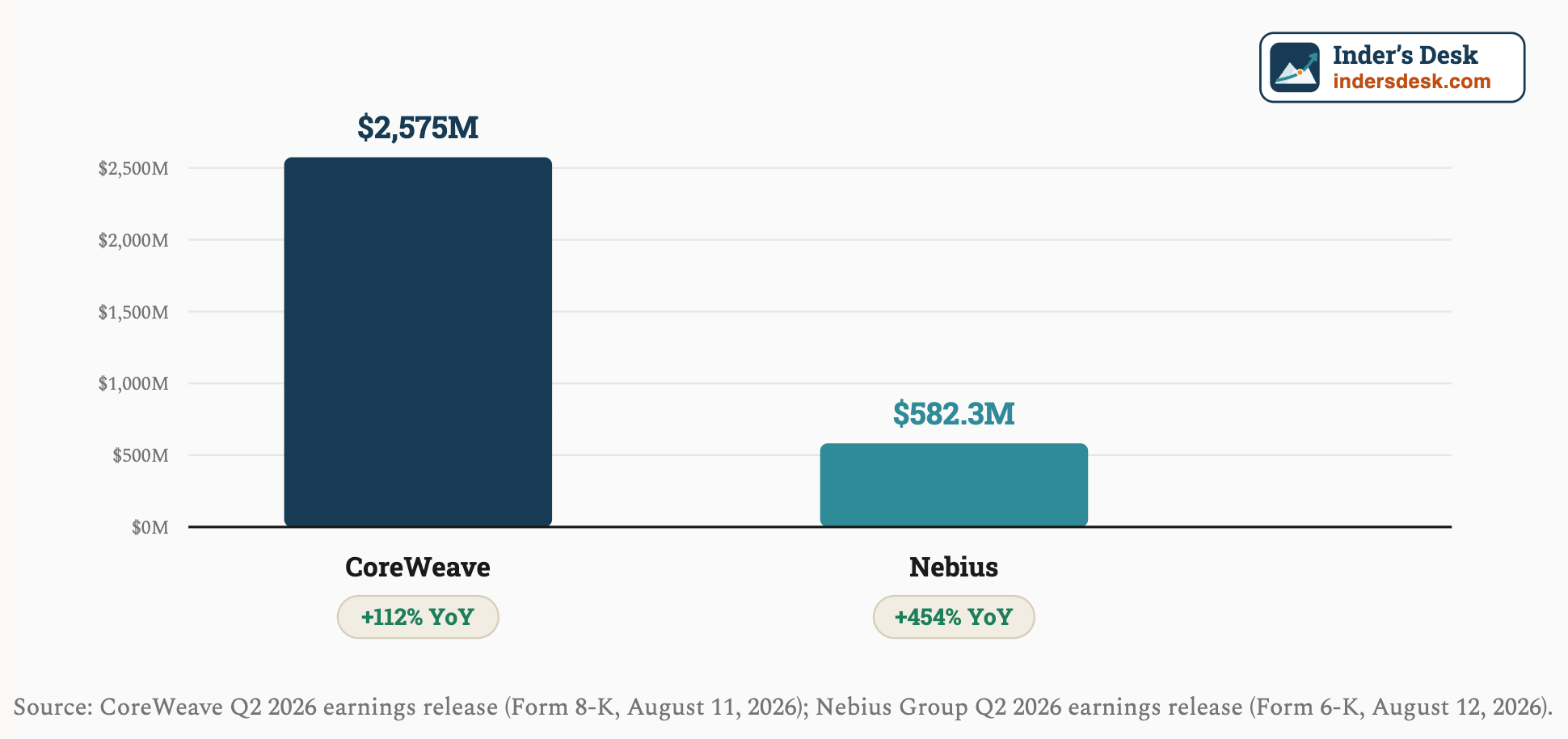
Revenue tells us the demand is real. It does not tell us how much adversity shareholders can survive. For that, we need to look at how each buildout is financed.
2. The number the market cannot ignore
CoreWeave borrows heavily to build. Nebius has relied more on equity, convertible debt and customer prepayments.
At June 30, CoreWeave carried $35.1 billion of debt and $16.5 billion of operating and finance lease liabilities against only $5.0 billion of shareholder equity.
That is more than 10 times as much debt and lease liabilities as equity. Debt alone was approximately seven times equity.
Nebius reported $8.5 billion of debt, plus at least $1.5 billion of disclosed non-current operating lease liabilities, against $10.3 billion of shareholder equity.
Its disclosed ratio was roughly 1-to-1. That figure is a floor because Nebius does not separately disclose its current lease liability, but the larger conclusion does not change.
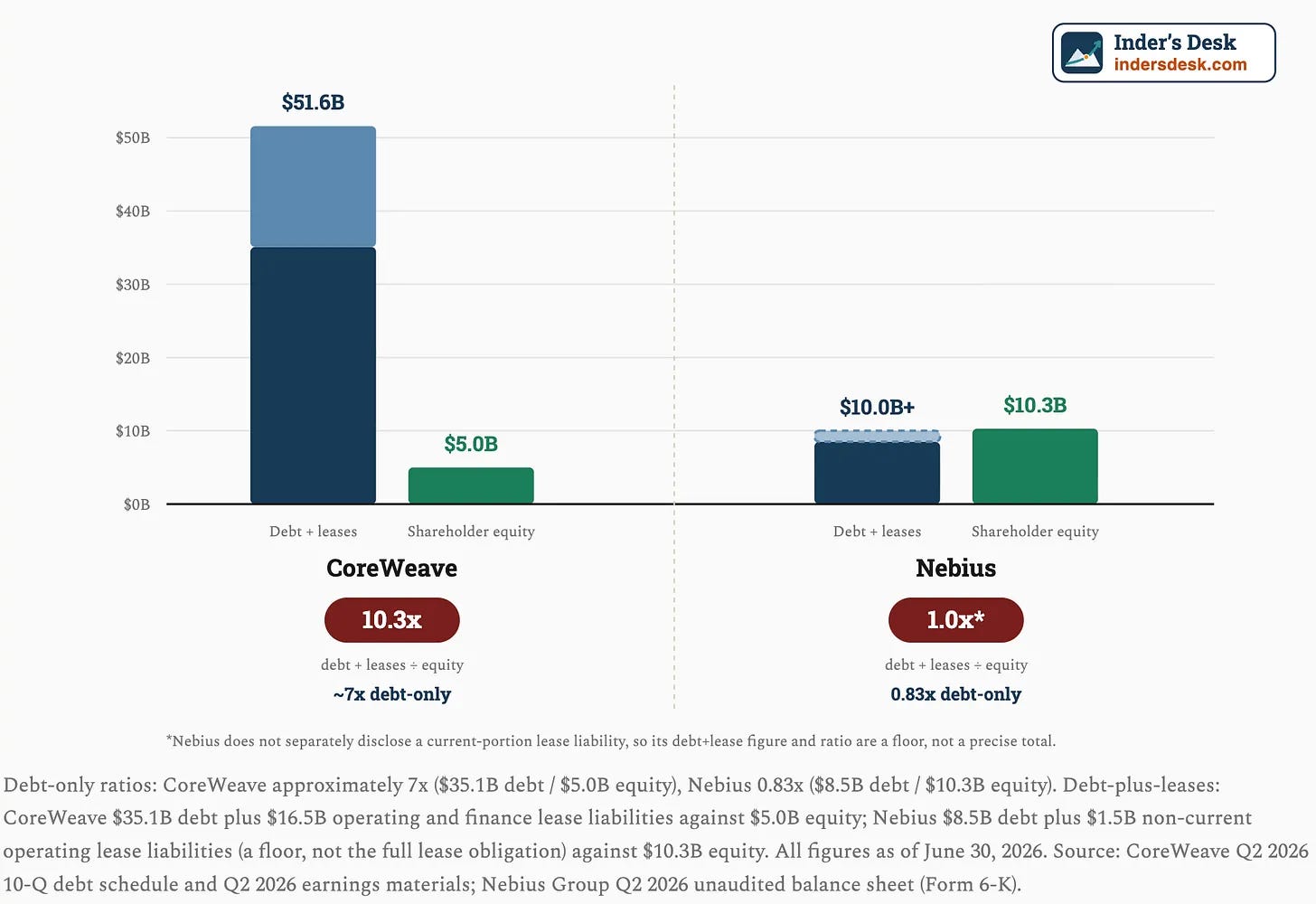
This is not a rounding difference. It is a roughly tenfold difference in balance-sheet leverage, and it changes how many things must go right for common shareholders.
3. How much of the buildout their own cash flow covers
Neither company is self-funding its expansion. But CoreWeave’s Q2 operating cash flow covered only about 11% of its cash purchases of property and equipment, compared with approximately 40% for Nebius.
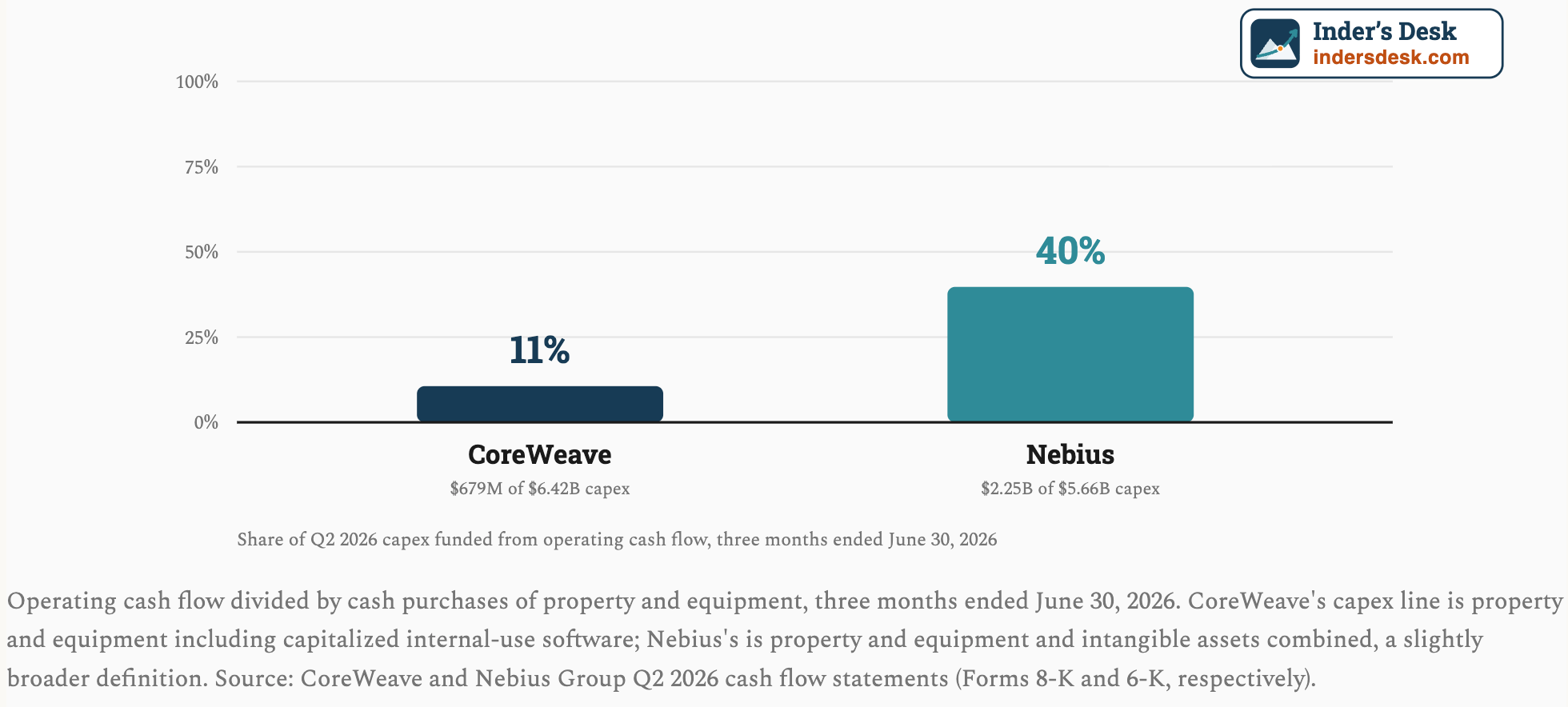
The comparison is directional rather than perfectly like-for-like because Nebius includes purchases of intangibles in its denominator while CoreWeave’s measure is narrower. Part of Nebius’s advantage also reflects timing: management said roughly 70% of its Q2 deals included customer prepayments covering 50% to 60% of the associated capex.
Even after those caveats, the consequence is different. CoreWeave needs substantially more outside capital, and far more of that capital stands ahead of common shareholders.
4. Backlog proves demand, not financial resilience
CoreWeave’s $104.2 billion revenue backlog is the strongest part of the bull case. Nebius has disclosed more than $40 billion of customer commitments.
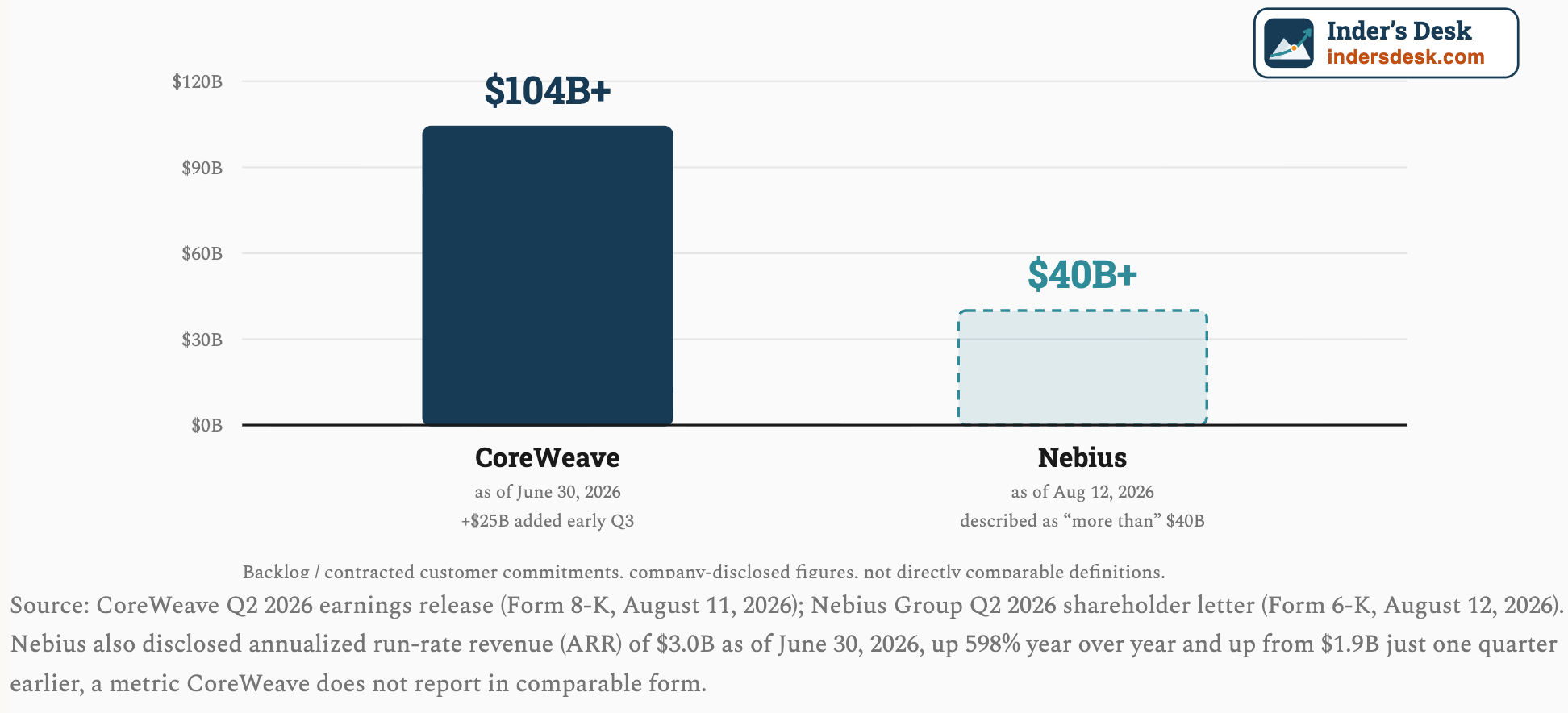
The two figures are not directly comparable. CoreWeave reports remaining performance obligations plus other amounts it expects to recognize under committed contracts. Nebius describes its figure more broadly as customer commitments.
Backlog proves customers want the capacity. It does not turn future revenue into cash today, establish the return on the capital being deployed or prove that debt service is comfortable. Demand and financial resilience are two different questions.
5. CoreWeave’s operating profit still trails its financing burden
CoreWeave is not broken. It is levered.
The bull case improves the math, but it does not clear it.
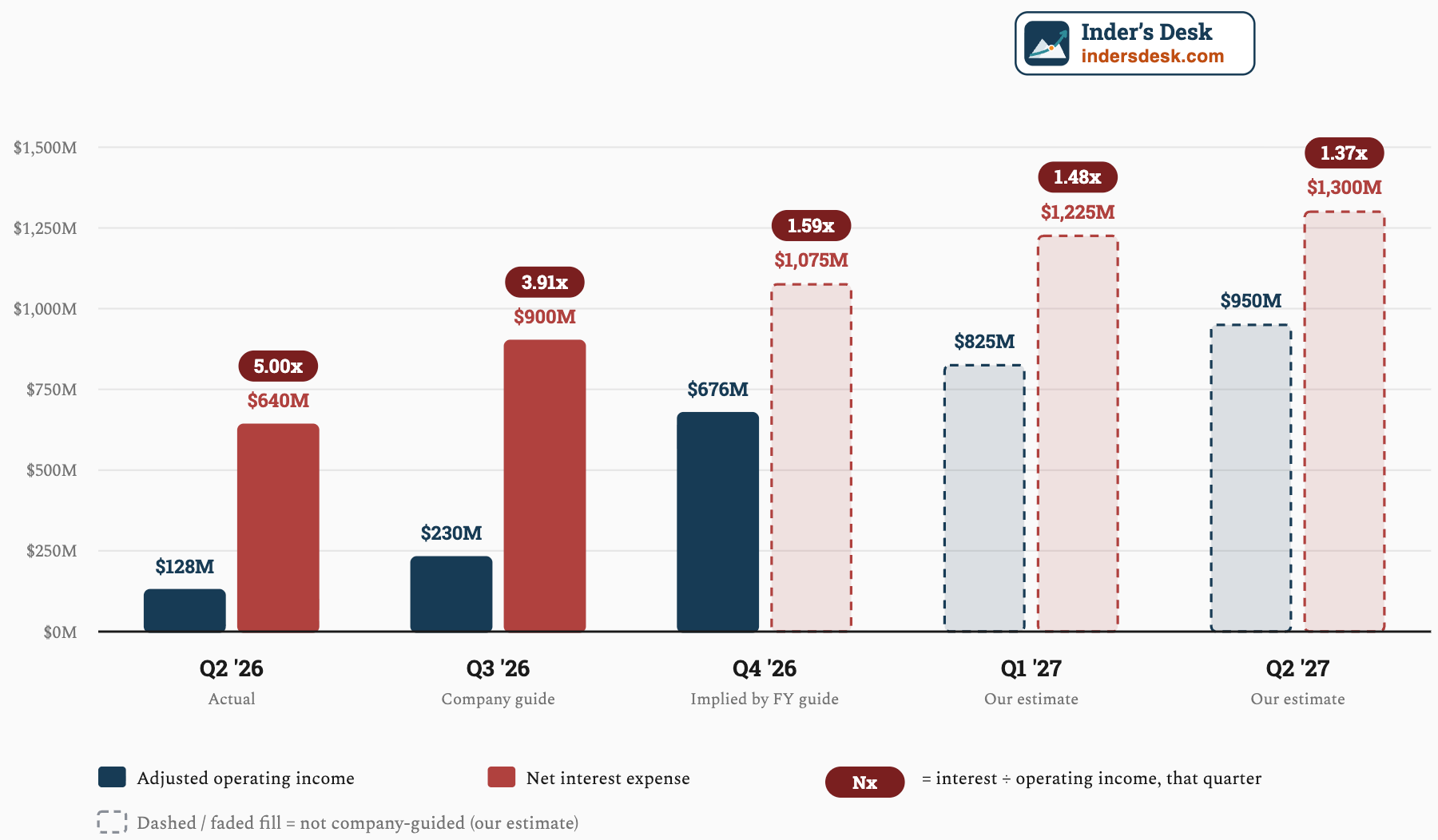
CoreWeave reported $128 million of adjusted operating income against $640 million of net interest expense in Q2. Its Q3 guidance implies net interest expense equal to 3.3 to 4.7 times adjusted operating income. At the midpoint, that is approximately $230 million of adjusted operating income against $900 million of net interest expense, or 3.9 times.
Subtracting the first three quarters from CoreWeave’s raised full-year guidance implies approximately $676 million of adjusted operating income against $1.075 billion of net interest expense in Q4, reducing the ratio to about 1.6 times.
The dashed 2027 bars are our estimates, not company guidance, and they are the least certain numbers in this analysis. They suggest the ratio could settle around 1.4 to 1.5 times through mid-2027 rather than fall below 1.0. The financing burden becomes more manageable, but does not disappear.
Management has reduced CoreWeave’s blended cost of debt by almost 300 basis points over the past year. That is genuine progress. But the floating tranches on its three newest GPU-backed facilities were priced at SOFR plus 225 basis points, plus 450 and then plus 550.
Those facilities are not directly comparable. They involve different customers, guarantees and contract durations. Still, the larger message is clear: access to capital is not merely a finance function for CoreWeave. It is part of the operating model.
What the CoreWeave math adds up to
Revenue genuinely grew 112% in Q2, but adjusted operating income fell 36%. Growth and profitability are moving in opposite directions right now.
Next quarter’s guidance implies $3.30 to $4.70 of net interest expense for every dollar of adjusted operating income.
On company figures, the gap narrows through Q4 2026 but does not close. Even in our extrapolation to mid-2027, net interest expense remains 1.4 to 1.5 times adjusted operating income.
Convertible financing moves risk from cash coupons toward potential dilution. CoreWeave raised $6.6 billion at 1.75% coupons, compared with $2.75 billion of straight notes at 9.75%. The April tranche has an initial conversion price of $119.60, but conversion is conditional, CoreWeave may settle in cash, shares or both, and capped calls offset potential dilution up to $230.
The $104.2 billion backlog is real evidence of demand. It is not proof that the company can service its obligations comfortably.
When a company is this leveraged, investors are betting on more than AI demand. They are betting on execution, utilization, customer credit, refinancing conditions and the useful life of the GPUs being financed.
The short thesis does not require AI to disappear. It only requires one of those assumptions to weaken.
6. Nebius is buying room for error, but shareholders are paying for it
Nebius is not self-funding its expansion, and it is not a low-risk business.
Q2 revenue reached $582.3 million, up 454% year over year. Annualized run-rate revenue reached $3.0 billion, up from $1.9 billion one quarter earlier. Management disclosed more than $40 billion of customer commitments.
Nebius has also raised aggressively. It has approximately $8.5 billion of original convertible principal issued since 2025. It sold 12.7 million shares through its at-the-market program for approximately $2.8 billion, with additional capacity remaining. It separately raised $2.0 billion through pre-funded warrants.
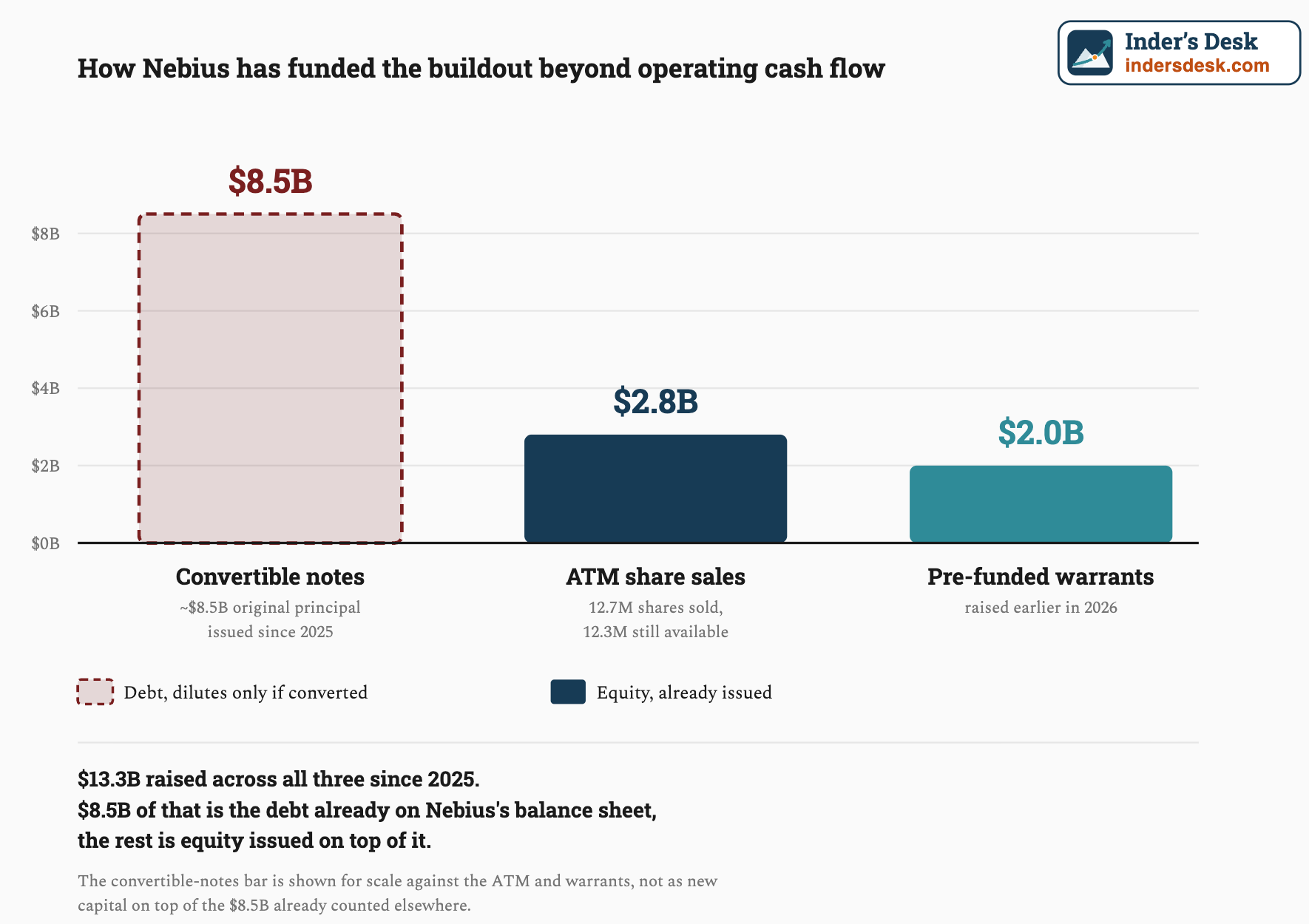
Nebius shareholders are paying for the buildout through dilution and a substantial convertible-note overhang.
But equity dilution and balance-sheet leverage fail differently.
Dilution reduces each shareholder’s ownership. Heavy debt and lease obligations create fixed claims that remain even when demand, pricing or deployment timing disappoints.
Nebius has not eliminated risk. It has shifted more of that risk onto shareholders through equity issuance while preserving more balance-sheet flexibility.
7. The cleaner balance sheet is not automatically the better stock
This is where the argument gets uncomfortable.
CoreWeave could still outperform Nebius.
If the AI infrastructure boom runs longer than expected and CoreWeave executes, its larger scale and heavier leverage could produce far more torque in the equity. The same capital structure that attracts short sellers could become rocket fuel in a sustained bull case.
Nebius could have the cleaner balance sheet and still become the worse investment if dilution continues, returns on new capacity disappoint or investors pay too high a valuation for that financial flexibility.
Price matters. Execution matters. The balance sheet is not the entire thesis.
But it determines how much room management has when the thesis does not unfold perfectly.
On that measure, these equities do not offer equal resilience.
CoreWeave is the higher-torque bet. Nebius is the higher-optionality bet.
My view is simple: I would not treat them as interchangeable AI infrastructure stocks, and I would not underwrite them at the same level of risk.
When CoreWeave has more than 10 times as much debt and lease liabilities as shareholder equity, you are not only betting on the AI boom.
You are betting that almost nothing important goes wrong.
That is why the short case is louder.
Which risk would you rather own: CoreWeave’s balance-sheet leverage or Nebius’s continuing dilution?
Leave your answer in the comments. If you disagree with my framing, tell me which assumption I have wrong.
Sources
See More
Wiring the AI Factory - Networking Primer — How cheap inference and autonomous agents turn the network into the next AI bottleneck.
Amazon’s $220B Capex Guide, the $496B Backlog, and the Fine Print Inside a Blowout Quarter — What hyperscaler growth, backlog and capital intensity reveal about the AI buildout.
Who Is Actually Getting Paid From SpaceX’s AI Buildout? — The verified beneficiaries of Colossus, Colossus II and Terafab, separated from speculation.
Disclaimer:
This article is for informational and educational purposes only and does not constitute financial, investment, tax, or legal advice. Any opinions, scenarios, price targets, or market observations reflect my personal views and may change without notice. Investing and trading involve substantial risk, including the possible loss of principal. You are solely responsible for your own investment decisions, position sizing, risk management, and trades. Conduct your own research and consult a qualified professional where appropriate.


